Amateur Radio Does Not Sell in Spain
Here in Spain the annual amateur radio fair has just been held: IberRadio 2025. An important event in the community that captures all national attention of the sector.
I have not attended. It is too far for me, and honestly, nothing motivates me to pay 1.30 € per liter of diesel fuel, the tolls required to drive on roads built with public funds, or the possibility of bringing a prescription thanks to some modern social control system camouflaged as radar.
I have to settle for watching the videos of the companions who did attend. And the portrait I take from the event is, good or bad, the very image of Spanish amateur radio. There can be no better mirror.
A very pampered space, full of brand stands, associations, stations. Everything decorated, all in gala attire, well-placed smiles, giving away merchandising as if it were the Comic-Con of waves. You can see the enthusiasm. You can see the dedication. But you also see what is always there:
Many people, little youth.
Under 50, few. Under 40, almost in danger of extinction.
Everyone greets each other, shakes hands, says nice words…
And when going home back… the real show begins. The communities fill with criticism. If that other sold very dear, if that one is a fake, if the one on the corner is a mafia man with call sign.
Just like amateur radio in general: it is sold as friendship, fraternity, collaboration, freedom, gentlemen of the air. But when you turn off the equipment, what remains many times is something very different.
Amateur radio is spoken of as if it were a paradise. But today I am going to give you my alternative point of view. One that perhaps explains why amateur radio does not cause interest in the general public, and why maybe even with events like IberRadio cannot reverse its decline.
The secret club of those who believe they are Marconi
Do you want to be an amateur radio operator in Spain? Prepare yourself: you face more bureaucracy than adopting a koala in Australia. License, exam, paperwork… All of this so that you can say “hello” on 40 meters to someone in Cuenca.
But the best comes when you finally get your call sign and throw yourself to look for community.
That is where you realize this is not a hobby: it is a lodge. And not of the fun ones. Closed forums only for members. Inaccessible magazines unless you pay dues. Unwritten rules that are applied as if they were dogma of faith.
URE the maximum weight
The “URE (Union of Amateur Radio Operators) is not a little group of colleagues, it is “the national reference”. Its weight is real, so much that:
- It officially represents Spain in international telecommunications organizations.
- It has pressure capability against public administration.
- It manages a large part of the competitive ecosystem of contests and diplomas.
- It possesses a network of local sections distributed throughout the country.
In summary, it has “resources, history and legitimacy”. If someone can set the trend and direct amateur radio in Spain towards a more open and attractive future, it is the URE.
And however, its digital strategy seems taken from a “PowerPoint of ’98” made with ClipArt.
In full 2025, its online communication is clumsy, not very attractive and deeply closed.
- Its magazine , made by a base of enthusiastic members, is not available for the general public.
- Its forum , instead of being an open space to share knowledge and attract new talents, has limitations for non-members, functioning as a private access restricted club.
- Their social networks , when they exist, seem like notice boards instead of live channels of dissemination.
Everything remains between the “dues brothers”, an endogamous ecosystem that rewards permanence and punishes external curiosity.
What is the result? A perfect recipe to dissuade any young person with technological interests and “zero patience for closed systems”.
Platforms that seem public but are private walled gardens
QRZ.com is the Facebook of amateur radio operators. Or rather the LinkedIn of those who believe their call sign is a noble title. Everyone uses it. Everyone needs it. But it does not cease to be a private company with rules you swallow without complaining.
They can close your profile, limit functions, or charge for improvements without you being able to do much more than cry on 20 meters.
And she is not alone. There LoTW, eQSL, Clublog, HamQTH… Each one with its format, its outdated web and its own ecosystem. Interoperability between them is a joke of bad taste. And if someone proposes an open, interoperable and community platform, the rest looks at it as if they had said “use WhatsApp in voice mode”.
The problem is that while we continue trapped in these private enclosed areas, “the world already moves towards open systems, free code and decentralized. Examples like the “blockchain” or the “Fediverso” demonstrate that collaborative models exist, transparent and without owners that allow building healthier and more resilient communities.
Amateur radio, with all that it pretends of independence and freedom, should look in that direction instead of continuing tied to private platforms that control the data and dictate the rules.
Where is the free spirit of waves? In the Terms and Conditions.

The civil war of modes
You thought amateur radio was a peace and global fraternity hobby, right? Mistake. In practice it is a trench of egos where each mode has its crusaders:
- The ones of “voice” usually despise the ones of “FT8″ , accusing them that “that is not real radio, it is a video game that does everything by itself”.
- The ones of “CW” look over their shoulder at everyone, because they believe if you do not master the Morse code that they learned in the military, you have no right to call yourself amateur.
- The ones of “DMR” are directly ignored, as if the digital were a heresy for “slackers” who do not know how to connect a mic.
The result is that the debates are not technical nor enriching. They are “theological discussions , comparable to those of a religion with multiple sects, where each group defends its absolute truth and disqualifies the rest. Like in the Congress of Deputies, which instead of legislating laws that favor the country’s development, spend the day discussing who steals more or what party accumulates more corruption cases.
Content creators pushed aside
Content creators could be the lifeboat of amateur radio, and some really are. There are YouTubers, podcasters and bloggers who put their passion for radio before their own ego and who share their knowledge generously, no matter how many followers they gain or whether others get the credit.
The problem is that they are the exception, not the rule. Most live in their “ivory tower”:
- They do not link to each other.
- They are not recommended.
- They do not collaborate.
- They are criticized.
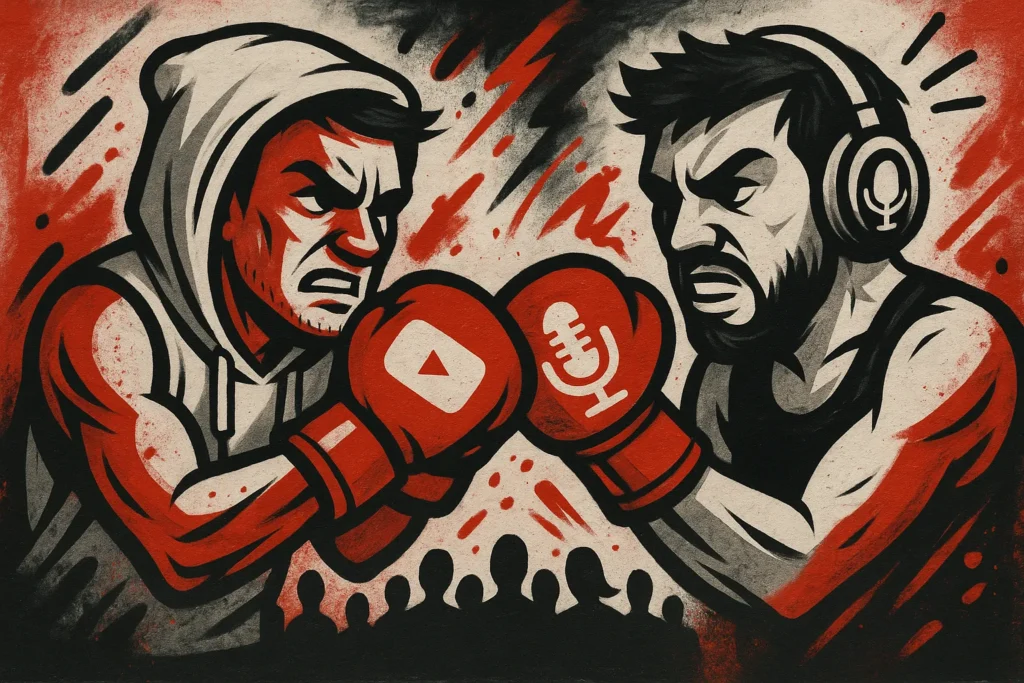
The newcomer, instead of finding a cohesive community that welcomes and forms him, bumps into “dozens of isolated communities” , often ignoring each other or, worse still, competing for the same small space.
The result: a great dispersion of efforts, where individual talent shines, but collective potential is lost.
Contests that look like civil service exams
Amateur radio contests could be the “analog e-sport of the 21st century”. They could hook new generations if presented with freshness, spectacle and a minimum vision of future.
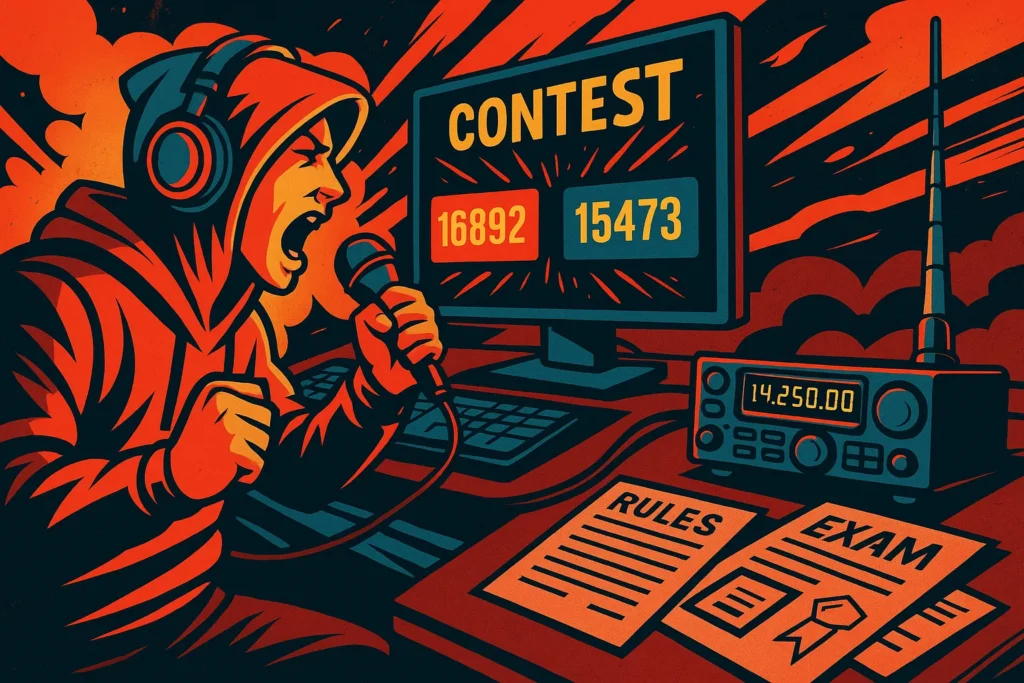
Young people expect to find something dynamic:
- Real-time markers
- Visible and accessible rankings from any device.
- Narratives that make vibrate as if they were watching a LoL or Valorant finals.
What they find is very different:
- Confusing regulations, hidden in PDFs with more jargon than clarity.
- Absurd paperwork that looks more like a civil service exam than a competition.
- Logs in “.ADIF” sent by email, processed weeks later, and results published with months of delay.
- Diplomas in PDF without design, that more than a prize seem like a school voucher.
Do you remember Ibai’s marble castings? With a well-made narration, those videos seemed more exciting than a fight for the podium in the last laps of a Formula 1 race. That is the difference between understanding how an event communicates today and getting stuck in the past.
Instead of an open and motivating spectacle, amateur radio contests continue to be “a cold procedure” , seized after bureaucracy. And with this, all competitive potential is thrown away.
Passion exists, but the ecosystem kills it
The most tragic is that amateur radio “still has brutal things to offer”:
- Communications without depending on Internet or commercial infrastructure. An autonomous, direct system that is not subject to fiber cuts, server crashes or decisions of a multinational. When you turn on the equipment, what comes out in the air depends only on you, your antenna and your knowledge.
- Direct connection with satellites and real experimentation. From conversing with the International Space Station to putting a university cubesat in orbit, amateur radio allows experimenting with technologies that in other fields would be inaccessible. We do not talk about playing with simulators: we talk about tests in the physical world, in real time, where creativity is measured in antennas built in the garage and signals crossing the planet.
- An open laboratory of technological innovation. SDRs, digital modes, ionospheric propagation, fractal antennas, integration with free software… Amateur radio is fertile ground for the curious, a space where to mix electronics, programming and telecommunications without asking anyone permission.
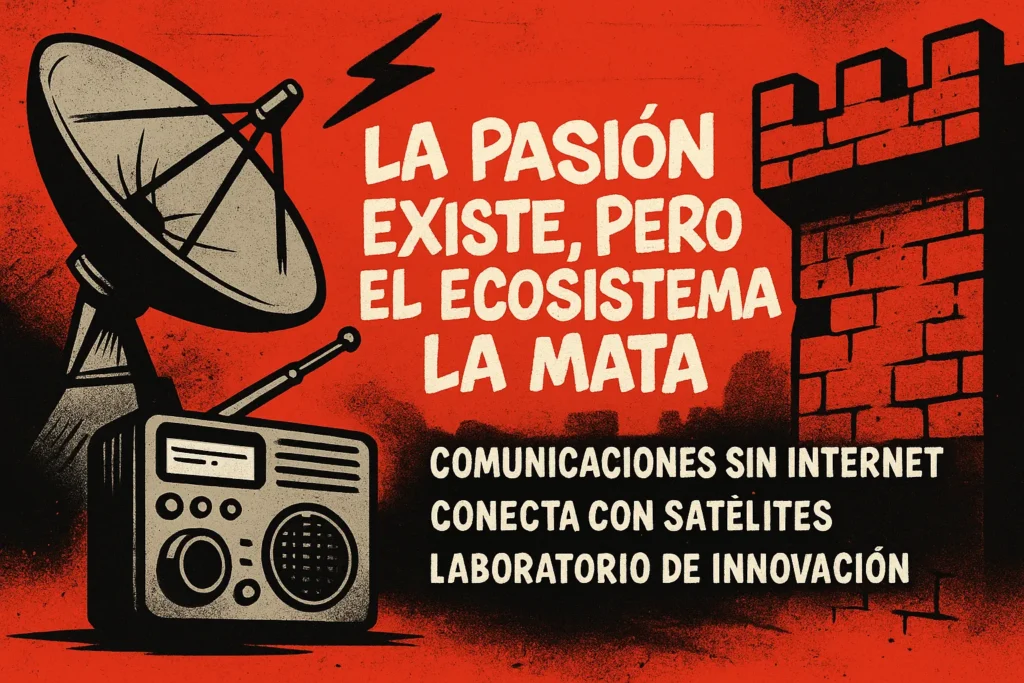
But all that potential remains buried by a community that prefers “defend its plot before opening the door to the future”. Amateur radio could be a magnet for makers, students, engineers and tech curious people. It could be the bridge between analog and digital. It could be a space of collective experimentation, open and vibrant.
However, it insists on closing itself in its own walls.
Unite forces so that amateur radio hits hard
What we really need is “unite forces”. All of us who love radio, with its different styles and ways to enjoy it, should stop looking at each other with distrust and start paddling in the same direction. Not for pride, but for the future of our hobby.
And after spitting so much venom as “angry snake” , I confess to you something: “despite everything, it still deserves enormously to dive into this world”. The satisfactions surpass with greatness the disappointments. For that we continue hooked, with a loop that gets so inside it is already not let go.
If you are amateur radio and you do not recognize yourself in what I describe, probably you are one of those “wonderful companions” that I am finding in each QSO, in each group, in every corner of the spectrum. Authentic people, who share without expecting anything in return, who infects enthusiasm and keeps alive the magic of radio. And you are many, although sometimes your voice remains covered by the noise of a minority that shouts more than it contributes.
The conclusion is simple: “amateur radio remains a fascinating world and deserves that we take care of it together”. If we manage that passion weighs more than egos, that collaboration beats isolation and that openness surpasses secrecy, amateur radio not only will survive, but will return to shine.
So if this article touched you a bit on the balls, congratulations: “still feel something”. Share it. Discuss it. And if you have a channel, an account, a blog, link up. Because only by giving voice to it, we multiply the signal.
Other articles that perhaps interest you:
From Analog Dips to Digital Bits. The Unbreakable Evolution of Amateur Radio