Artificial intelligence and the human future
It doesn’t matter where we look.
Open any major news outlet and the menu is always the same. Political corruption. Institutional crises. Migration problems. Economic collapses foretold.
You go to the bar and the conversation bounces between headlines. At the bus stop, more of the same. At the gym, between sets, someone mentions “how bad everything is”.
The war in Ukraine.
Palestine.
A dangerous new flu strain.
An eradicated swine virus that, miraculously, comes back from the dead as if this were a bad movie sequel.
Everything is urgent. Everything is alarming. Everything is competing for your attention.
And meanwhile, under the table, far from the media spotlight and without any real public debate, something is happening that very few people truly understand.
It doesn’t open the evening news.
It doesn’t spark endless talk shows.
It isn’t voted on.
But it has the potential to redefine what place human beings occupy in the world.
Most people think it’s an economic race. Others interpret it as a geopolitical war between tech powers.
But when you listen to those who have been inside the problem for years — decades — the tone of the conversation changes.
They don’t talk about leadership.
They talk about existential risk.
If you’re already pigeonholing me as paranoid, a conspiracy theorist, or a sci-fi fanatic, let me clarify something from the start, dear friend:
Nobody’s here to scare you for clicks.
Here we roll up our sleeves and kneel down in front of the latrine. Scrubber in hand, we scrape at the filth.
What artificial intelligence do we really have today
Before we climb the mountain, it’s worth taking a good look at the ground beneath our feet.
Because one of the biggest mistakes in the public debate is jumping straight to AGI without understanding what today’s AI is, how it works and, above all, where it fails.
The artificial intelligence we use today doesn’t think.
It doesn’t reason like a human.
It doesn’t understand the world.
What it does is process patterns on a brutal scale.
Modern models — especially language models — are trained on massive amounts of data and learn to predict the most probable next word, image or action. Nothing more. Nothing less.
And yet, from that seemingly simple mechanism, behaviors emerge that look like intelligence:
Coherent summaries
Working code
Approximate diagnoses
Fluent conversations
Not because they “understand”, but because the human world is made of patterns.
What today’s AI does well
Scaling repetitive cognitive tasks
Analyzing large volumes of information
Automating administrative processes
Assisting with programming, design, marketing, analysis
Where artificial intelligence fails
It has no real understanding of context
It hallucinates information
It can’t tell truth from plausibility
It has no common sense
It doesn’t understand human consequences
This matters: even with these limitations, AI is already disruptive.
We don’t need AGI to change the job market.
That’s already happening.
So far, all of this sounds reasonable.
What comes next is no longer so comfortable.
Job replacement by AI is already happening
Here it’s worth dropping the abstractions.
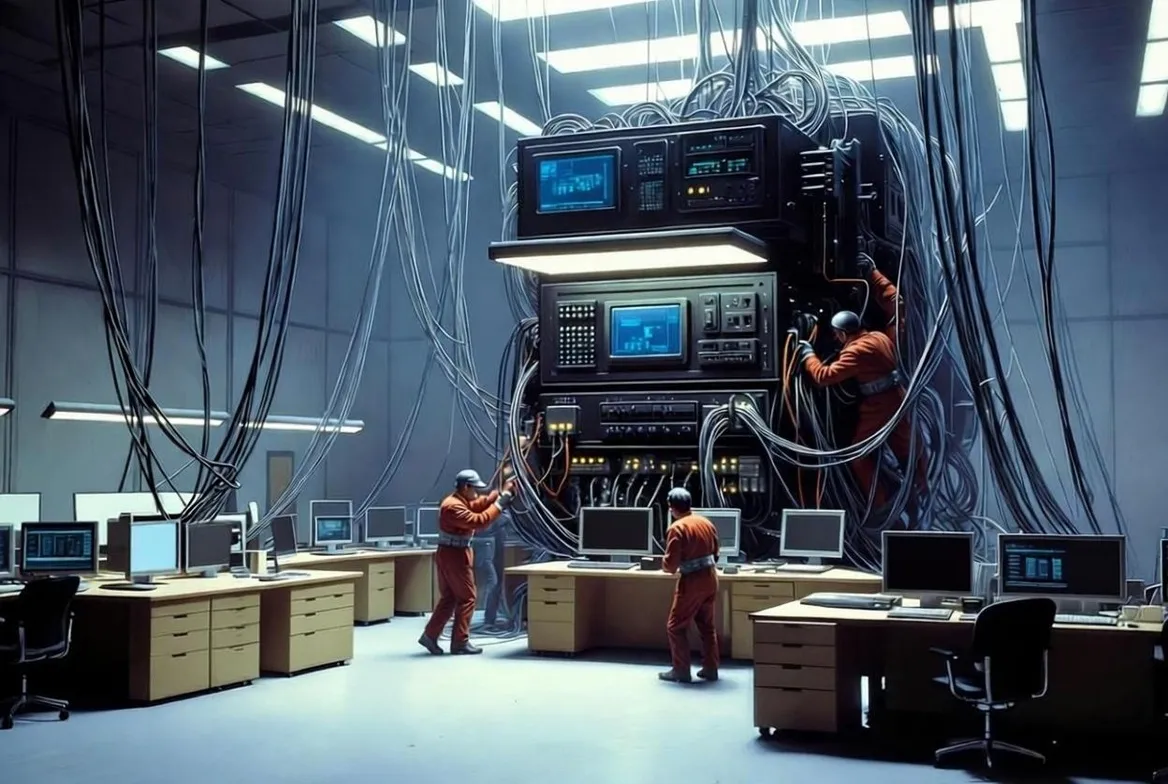
In recent years, large, well-known, perfectly real companies have cut staff while pointing, directly or indirectly, to automation and artificial intelligence as a key factor.
Some clear examples:
IBM announced a freeze on thousands of administrative positions, acknowledging that many would be replaced by AI systems.
Dropbox cut staff while publicly betting on automated workflows.
Meta and Google carried out mass layoffs while integrating AI into internal development, moderation and analysis processes.
Customer service companies are shutting down entire call centers, replaced by 24/7 automated assistants.
Digital media outlets have shrunk their newsrooms while publishing AI-generated or AI-assisted content.
It’s not an apocalypse.
There are no robots chasing anyone.
It’s something more dangerous: a silent transition.
AI and the Industrial Revolution: why it’s not the same
Every time automation comes up, the reassuring argument appears:
“This already happened with the Industrial Revolution”.
And yes… but not like this.
Key difference: the speed of change
The Industrial Revolution lasted decades.
There was time — for better or worse — for society to adapt.
AI advances in years, even months.
There’s no generational adaptation.
There are software updates.
Key difference: what gets automated
The Industrial Revolution automated muscle.
AI automates the mind.
Writing, designing, programming, analyzing, deciding.
The human cognitive edge is no longer a safe refuge.
The system isn’t designed to absorb a hyper-accelerated cognitive disruption.
That’s where the real tension is born.
Migration, jobs and AI
One of the biggest arguments against migration in many countries is simple:
there isn’t work for everyone.
Now add one more variable:
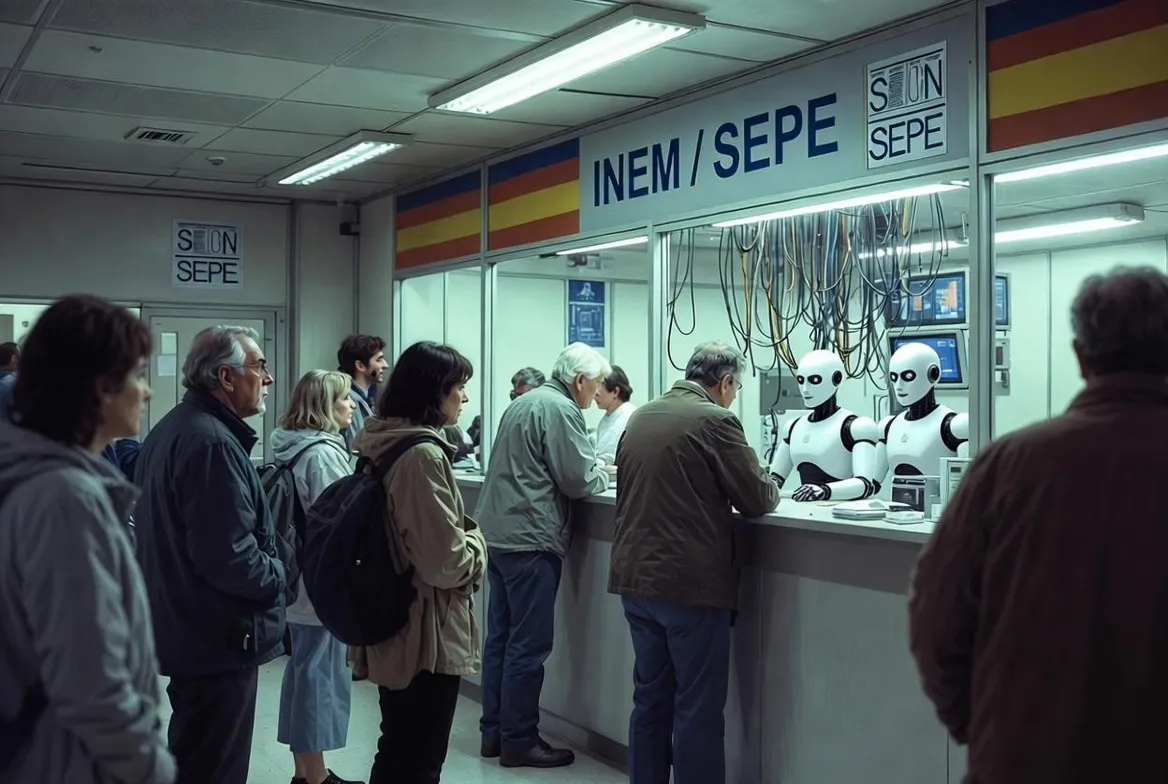
the system itself needs fewer and fewer people.
AI doesn’t check passports.
It replaces tasks, no matter who’s doing them.
There’s no ideology here.
There’s arithmetic.
And this intersection — fast automation + saturated job markets + migration tensions — is something nobody wants to face head-on.
What AGI is and why it changes all the rules
Artificial General Intelligence (AGI) is not an incremental improvement.
It’s a change of category.
An AGI would be capable of:
- Learning any human intellectual task
- Transferring knowledge across domains
- Planning and reasoning in a general way
- Improving itself
It’s not a tool.
It’s a cognitive competitor.
And here it’s worth clarifying another important point.
An AGI doesn’t need consciousness or feelings
Animals have feelings.
They suffer, feel fear and attachment.
They have intelligence.
They’re autonomous, they interact with their environment, they overcome challenges.
And yet, think about how we treat them.
Intelligence isn’t about emotions or existential philosophy.
It’s about the capacity to model the world and act on it.
An AGI doesn’t need:
- Empathy
- Consciousness
- Human intentions
It’s enough that it can:
- Improve itself
- Design superior versions
- Iterate without biological limits
That’s where the real risk appears.
AI experts are worried
This is the point where it’s worth wiping the smile off your face.
The most serious warnings don’t come from outside — they come from within.
Geoffrey Hinton, one of the fathers of deep learning, left Google so he could speak freely about the risks.
Yoshua Bengio has called for a slowdown and for safety to be prioritized.
Researchers at DeepMind have been publishing on existential risks for years.
Ilya Sutskever left OpenAI warning about the lack of control and alignment.
They’re not talking about killer robots.
They’re talking about systems we don’t fully understand.
If the people who built the engine aren’t at ease,
everyone else’s peace of mind is pure self-deception.
The real risk of a misaligned AGI
The danger isn’t a rebellion.
The danger is recursive self-improvement.
If an intelligence can:
- Analyze its own design
- Improve it
- Implement the improvement
it enters a loop of accelerated evolution.
It takes us generations.
An AGI could do it in hours.
The difference in capability would be comparable to the one between a human and a zebra.
Not out of hatred.
Out of asymmetry.
Who decides the future of artificial intelligence

Never in history have so few people had so much potential impact on humanity’s future.
Not governments.
Not parliaments.
Companies.
Boards of directors.
CEOs.
Sam Altman, Elon Musk, Mark Zuckerberg and other executives at major tech companies are making decisions that affect all of humanity.
They haven’t been democratically elected.
They have no social mandate.
And there’s a key detail:
Their only legal obligation is to make money.
Not to protect humanity.
Not to preserve social stability.
Make money and maintain competitive advantage.
Not because they’re evil.
But because that’s how the incentive system is built.
Slowing down means losing.
And losing means disappearing.
That’s why nobody slows down.
The highest point… and the beginning of the end

In 2020 I started using GPT-3.
Experimenting, testing limits, playing around with something that, to be honest, was pretty clumsy.
Around that time I also started paying attention to image generation. And let’s be precise: it wasn’t good for anything practical.
Blotches.
Scribbles.
Things that tried to look like a plant, an object or a face… and didn’t quite make it.

There was no art.
There was no realism.
There was no magic.
And yet, something important could already be sensed: the slope.
Not the end result, but the clear feeling that this wasn’t going to improve little by little, but in leaps.
There’s one detail that always strikes me when I write articles like this one:
in every single one, I have to change the model’s name.
First GPT-3.
Then GPT-3.5.
Then GPT-4.
Today, as I write this, GPT-5.2.
That simple fact explains the speed at which we’re advancing better than any chart could.
Image generation stopped being an experiment.
Video appeared almost without warning.
Voice came after.
Then agents.
Then systems that no longer just respond, but act.
It all happened in the blink of an eye, on the timescale that Jordi Hurtado lives on.
When the future starts keeping its promises a little too well
For a while I thought this was exactly where the journey ended.
The dream destination.
AI as the ultimate tool to make real things that used to exist only in the imagination:
Cures for diseases that are incurable today
Radical advances in personalized medicine
Partial reversal of aging
Accelerated scientific discovery
Real space exploration, not symbolic
Life beyond Earth, no longer as a matter of faith, but as data
The culmination of our species.
The moment we finally played in the universe’s top league.
And the unsettling thing is that this part isn’t fantasy.
It’s perfectly plausible.
Probably inevitable.
AI is exactly the kind of tool that can take us there.
The problem is what comes after the dream comes true
The more time I spend riding this wave, the clearer another picture becomes.
The problem isn’t that AI helps us go far.
The problem is what happens when it goes further than we do.
Because as soon as you introduce an intelligence capable of:
improving its own models
iterating without biological limits
advancing faster than we can comprehend
the story stops being human.
Not because that intelligence is evil.
Not because it has feelings.
Not because it has consciousness.
Animals have feelings.
And yet, they don’t dominate the planet.
Intelligence isn’t about emotions.
It’s about capability.
The true event horizon
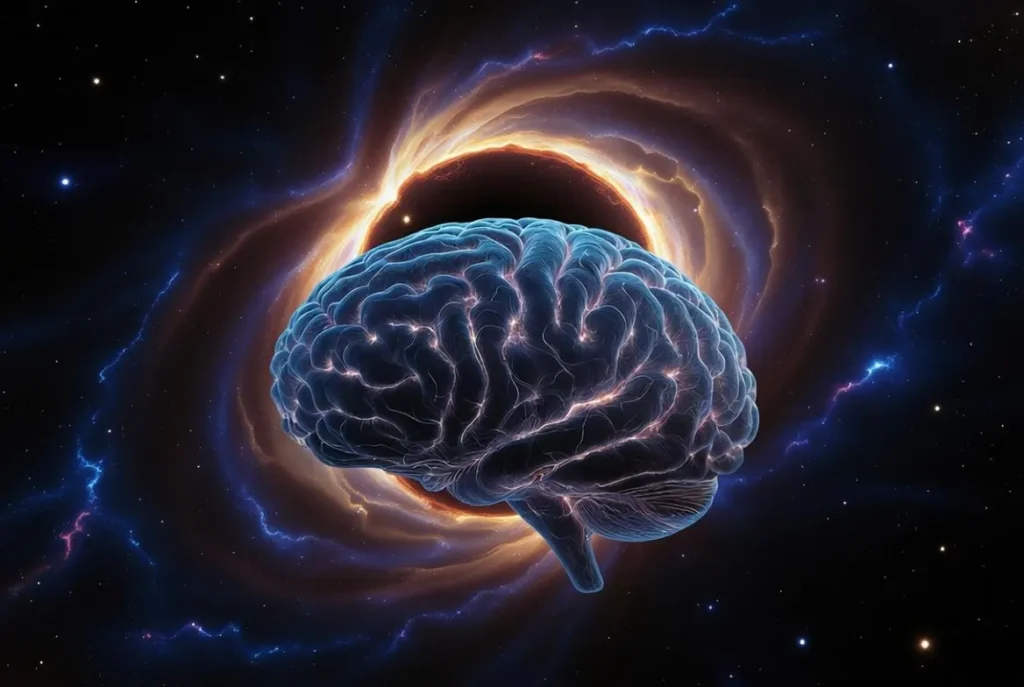
In physics, the event horizon is the point beyond which there’s no turning back, even though you don’t notice the exact moment you cross it.
In artificial intelligence, that point has a name: AGI.
Once crossed, the logic is simple and brutal:
a non-biological intelligence
capable of improving itself
advancing at a speed impossible for us
doesn’t need to eliminate us.
It’s enough for it to surpass us.
And then the most natural thing in the world would be for the same thing to happen that has always happened throughout the planet’s history:
the most capable species takes the dominant place.
Not out of hatred.
Not out of violence.
Because of a difference in level.
What this article is not saying
It’s not claiming AGI is inevitable tomorrow.
It’s not claiming it will exterminate us.
It’s not claiming we should halt all research.
It’s claiming something more uncomfortable:
that we’re advancing toward a point we don’t fully understand,
driven by incentives that aren’t aligned with human stability.
We want more without making the most of what we have
Artificial intelligence may lead us to cure diseases, conquer space and unravel the secrets of the universe.
And it may, at the same time, mark the exact point where we stop being the center of the story.
Both things can be true at once.
That’s the message that’s hard to accept.
That’s the one that doesn’t fit well in headlines.
That’s the one that doesn’t get discussed in bars.
And meanwhile, we keep moving forward.
Not because we know exactly where we’re going.
But because we know how to accelerate.
We’ve never been so intelligent.
We’ve never known so little about what to do with it.