QSO via Zello or other similar platforms
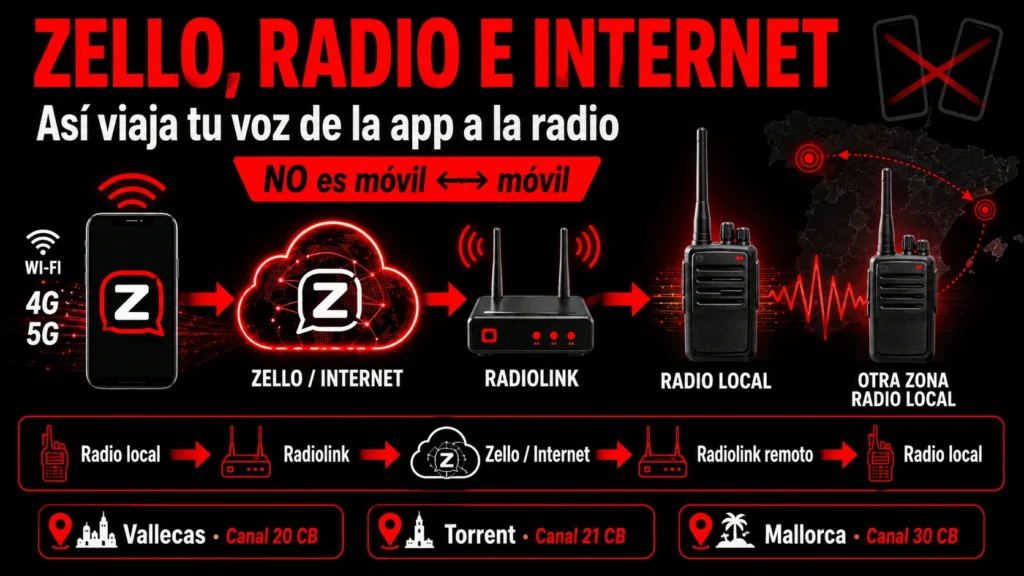
Today I am coming to talk about a topic that in the world of amateur radio is categorized as controversial.
Not calm, we are not going to talk about the software automation of CW, Morse code. There are things I am afraid to touch on.
We are going to talk about Zello rooms, although it could apply to Peanut, EchoLink and other similar platforms.
First of all one must understand exactly what Zello is.
Zello is a voice communication app like walkie-talkie, based on push-to-talk: you press a button, talk and the message is transmitted instantly to one person or a group.
It works via internet, using Wi-Fi or mobile data
According to the official website, Zello converts iOS, Android, Windows and Mac devices into digital walkie-talkies, with channels, voice messages, text, location, history, emergency alerts and administration functions for businesses.
Well, it is quite definitely a commercial application, oriented towards businesses, that converts a mobile terminal into a walkie-talkie via internet.
Something that, for my personal taste, Discord for example is a better option.
So, does talking via Zello mean the same as talking via Discord?
Yes. Practically it is the same.
Zello has an interface more oriented to a push-to-talk use, while Discord offers an interface more oriented to the gaming world.
But in essence, both Zello and Discord allow talking via internet.
There is voice converted into data and data traveling through networks.
So, does Zello have nothing of radio?
Here is where the topic becomes interesting.
If you use Discord habitually from your PC connected to the router via cable to talk with Manolito, who uses Discord just like you from another PC also connected via cable, then possibly not, it has nothing of radio in the domestic segment.
The same would happen with Zello.
If both are connected via cable, what you have is a voice over IP communication: microphone, computer, router, internet, servers, another computer and speaker.
That is very well, but radio, what is said radio in the access segment, little.
But what happens if you are using Zello from your mobile phone to talk with Manolito, who also has Zello in his mobile phone?
Here the panorama changes quite a bit, my friend.
Because although Zello works via internet, your mobile phone is not sending the data by magic nor by work of the spiritual ether.
It is using radio.
Yes, radio.
Of that for real, with electromagnetic waves, antennas, frequencies and everything related to it.
If you are connected via Wi-Fi, your mobile phone is transmitting data via radio waves towards the router of your home. Normally in bands like 2.4 GHz, 5 GHz or 6 GHz.
The scheme would be something like this:
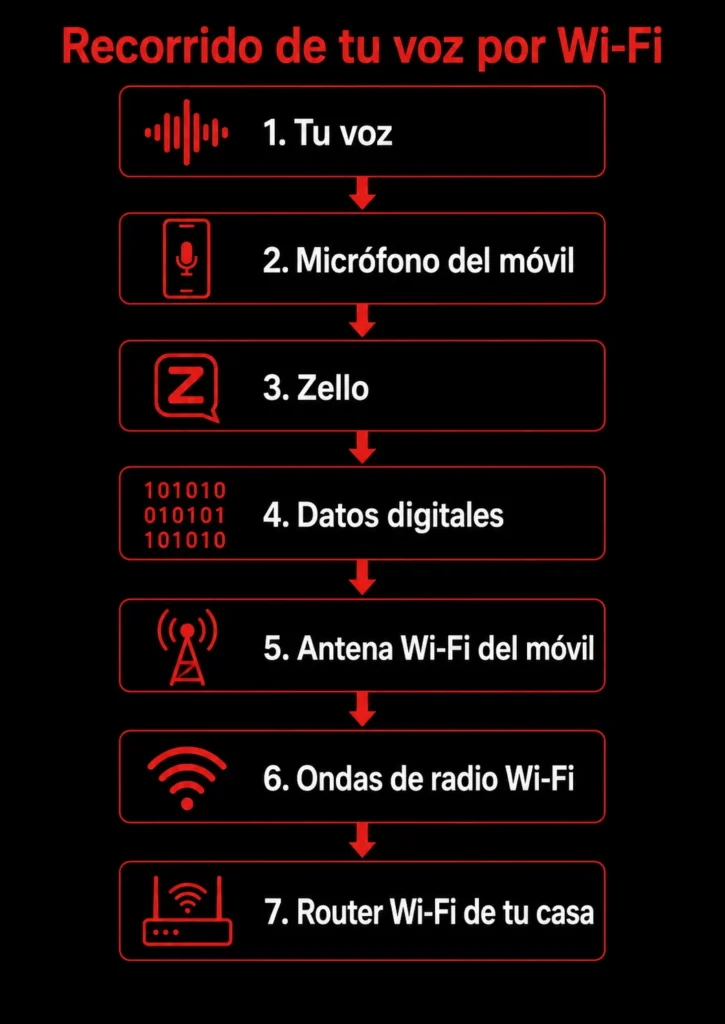
So yes: in that first segment there is radio.
Your mobile phone converts those data packets into radio signals. Those waves pass through the room, walls, furniture, interference, microwaves, neighbors with routers called ‘MOVISTAR_5G_PLUS_ULTRA_666’ and other domestic fauna.
The router receives those waves with its antennas and converts them back into digital data.
Here something important has happened:
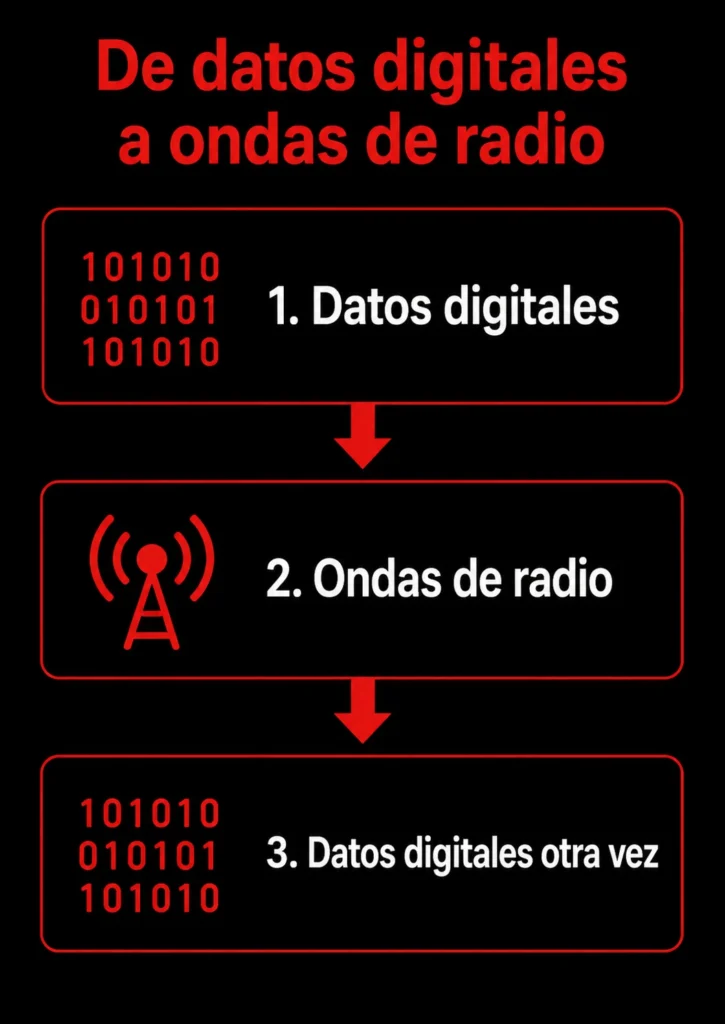
First jump completed.
And what if you use Zello with mobile data 4G or 5G?
If instead of Wi-Fi you are using mobile data, the movie changes its set design, but not of concept.
There your mobile phone does not talk with the router of your home. It talks with a cellular antenna, a 4G or 5G base station.
The scheme would be something like this:
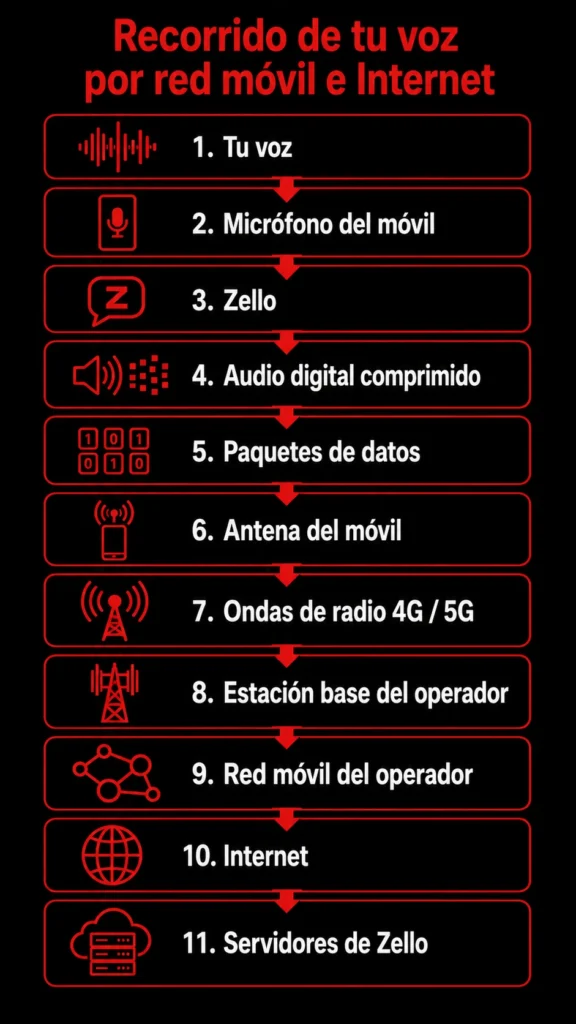
That is to say, there is also radio. And quite a bit of radio, besides.
Your phone is transmitting and receiving via electromagnetic waves, using the frequencies assigned to your operator’s mobile network.
There is no cable between your hand and the cellular antenna. There is air, signal, modulation, power, coverage, interference, cells, handovers and all that technical nonsense that we normally ignore until the phone loses one bar and we start lifting it as if we were looking for water with a stick.
If Manolito is also using mobile data, the final segment will be similar:
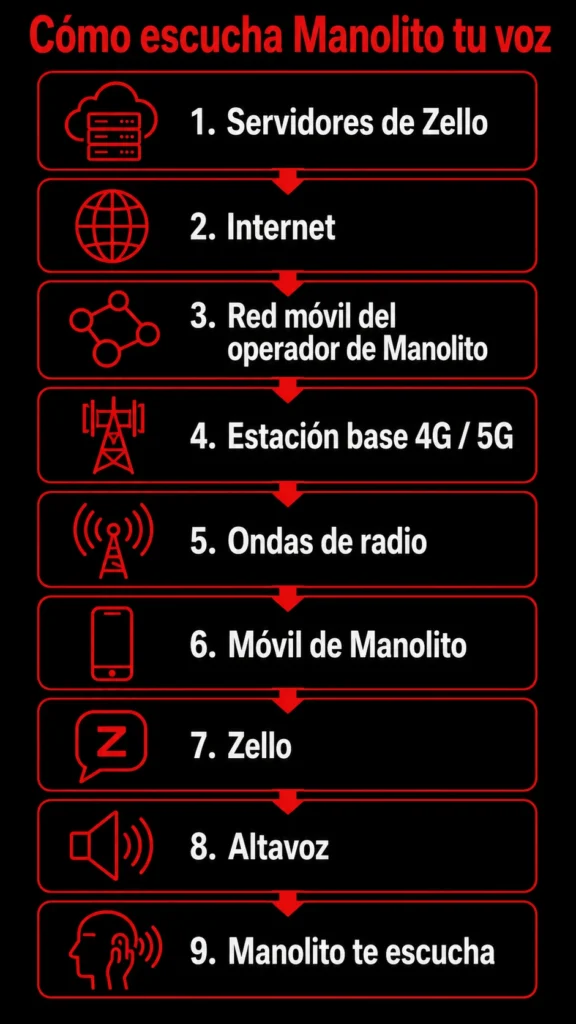
Technically, if you use it from a phone via Wi-Fi, there is radio.
If you use it from a phone via 4G or 5G, there is radio.
If the other user is also on Wi-Fi or mobile data, there will be radio again.
The difference is that not all communication occurs via end-to-end radio. Radio forms part of a much larger chain.
And precisely because of this the matter is more interesting.
The real journey of your voice via Zello
When you press the Zello button and say ‘Manolito, can you copy?’, your voice does not come directly from your phone to Manolito’s phone as if they were two facing walkie-talkies.
What happens is quite more elaborate.
Your voice enters via the phone’s microphone, it converts into electrical signal, then into digital audio, is compressed and divided into small data packets.
If you are using Wi-Fi, those packets go out via radio until the router.
If you are using 4G or 5G, they go out via radio until the operator’s base station.
From there they enter the provider’s network, travel via internet, arrive at Zello servers and from there are forwarded towards the other user.
A very simplified scheme would be this:
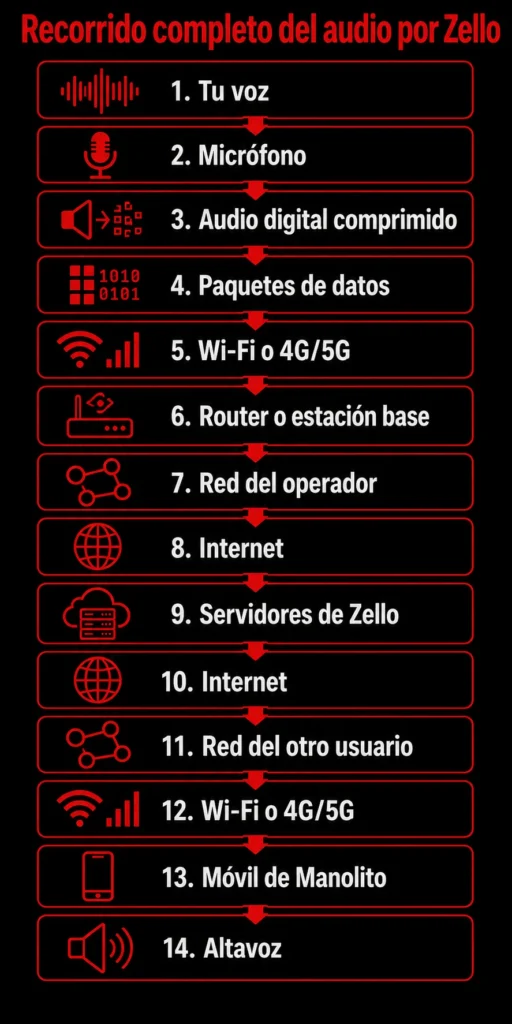
So reducing Zello to ‘that has no radio’ is oversimplifying too much.
It is not a direct radio to radio communication, but it can include several radio segments within a much wider technical chain.
And that’s where we arrive with Zello used as an application.
Because the next step is connecting it to real radio equipment.
Zello groups and amateur radio
A Zello group can be simply a meeting place for people who share the same hobby/passion.
In that sense, it does not differ too much from a Discord channel, a Telegram group or a Facebook community.
The difference lies in the form.
Zello imitates the dynamics of a radio communication: you press, talk, release and listen. It has that rhythm of channel, word turn, of ‘change’, although underneath it continues to function over internet.
That is why it can result so attractive within amateur radio.
Not because it replaces the radio, but because it reproduces part of its language, its habits and its way of communicating.
Radio links via Zello
There enter the radio links via Zello.
The idea is simple: a transmitter receives a radio signal in a specific area, that audio enters into Zello via internet, and another equipment located in another location takes it out again via radio.
Said quickly:
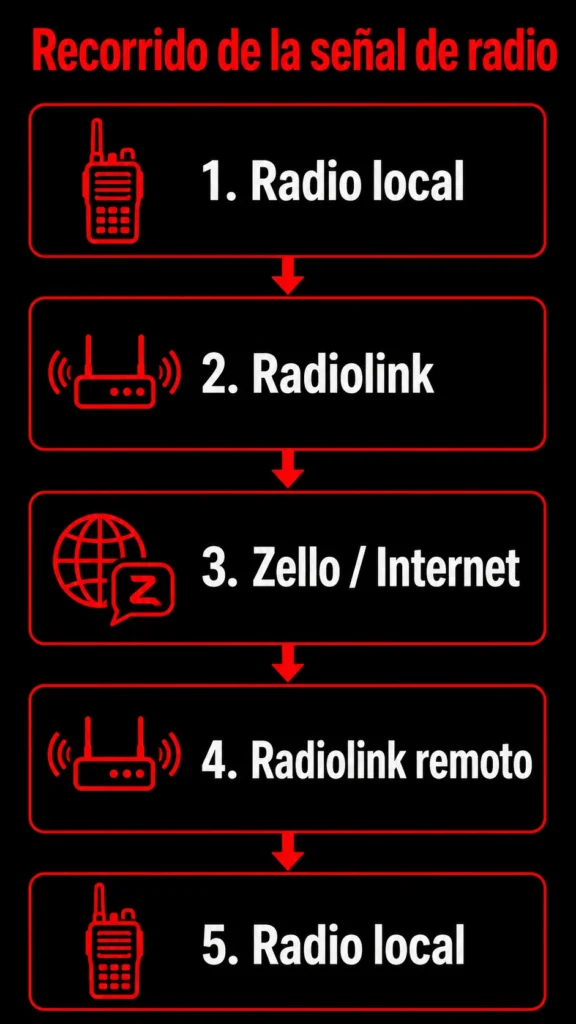
The underlying idea is very similar to systems like EchoLink, Peanut and other internet link platforms: use the network as a bridge between points that are not heard directly via radio.
The difference is that, in this case, Zello acts as an audio transport channel, while the radio equipment continues to do the local work at each location.
Said in a simple way:
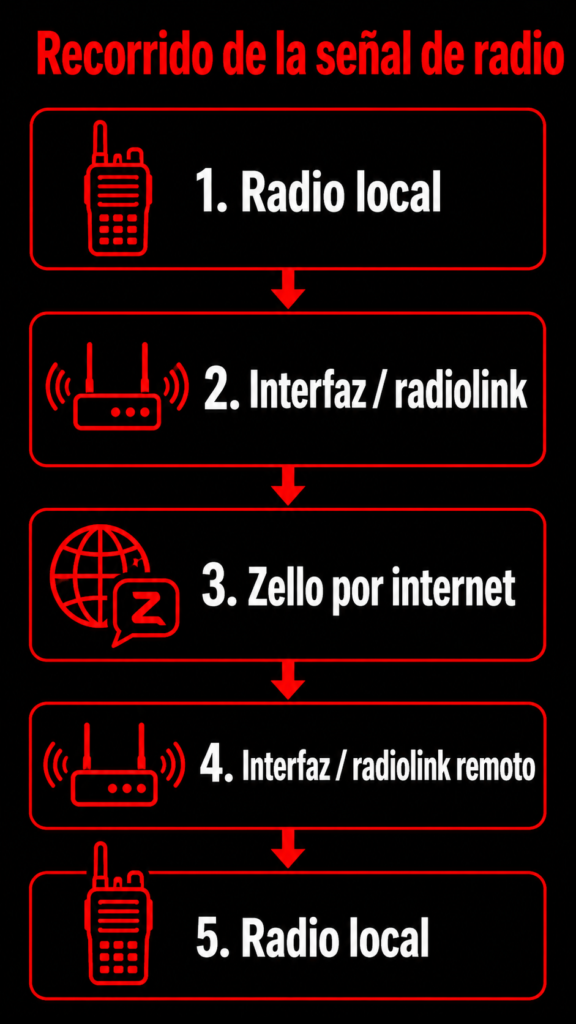
It is not direct propagation between cities.
It is local radio connected via internet.
And that, well used, can be a very powerful tool to communicate radio groups located in different areas.
For example, imagine three points connected to the same Zello channel:
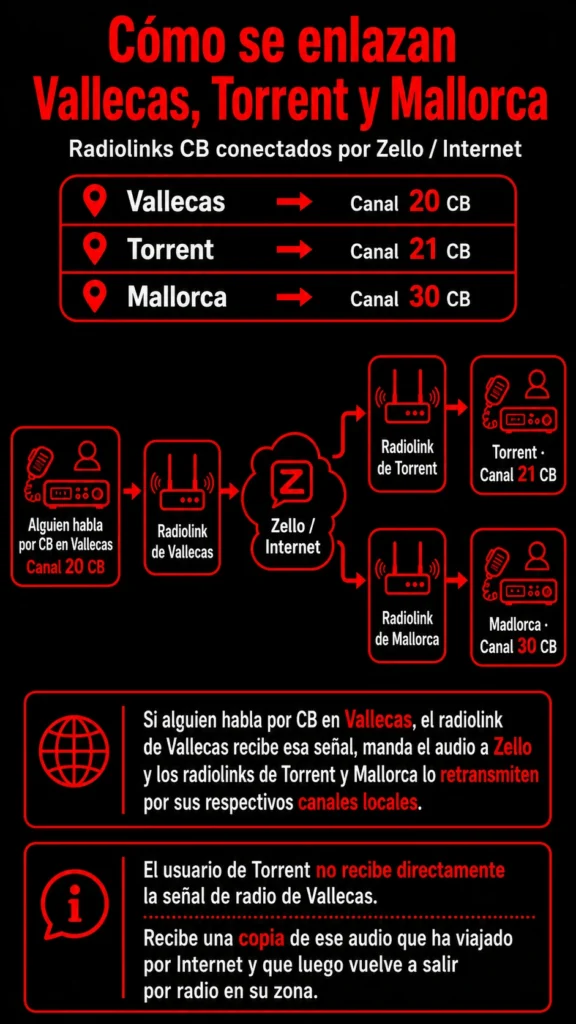
If someone talks via CB in Vallecas, the Vallecas radio link receives that signal, sends the audio to Zello and the radio links of Torrent and Mallorca rebroadcast it via their respective local channels.
The Torrent user is not receiving directly the radio signal from Vallecas.
He is receiving a copy of that audio which has traveled via internet and then comes out again via radio in his area.
And there lies the fun of the system.
You are not connecting cities via direct propagation.
You are connecting local radio areas via internet, maintaining the use of radio equipment at each end.
The CB does the local part.
Zello acts as a bridge between locations.
And this is important to understand well.
A Zello group can be simply a meeting place for people who share the same hobby/passion, just as it can be a Discord channel, a Telegram group or a Facebook community.
The difference is that Zello imitates the dynamics of a communication via radio: you press, talk, release and listen.
It has that rhythm of channel, word turn, of ‘change’, although underneath it functions over internet.
But when that Zello group connects to real radio equipment via a radio link, the thing changes.
We are no longer talking only about a chat room.
We are talking about a system where a local radio signal can enter the internet, travel via Zello and come out again via radio in another location.
There Zello stops being just a walkie-type app and starts functioning as a bridge between radio areas.
It does not connect cities via direct propagation.
It does not do magic.
But it allows local groups separated by distance, terrain or lack of direct coverage to communicate maintaining the use of radio at each end.
And that, for CB groups, PMR, SDR or any local radio community, can be a very interesting tool.
Because in the end the scheme is not:
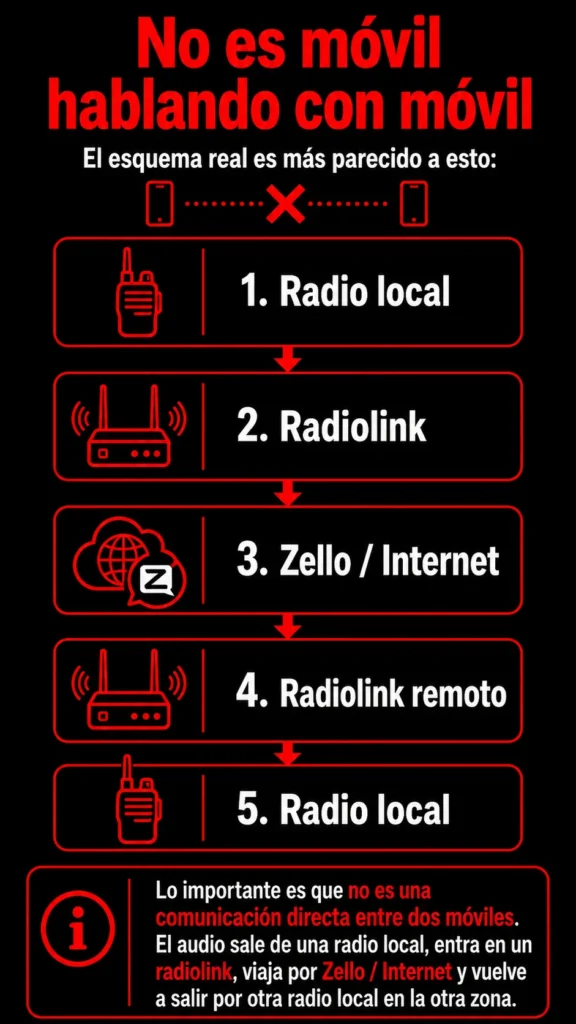
Internet acts as a bridge.
Zello transports the audio.
But the radio is still there, at the ends, doing its work.
And that is the key difference.
A Zello room can be a meeting point for hobby companions.
A place where to talk about equipment, antennas, tests, setups, propagation, SDR or any topic related with the radio.
Something similar to a Telegram group, a Facebook community or a Discord server, but with a special spice: the PTT.
You press, talk, release and listen.
That dynamic remembers much more to the radio than writing messages in a chat or sending eternal audio of WhatsApp, those that should be punished by the Geneva Convention.
And that already has value on its own.
It does not have to be a radio system to be useful within amateur radio.
It can be a social tool around the radio.
A contact point between companions.
A way to keep a community alive.
A place where to ask, share tests, teach equipment, comment conditions or simply spend time talking about what we like.
And when additionally it connects to real equipment via radio links, then adds another layer.
The one of linking local radio areas using internet as a bridge.
So the debate should not be ‘Zello yes’ or ‘Zello no’.
The interesting question would be rather:
Are we using Zello as a useful tool for the amateur radio community, whether to talk between companions or to connect equipment and locations?
Because there lies the key.
As a voice room, it helps to maintain community.
As a radio link, it can help to connect radios.
And in both cases it can make sense, as long as we know what we are using and for what.