LoRa APRS without a licence: the ISM band, aprs.fi and what Spanish law says
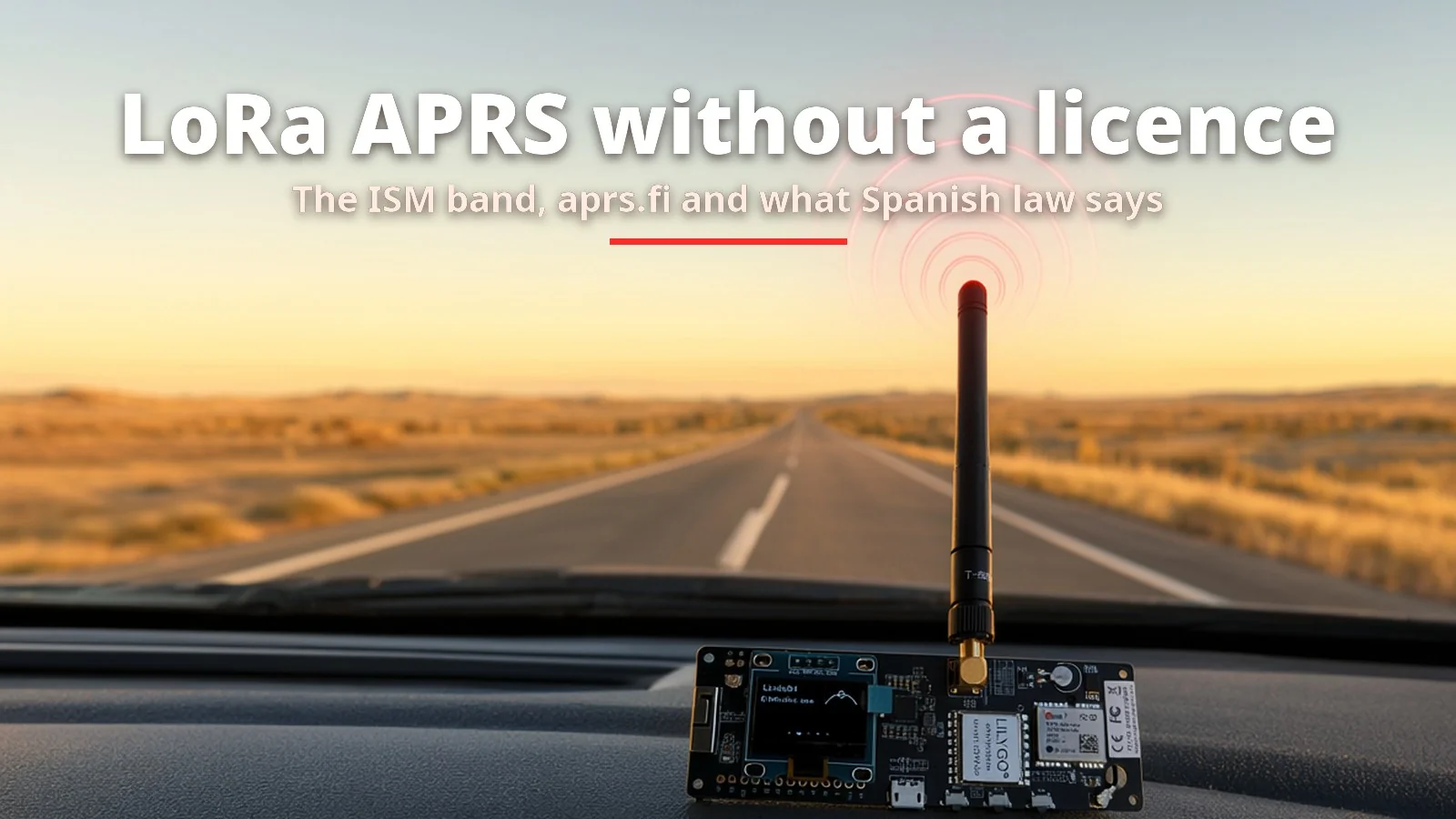
I am a licensed radio amateur. But before I got my licence, I had already crossed Spain from end to end with a LILYGO T-Beam sending APRS frames, and I often showed up on maps such as aprs.fi with identifiers like NVLD23.
During that time I received complaints from the odd radio amateur. And I have always argued the same thing: that I was not doing anything outside the regulations.
This article is the long version of that argument. It separates what the law says, what the network rules say and what is just custom, so the discussion can start from the facts.
The short answer
In Spain, a person without a licence can transmit APRS frames with a LoRa device such as the LILYGO T-Beam on 433.775 MHz as long as they respect the conditions of the ISM band. If that frame appears on aprs.fi, it is not because they uploaded it: it is because an igate received it and forwarded it to the network.
If you do not know what APRS is, start with my article on APRS in amateur radio and come back afterwards.
aprs.fi is not the network: the rule lives in APRS-IS
The «amateurs only» restriction is not in the aprs.fi terms of use, and anyone who says so is looking in the wrong place. It is in the policy of APRS-IS, the network of servers that collects what the igates send.
- aprs.fi is a website. It shows what flows through APRS-IS. Its author, Hessu (Heikki Hannikainen), made it clear: «Non-amateurs may use aprs.fi, the web site, directly on the web» (aprs.fi group, March 2014).
- APRS-IS exists, according to its website, to provide worldwide capabilities to amateur radio APRS networks. That same website asks that non-amateur content stay out of the main network and go to FireNet instead.
What is FireNet?
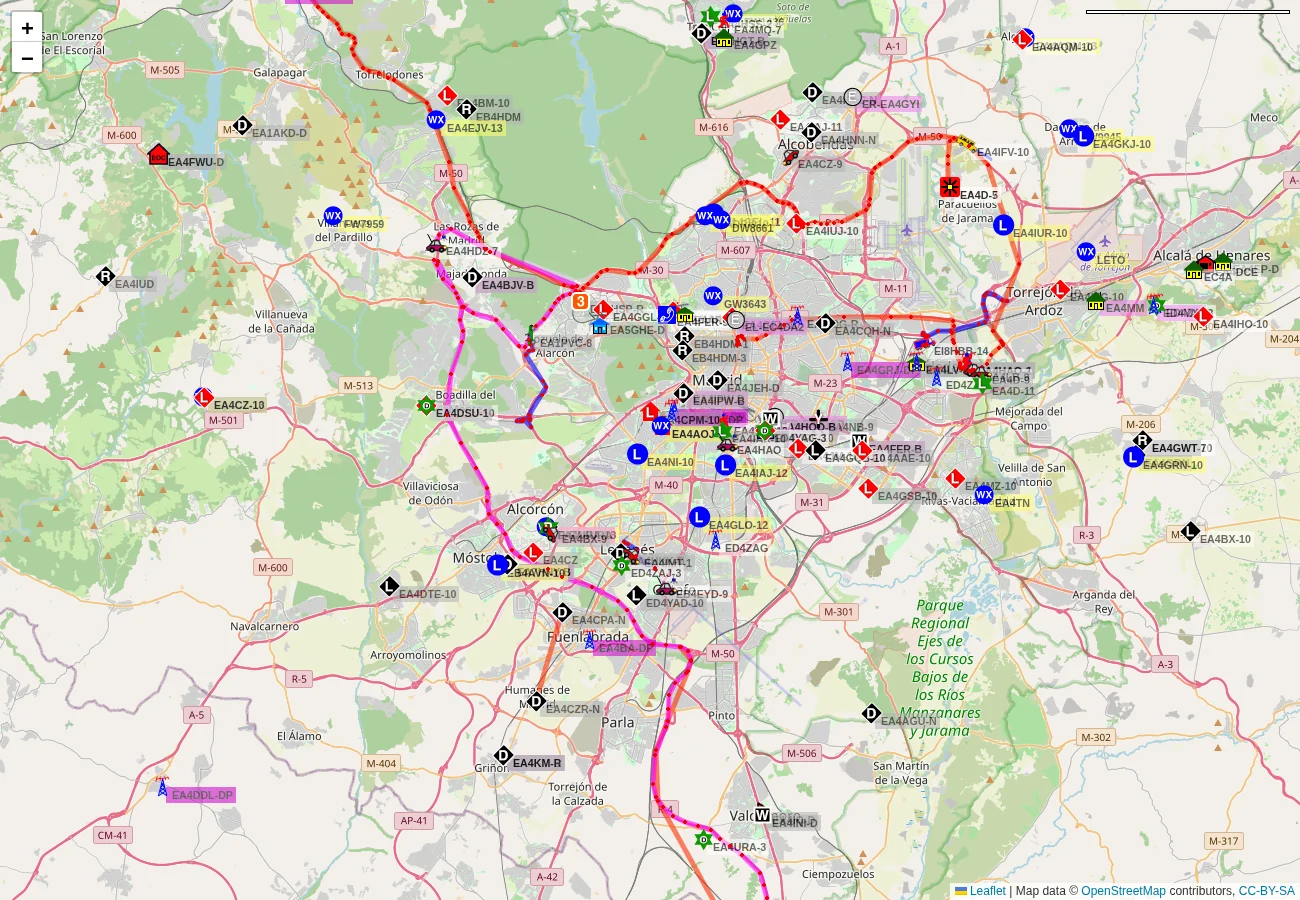
FireNet is a network of APRS servers separate from APRS-IS. According to the APRS-IS website itself, it exists to give radio amateurs and software authors «a place to inject non-amateur radio information». The examples it gives are airport weather reports (METAR) and earthquake reports: data that is useful on an APRS map but does not come from an amateur station.
To do that, its servers have a «local-only» port: whatever is sent through it stays inside FireNet and does not pass to APRS-IS. Anyone connected to FireNet, on the other hand, still sees all the APRS-IS traffic as well as that local data. In other words: amateur traffic flows into FireNet, but non-amateur traffic from FireNet does not flow out to APRS-IS, so it never ends up retransmitted on an amateur frequency.
The same policy asks that non-amateur content is not passed off as an amateur station, and recommends publishing it as APRS «objects».
That policy is a usage rule for the network, not a law or a regulation published in the Spanish Official Gazette (BOE).
Showing up on aprs.fi without APRS-IS: web stations
There is also a route that does not touch anyone’s network. aprs.fi has web stations: with a free account, you can publish your position straight on the map, either by marking it by hand or with the geolocation of your browser or phone.
Its official guide is clear: these stations «do not need to have a valid amateur radio callsign attached to them» and «they’re only visible on the aprs.fi web site». They do not enter APRS-IS, so no igate can retransmit them over the air. Hessu repeated it in March 2026: uploading positions only to the website is acceptable because «it’s not going to get transmitted anywhere».
The difference with the T-Beam is that here the position arrives over the internet, not over the air. For someone who just wants to be followed on the map, it is the route nobody can argue with.
433.775 MHz: two legal uses on the same frequency
The European LoRa APRS frequency sits in two places at once: in the 70 cm amateur band (430-440 MHz) and in the 433.050-434.790 MHz ISM band. In the current Spanish National Frequency Allocation Table (CNAF), approved by Order TDF/732/2026, that band is listed as «Banda de aplicaciones ICM 433,05-434,79 MHz» (ISM applications band), with notes UN-30, UN-32, UN-115 and UN-154 and uses «E y C (según notas UN)». In the CNAF, the letter C means «uso común», common use.
Note UN-30 of that CNAF is plain about it: in the 433.050-434.790 MHz band, «se permite con la consideración de uso común» (it is permitted as common use) «la utilización de dispositivos no específicos de corto alcance (SRD)», the use of non-specific short-range devices. It adds that these installations must accept harmful interference that may result from ISM applications or other radio uses on these or adjacent frequencies.
The technical conditions are those of the note itself and of radio interfaces IR-264, IR-265 and IR-266 (BOE-A-2021-9913):
| Interface | Band | Maximum power | Access condition | Applies to 433.775 MHz? |
|---|---|---|---|---|
| IR-264 (type a) | 433.050-434.790 MHz | 1 mW e.r.p. | No duty cycle required | Yes |
| IR-265 (type b) | 433.050-434.790 MHz | 10 mW e.r.p. | Duty cycle ≤ 10 % | Yes |
| IR-266 (type c) | 434.040-434.790 MHz | 10 mW e.r.p. | Channels ≤ 25 kHz | No (LoRa APRS uses 125 kHz and sits below 434.040) |
Someone transmitting within these conditions is not «on an amateur frequency without permission»: they are using the ISM band as common use, as note UN-30 allows.
Is someone without a licence breaking any rule?
No, if they meet the ISM conditions. The key word is «if»: many devices ship configured outside them.
Power: 10 mW e.r.p. at most
Check the power your firmware is set to: the limit is 10 mW e.r.p., and e.r.p. includes the antenna gain. With a gain antenna, the device’s own power has to be lower.
Duty cycle: 10 % at most
The duty cycle is the share of time the device spends transmitting. It depends on how long each frame lasts on air and how often you send a beacon: the more frequent the beacons, the closer you get to 10 %.
A compliant device
The BOE itself points out that meeting the interface does not exempt the device from the other requirements of the Spanish regulation on conformity assessment of radio equipment (Royal Decree 188/2016).
Do not impersonate anyone
Using someone else’s real callsign is a problem, and joining the network as if you held a licence also creates confusion. The cleanest option is an identifier that does not look like an official callsign.
No voice or audio
This does not affect APRS, which is data, but interfaces IR-264 and IR-266 exclude audio and video applications, except voice with advanced mitigation techniques.
Meeting all this, transmitting on 433.775 MHz is legal and does not require an amateur radio licence.
Who puts the frame on the network?
The unlicensed user transmits over the air and nothing else. The decision to forward the frame to the internet is made by whoever operates the igate.
| Link | What it does | Who controls it | Problem? |
|---|---|---|---|
| The user’s T-Beam | Transmits the frame in the ISM band | The user | None if it meets the ISM conditions |
| Receive-only igate | Receives and forwards to APRS-IS | Its operator | Goes against APRS-IS policy |
| APRS-IS | Distributes the frame worldwide | Its administrators | Traffic its policy does not want |
| aprs.fi | Shows the frame on the map | Hessu | None: it only displays it |
| Transmitting igate or digipeater | May retransmit it on an amateur band | Its operator | Yes: an amateur station transmitting non-amateur traffic |
The real risk is in the last row. Hessu put it like this: students with ISM trackers «would not be breaking any laws», but their traffic on APRS-IS «would at times cause hams operating transmit-capable igates to break their license conditions» (aprs.fi group, November 2022).
The user does not create that situation: it is a consequence of using a frequency shared by the amateur band and the ISM band.
What can and cannot be demanded
Having the right to transmit is not the same as having the right to be relayed. Both sides are right about something.
What cannot be demanded of the unlicensed user
- That they stop transmitting in an ISM band where they are authorised.
- That they answer for what someone else’s igate does with their frame.
- That they accept being called a «pirate» or accused of an offence they are not committing.
What radio amateurs and network administrators can do
- Filter or block their identifier on their igates, or on APRS-IS and aprs.fi.
- Ask them to stay off their network, since they run it.
- Use another frequency outside the ISM overlap, as the United Kingdom does with 439.9125 MHz (UKHAS, 2025).
What is not mandatory
No rule requires an unlicensed user to configure their beacon in any particular way: not to drop the digipeat path, not to give up APRS messages, not to add a specific comment, and not to set up their own receiver and server. Their only obligation is the ISM conditions. Everything else is a request from whoever runs the network, not a legal requirement.
What to reply if you are accused
| Accusation | Reply |
|---|---|
| «You are transmitting on an amateur band without a licence» | 433.775 MHz is also an ISM band. At 10 mW e.r.p. and a duty cycle ≤ 10 % it is common use by short-range devices (CNAF note UN-30; interface IR-265). |
| «aprs.fi is for radio amateurs only» | aprs.fi is a website anyone can use, and it even lets people publish positions without a licence through its web stations. The restriction belongs to APRS-IS and is a usage rule, not a law. |
| «You got into the network illegally» | The frame was forwarded by an igate. The user did not connect to anything. |
| «Because of you, igates break their licence» | Only if a transmitting igate or a digipeater retransmits the frame. That is controlled by its operator, with filters. |
| «Stop transmitting» | There is no legal basis to demand it. It is fair to ask them to stay off the network, and to filter the station. |
This article describes Spanish regulations and is not legal advice. It is based on the CNAF approved by Order TDF/732/2026; if a new one is approved, check it.
Sources
- BOE-A-2021-9913: interfaces IR-264, IR-265 and IR-266, SRDs in the 433 MHz ISM band (in Spanish)
- BOE-A-2026-15661: Order TDF/732/2026, current Spanish National Frequency Allocation Table, note UN-30 on p. 101231 (in Spanish)
- APRS-IS: usage policy
- aprs.fi group (2014): website use by non-amateurs
- aprs.fi group (2022): igates and ISM trackers
- aprs.fi group (2026): positions uploaded only to the website
- aprs.fi: web stations: official guide
- UKHAS (2025): legality of LoRa APRS in the United Kingdom
If this helped you, buy me a coffee
433.775 MHz · LoRa · SF12 · 125 kHz
NVLD23>APLRT1::READER :Buy me a coffee!
✔ CRC OK · message for you
Message received: send a beacon back
If this article cleared things up, a coffee helps me keep writing.
☕ Buy me a coffeeNo subscriptions, no sign-ups: just a coffee.
Keep exploring radio
- APRS in amateur radio: what it is and how the system works.
- APRSDroid guide: APRS from your phone, installation and setup.
- aprStar: my APRS client with a messenger look.
- Your first amateur radio rig: where to start if you want to get your licence.
Frequently asked questions
Do I need a licence to use LoRa APRS on 433.775 MHz in Spain?
No, as long as you respect the ISM band conditions, for example those of interface IR-265: 10 mW e.r.p. at most and a duty cycle of up to 10 %.
Is it illegal to appear on aprs.fi without being a radio amateur?
No. aprs.fi is a website. The restriction is in the APRS-IS policy, which is a usage rule for a private network, not a law.
What power should I set my T-Beam to?
Whatever keeps you at or below 10 mW e.r.p. (or 1 mW if you want to transmit with no duty cycle limit, interface IR-264). Remember that e.r.p. includes the antenna gain.
Can I appear on aprs.fi without a licence and without a radio?
Yes. aprs.fi web stations let you publish your position from your browser or phone with a free account. They need no callsign and do not pass to APRS-IS.
Can I use a made-up callsign?
Better an identifier that does not look like an official callsign, and never someone else’s.
Affiliate links. As an Amazon Associate I earn from qualifying purchases.