Definitive legal guide to antennas in Spain: amateur radio, CB-27 MHz and television

Installing an antenna in Spain can turn into a small legal minefield.
Many people think they need the community’s permission for absolutely anything.
Others just put it up without saying a word.
And almost nobody really knows what the law actually says.
This guide leaves out the myths and the typical “know-it-all brother-in-law” advice, and goes straight to the source:
only the BOE (Spain’s official gazette), in hand.
Even so, take it with a grain of salt: I’m not a lawyer or a legal expert, I’ve simply gone through the BOE for you to explain clearly what the law really says.
Three types of antenna, three legal frameworks
| Antenna type | Purpose | Main rule (BOE) |
|---|---|---|
| Amateur radio | Transmission and reception under a personal licence | Law 19/1983, of November 16 (BOE-A-1983-31093) 2623/1986, of November 21 (BOE-A-1986-33766) |
| CB-27 MHz | Licence-free open communication | Order IET/614/2015, of April 6 (BOE-A-2015-3864) Order ETD/1449/2021, of December 16 (BOE-A-2021-21346) Order ETD/625/2023, of June 12 (BOE-A-2023-14422) |
| TV / satellite dish | Reception of broadcast or satellite services | Royal Decree-Law 1/1998, of February 27 (BOE-A-1998-4769) Law 49/1960, of July 21, on Horizontal Property (BOE-A-1960-10906) |
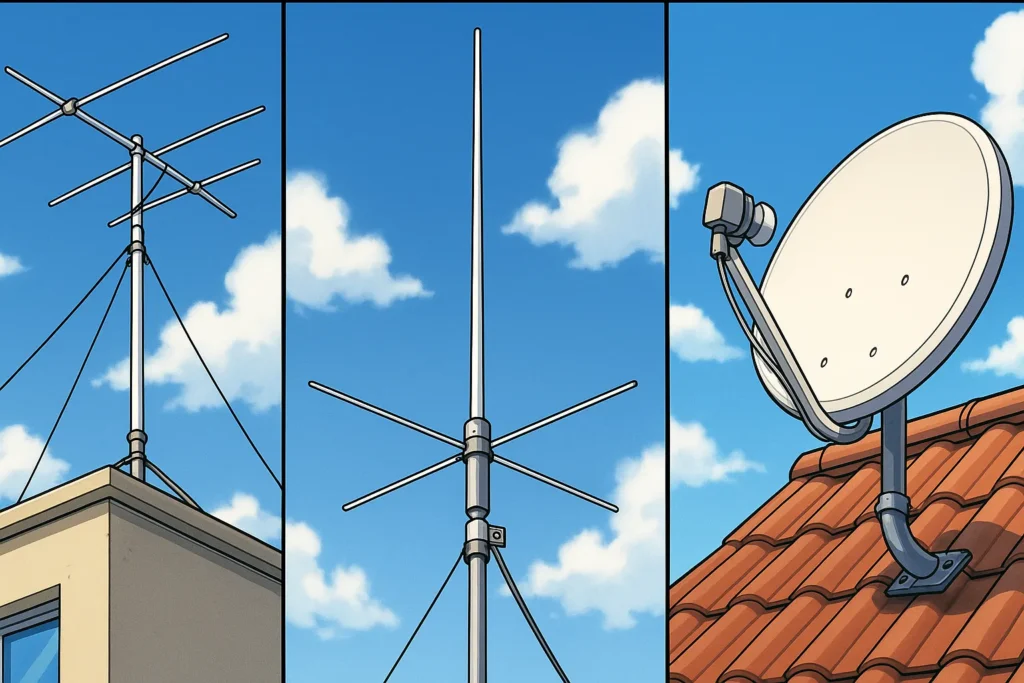
All three share the same practical problem:
they affect shared elements of the building (façade, roof or structure).
And that triggers the Horizontal Property Law (LPH).
Amateur radio: an individual right recognised by law
Law 19/1983 (BOE-A-1983-31093)
- Art. 1. “Duly authorised amateur radio operators may install, at their own expense, antennas for transmitting and receiving broadcasts on buildings or premises they use, under the conditions determined by regulation.”
- Art. 2. “The owners of the antennas shall be liable for any damage or loss caused by their installation, maintenance or removal, and must take out civil liability insurance covering these risks.”
- Art. 3. “Failure to meet the technical requirements or the lack of the corresponding insurance policy shall result in the loss of the right recognised in this Law.”
Note:
The regulatory development of this law is set out in Royal Decree 2623/1986, of November 21 (BOE-A-1986-33766), which establishes:
- The procedure for prior notice to the owner or the community.
- The possibility of reasoned objection only on technical, safety or structural-damage grounds.
- The safety, resistance and grounding requirements, as well as the obligation to hold insurance and to fix any defect that affects safety.
Technical regulation: RD 2623/1986 (BOE-A-1986-33766)
It develops the law and requires:
- Compliance with safety, resistance and grounding rules (arts. 12–18).
- Procedure/paperwork and documentation for the first installation or structural impact (chapter II onward; arts. 2–6, 12 ff.).
- Mandatory civil liability insurance (art. 20).
- Duty to fix immediately any defects affecting safety (art. 19).
- Urgent works by the property: may involve temporary removal without the deadlines in art. 6 (art. 7).
You don’t need the community’s authorisation; it’s enough to give notice and install it safely.
They can only object on justified technical or structural grounds.
CB-27 MHz: open use, technical conditions from the CNAF
Current regime
- Order IET/614/2015, of April 6: updates note UN-3 (CB-27) of the CNAF (band 26.960–27.410 MHz, 40 channels, 4 W FM/AM/digital and 12 W PEP SSB, simplex, no repeaters).
- Order ETD/1449/2021, of December 16: approves the 2021 CNAF and repeals ETU/1033/2017.
- Order ETD/625/2023, of June 12: amends the 2021 CNAF.
Bottom line: using CB-27 doesn’t require an individual licence, but you must stick to the current UN-3 note of the CNAF.
And what about the CB antenna on your building?
There’s no specific “CB antenna law”; the general infrastructure regime applies:
- Royal Decree-Law 1/1998, of February 27, art. 1 and 9: right of co-owners and, where applicable, tenants to install or access telecommunications services if there is no shared infrastructure.
In practice: if there’s no equivalent ICT (shared telecom infrastructure), you can install your own antenna at your own cost, respecting the LPH (safety/aesthetics). If there is sufficient ICT, the community can require you to use it (connecting to the existing one).
TV / satellite dishes: ICT right with LPH limits
- Royal Decree-Law 1/1998, of February 27 (ICT): recognises the right to install/connect to infrastructure; if ICT doesn’t exist, an individual installation is allowed; if it exists and is sufficient, the community can require its use.
- Law 49/1960, of July 21, on Horizontal Property, art. 7.1: it’s forbidden to compromise safety, structure and the building’s exterior configuration/appearance.
Horizontal Property and legitimate objection
- LPH art. 7.1 (BOE-A-1960-10906): the owner may modify their private property without affecting safety/structure/exterior appearance; if it affects shared elements (façade/roof), limits apply and, where relevant, agreements are needed.
The community can only object on grounds of technical risk, structural damage or the existence of sufficient ICT (not for generic aesthetic reasons without technical justification).
Tenants
- RD-Law 1/1998 (arts. 1 and 9) includes tenants among the holders of the right to access/install; they will need the owner’s consent to work on the property.
Inspections and penalties (current rule)
- Law 11/2022, of June 28, General Telecommunications Law (BOE-A-2022-10757):
- Art. 106–108: classification of offences (very serious, serious, minor).
- Art. 109: penalties → minor up to €100,000, serious up to €2,000,000, very serious up to €20,000,000.
- Art. 110: criteria for grading penalties.
Summary without all the legalese
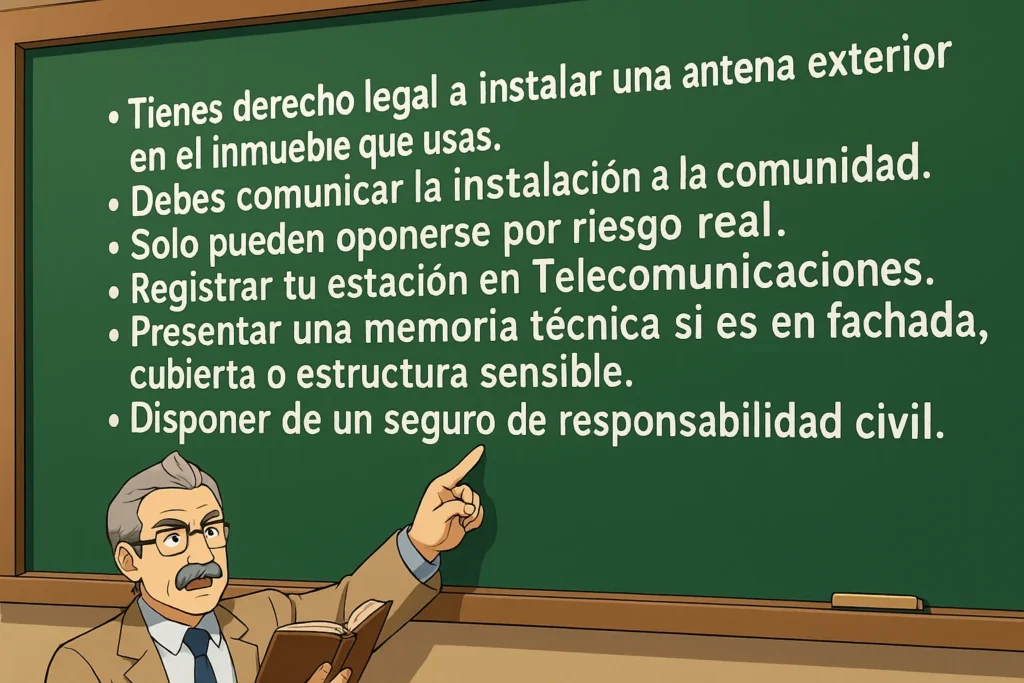
If you’re a licensed amateur radio operator
- You have the legal right to install an outdoor antenna on the property you use (your home or premises), even in shared areas like the rooftop, as long as you do it safely and follow the technical rules.
- You don’t need to ask the community for permission, but you do need to give notice before installing it.
- The community can only object if there’s a real risk to the structure, safety or the building.
- The law also requires you to:
- Register your station with the Provincial Telecommunications Inspection Office.
- Submit a technical report if the antenna is installed on the façade, roof or a sensitive structure.
- Hold civil liability insurance covering damage to people or property.
If you use CB-27 MHz
- You should only use type-approved equipment and follow the technical conditions of the CNAF’s UN-3 note: maximum power, channels, etc.
- You can install your antenna if there’s no shared infrastructure that already gives you that service.
- If it affects shared areas (façade, roof), notify the community in writing before doing it.
If what you want is a TV antenna or satellite dish
- You can install it if there’s no shared antenna that serves you.
- If there is one and it’s sufficient, the community can ask you to connect to it instead.
- Your installation can’t damage the building or seriously alter its appearance.
Final thoughts
Antennas aren’t a whim: they’re a form of communication, experimentation and technological freedom.
Spain has one of the most complete sets of regulations in the world to protect that right, but it only works if you know it and make it count.
And remember:
📻 no antenna, no radio — but no knowledge, no freedom.
Other articles you might like:
Balcony antennas: pride against the mockery
Why the Police can seize your walkie even if you’re not transmitting