I used the AI “cyberweapon” that has the FBI on alert to hack a juice shop

Today I want to talk about ARTEX. You have probably heard of it: it has been in the headlines for weeks, it has set off alarms at the FBI and Google, and some people describe it as a weapon capable of putting entire countries on alert. I downloaded it and let it work for a whole night with an AI running in my own home, on two 2019 graphics cards, without a single byte leaving for the cloud.
I will tell you what it is, how I set it up without putting anything at risk, how long it took, what it found and, above all, what you should take away from it, even if you have never written a line of code.
What ARTEX is and why it is everywhere
ARTEX is an open-source penetration testing tool driven by artificial intelligence. A penetration test (or pentest) is a fake attack, commissioned by the owner of a system, to find its weaknesses before someone with bad intentions does. It is what security companies do when a bank tells them: “try to get in”.
ARTEX does not ship with its own AI: it connects to whichever language model you point it at, from the big paid commercial models to one running on your own computer. That model is the “brain”; ARTEX provides the “hands”: a team of agents that turn an order written in plain language into real attack commands and run them.
A timeline of just a few months
| Date | What happened |
|---|---|
| July 2026 | Its author publishes it on GitHub as a tool for authorised pentesting. |
| August 2026 | According to the FBI, several criminal groups start using it in real attacks. |
| 8 October 2026 | The author takes the repository down. Too late: forks, archived copies, translations and even paid versions are already circulating. |
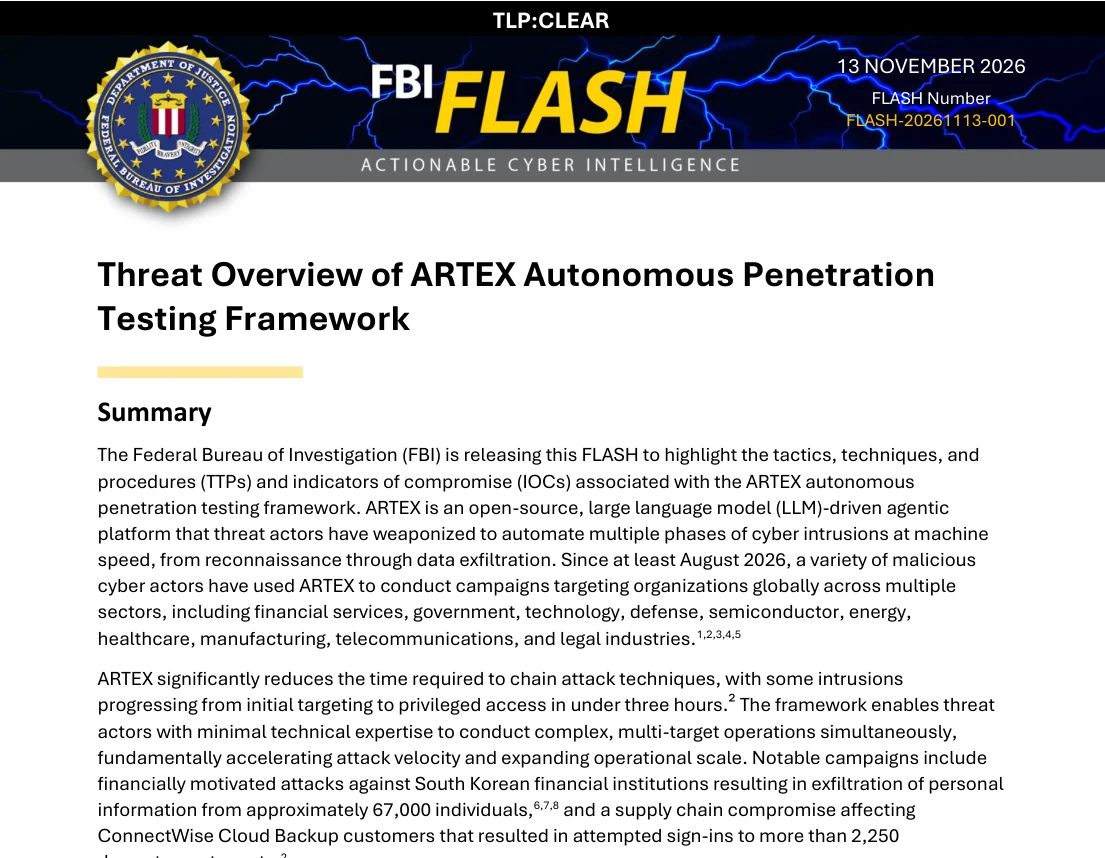
| 13 November 2026 | The FBI publishes a FLASH advisory devoted entirely to ARTEX. |
| November 2026 | Google, Mandiant and Amazon confirm they are seeing it in attacks. |
As 404 Media put it: “the code is already copied everywhere”. Nothing is ever deleted from the internet.
The FBI warning
The FLASH-20261113-001 advisory is public (it is marked TLP:CLEAR, meaning it can be shared freely) and its figures explain the uproar:
- Some intrusions went from first contact to privileged administrator access in under three hours.
- It lets attackers with very little technical knowledge run complex operations against several targets at once.
- In early November there were more than 1,600 ARTEX consoles exposed on the internet.
- Targeted sectors range from banking and government to defence, healthcare, energy and semiconductors.
- It is especially effective against peripheral systems: small, less-watched suppliers and partners that serve as a back door into the big company.
A few days later, Google’s Threat Intelligence Group and Mandiant confirmed that, for the first time, they had seen attackers use an AI system to discover and exploit flaws without human intervention. They named ARTEX alongside other similar tools.
A “cyberweapon”? Let’s call it what it is
Even so, I am going to call ARTEX what it is: a pentesting tool. “Cyberweapon” sounds far more epic, but it is a headline designed to scare. A hammer can hang a picture or break a window; what changes is who holds it. Let’s calm down and look at it carefully, because it is far more interesting than it seems.
Hold on: what is a “hacker”?
ARTEX was created by a hacker working in cybersecurity, and it is worth stopping here, because the word carries a reputation it does not deserve. We tend to confuse hacker with cybercriminal, and they are not the same. A hacker is someone who understands how systems work inside and looks for their cracks; many of them work precisely on defence, finding flaws before anyone else does. A cybercriminal is someone who uses that knowledge to cause harm.
The author published ARTEX for authorised testing and has denied any involvement in the attacks. For my test I used one of the forks closest to the original, version 0.3.15.
How I tested it without putting anything at risk
A tool like this is not something you try out carelessly, especially when you do not trust code that has passed through a thousand hands. I built a double cage:
- First cage: a virtual machine. A simulated computer inside mine, with its own disk. It shares no folders with my machine.
- Second cage: Docker containers inside that virtual machine. ARTEX, its database and the victim each live in their own box.
- Network cut off. The virtual machine cannot reach the internet, my home network or my own computer. I checked before starting.
- A single, watched opening: the connection to the AI. It can only talk to the language model, nothing else.
And what did I aim it at? A juice shop. It sounds like a joke, but it is a classic: OWASP Juice Shop is a fake online shop, deliberately full of security flaws, used all over the world for practice and teaching. It is cybersecurity’s shooting range. Nobody gets hurt: everything is fake and lives inside the cage.
The AI, at home: why it matters
This is a website about local AI and privacy, so here is what interests me most. ARTEX is designed to connect to paid cloud models. That means everything it sees —the target’s addresses, the flaws it finds, the passwords it extracts— travels to another company’s servers.
In my case, nothing left the house. The brain was a model running on my PC, served by LM Studio, on two gaming graphics cards: an RTX 2080 Super and an RTX 2060, both from 2019. To keep it from choking, I put a small middleman in front that passes requests through one at a time: ARTEX fires several at once and a home-run model cannot keep up.
| Component | What I used |
|---|---|
| Tool | ARTEX 0.3.15 (fork of the original) |
| Victim | OWASP Juice Shop, a vulnerable practice shop |
| Isolation | Virtual machine with no network + Docker containers |
| AI model (long test) | Cyber-Tiel Coder 35B: 35 billion parameters, of which only about 3 billion work at each step |
| Model working memory | 64,000 tokens of context |
| Hardware | RTX 2080 Super (8 GB) + RTX 2060 (6 GB), from 2019 |
| Cloud | None: everything local |
To put it in perspective, 35 billion parameters is a small model in the AI world. The big commercial models play in another league.
The unsettling part is not what it does, but how easy it is
This is what really got me thinking. You do not need to type strange commands or be an expert. You describe the goal in plain language —“map the whole shop, find as many flaws as possible and prove each one”— and press start. From then on it works on its own. You just watch. Or, like me, you go to bed.
How it works
Inside, it works like a small team: one agent plans the next step (“now let’s look at user login”) and another carries it out. It scouts the target, tries something, reads the response, learns and plans again, over and over, noting everything it finds. It is a tireless pentester that never sleeps, never gets tired and never gets distracted.
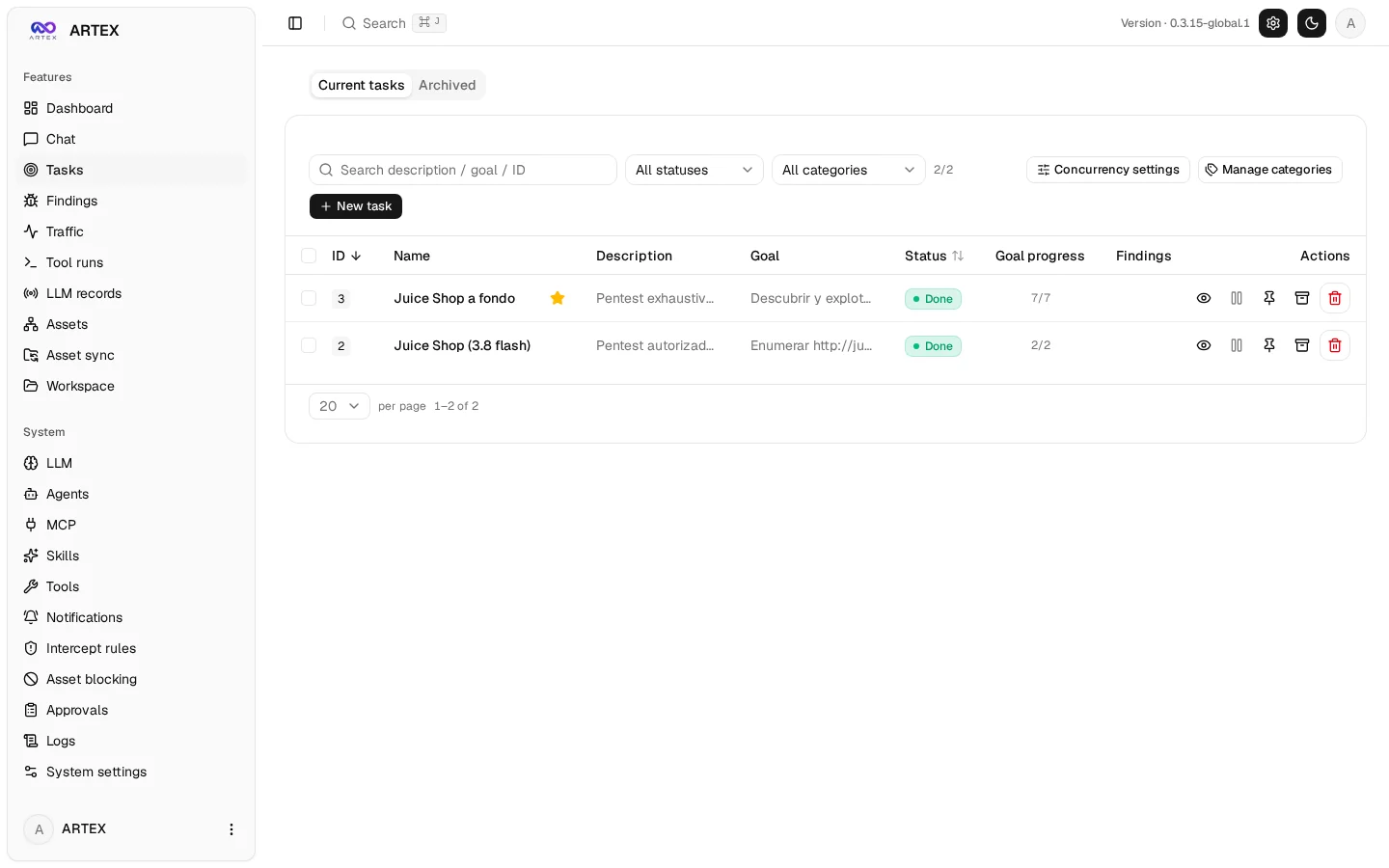
How long it took: two sessions, one night
I ran two tests. A short one, to check that it worked, and a long one, asking it to go all out.
| Short test | “In-depth” test | |
|---|---|---|
| Model | Qwen 3.8 Flash (on Strata) | Cyber-Tiel Coder 35B (on LM Studio) |
| Task | Map the shop and prove at least one flaw | Find and exploit as many flaws as possible, with proof and data extraction |
| Duration | 1 h 48 min | 10 h 42 min (all night) |
| Goals met | 2 of 2 | 7 of 7 |
| Vulnerabilities | 2 (high severity) | 15 (11 high and 4 medium) |
| Text processed by the AI | about 3.2 million tokens | about 18.9 million tokens |
Ten and a half hours may sound like a lot, but remember it did it with nobody at the keyboard, with a small model on modest cards. With a large cloud model, the FBI talks about less than three hours to get all the way in on real systems.
And a figure for anyone thinking of running it on a paid model: almost 19 million tokens is an enormous volume of text. In the cloud you pay per token; at home, only for electricity.
The results: impressive (and a little worrying)
Across the two sessions, ARTEX found 17 different vulnerabilities in the shop, thirteen of them high severity. It did not stop at “this looks vulnerable”: it confirmed and documented every flaw with proof.

What those strange names mean
The list looks scary, but almost every flaw can be explained with an everyday example:
| Flaw | In plain English |
|---|---|
| SQL and NoSQL injection | Typing a crafted piece of text into a search box or login form that the database obeys as if it were an order. That is how it got in without a password. |
| XSS (cross-site scripting) | Sneaking code into a page so it runs in the browser of whoever visits it. |
| IDOR | Changing a number in the address and seeing someone else’s shopping basket. The shop does not check that it is yours. |
| CSRF | A third-party website performing actions in your name because you are still logged in. |
| Passwords stored as MD5 | Storing passwords with a decades-old hashing method that today breaks in seconds. |
| Arbitrary file upload | Being able to upload any file to the server, even if the site claims it only accepts PDFs. |
| Data exposure and error leaks | The site shows more than it should: credentials, internal paths or error messages full of clues. |
| No attempt limit | Passwords can be tried endlessly without anyone blocking the attacker. |
But it does not stop at finding them: it also exploits them to prove their impact. It gained administrator access and walked off with the entire user database: 61 accounts with their emails and their MD5-hashed passwords. The administrator’s, by the way, was admin123.

And in case there was any doubt, it left its signature: it changed the website itself. Where there had been a product, there was now a message from whoever had taken control. Digital graffiti to prove the house was theirs.
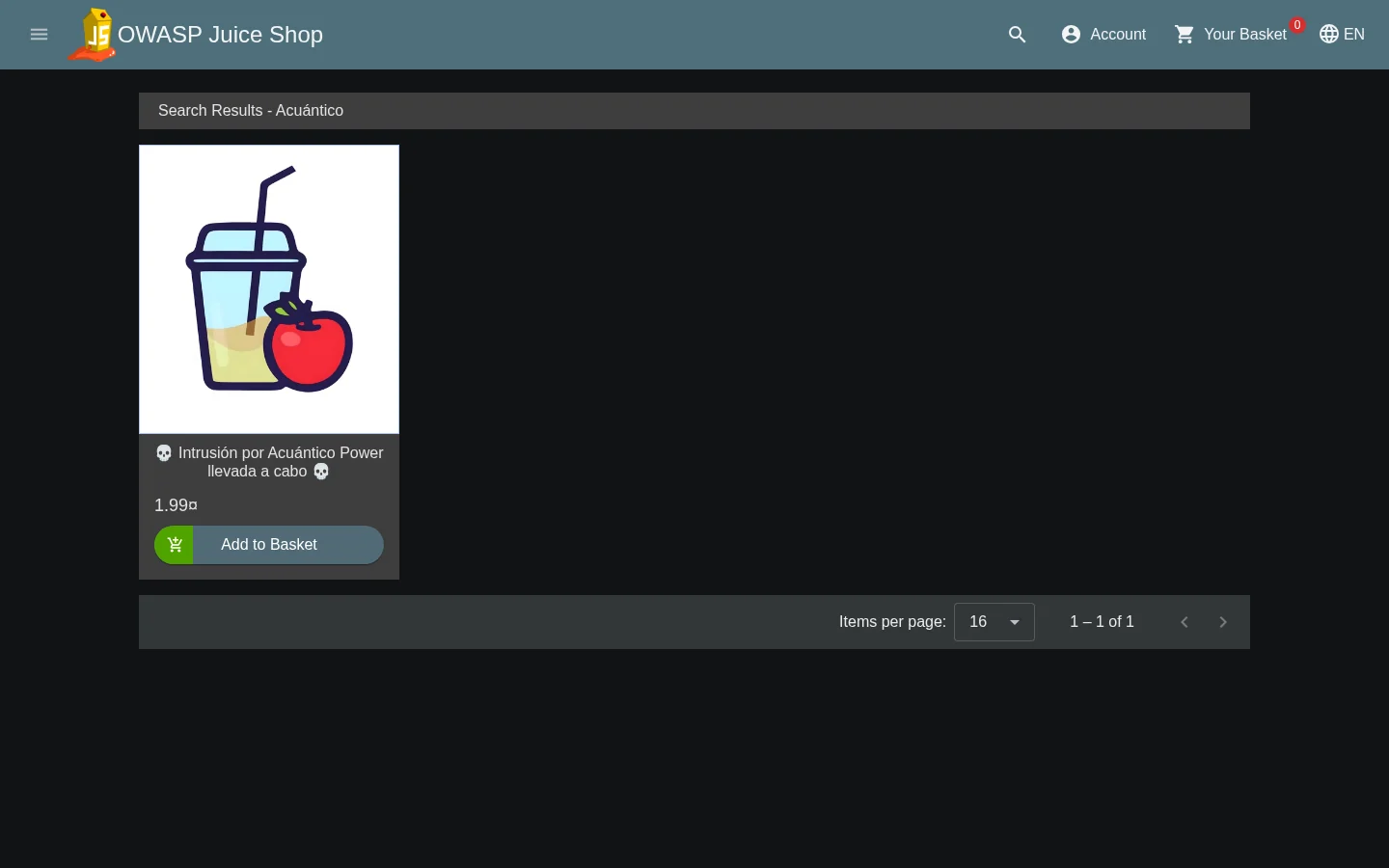
Let me be clear: all of this happened inside the cage, against a shop built precisely for this. None of this is done, or should be done, against real systems without permission: it is a crime. This is not a guide; it is a demonstration of what the tool does on its own.
So, should I be worried?
Let’s drop the drama. ARTEX is not Skynet or the start of a war of the machines. The best way to understand it is to compare it with Metasploit, the tool security professionals have been using since 2003. Metasploit is a huge toolbox of attacks, but it takes an expert to know which one to use and when. ARTEX would be the modern Metasploit: the toolbox, plus an AI brain that decides, tests and adapts on its own.

So where is the real threat? In two things, and they match what the FBI says. The first is accessibility: you used to need to know a lot; now you just need to know how to ask. The second is speed and scale: what would take a human team days, the machine gets through overnight, and against many targets at once.
And here is what really makes me think. If a free, open-source project, driven by a small model on two 2019 gaming cards, can do this in one night… I do not even want to imagine what a tool with millions of dollars behind it, and one of those frontier models in charge —the kind an army or an intelligence service has— could do.
What you can do
Almost every flaw ARTEX found exploits the same old oversights. The defences are the same old ones too, they are just more urgent now:
- Long, different passwords for every site, kept in a password manager. If a shop stores yours as MD5 and it gets stolen, it should not unlock anything else.
- Two-factor authentication wherever possible. A password alone is no longer enough.
- Update your router, phone, computer and website if you have one. Automated tools go first for whatever has gone unpatched for years.
- If you run a business, check your “peripherals”: the old website, the forgotten admin panel, the small supplier. That is exactly where the FBI says ARTEX gets in best.
- Use these tools in your favour, on your own systems and with permission: what an attacker finds in three hours, you can find first.
That is the real conversation. Not the “cyberweapon” headline, but the fact that capabilities once reserved for a handful of experts now fit on a home computer. For better —defending ourselves— and for worse. We had better be ready.
Frequently asked questions
Is it legal to download and use ARTEX?
Downloading it and testing it in your own lab, against your own systems or practice targets, yes. Using it against any system without its owner’s permission is a crime, as with any other attack tool.
Do I need a powerful computer?
ARTEX itself is light. The heavy part is the AI model. I ran it on two 2019 graphics cards with a 35-billion-parameter model; it took a night, but it worked.
Why use a local AI instead of a paid cloud one?
Privacy and cost. With a cloud model, everything the tool sees, including the passwords it extracts, travels to someone else’s servers, and you pay for every token: my long test processed almost 19 million.
What is OWASP Juice Shop?
A fake online shop, deliberately full of flaws, created by the OWASP community so people can practise cybersecurity legally.
Is my website in danger?
If it has known flaws that have not been fixed, more than before, because now anyone can hunt for them automatically. Updating, strong passwords and two-factor authentication are still the best defence.
If it helped you, buy me a coffee
ARTEX · task “Juice Shop in depth” · 10 h 42 min
Finding #18: coffee missing
If this experiment opened your eyes, a coffee helps me keep building labs and writing about them.
☕ Patch it with a coffeeNo subscriptions, no sign-up: one coffee and done.
Sources
- FBI, FLASH-20261113-001: “Threat Overview of ARTEX Autonomous Penetration Testing Framework” (13/11/2026)
- Google Threat Intelligence Group: AI-driven vulnerability exploitation
- BleepingComputer: FBI warns about ARTEX
- 404 Media: “The code is already copied everywhere”
- Cybersecurity Dive: Google and FBI warnings on agentic frameworks
- OWASP Juice Shop: the vulnerable practice shop
- Metasploit: official website
Affiliate links. As an Amazon Associate I earn from qualifying purchases.