Guide – Tutorial: How to get started in CB radio
Welcome to the Citizens Band!
CB radio (Citizens Band) is that mysterious world many people assume is dead, but it’s still ticking along, if a lot quieter than in the glory days of the 80s and 90s. Back when a truck without an antenna was like a bike without a saddle. Today, few people even know it exists, but the ones who do enjoy it with real passion.
CB is free, doesn’t require a licence, and is within reach of anyone who wants to experiment with radio and connect with other people from home, the car, or the nearest mountain.
Legal status of the Citizens Band in Spain
In Spain, CB is regulated by the National Frequency Allocation Table (CNAF). You don’t need a licence to operate, but you do have to meet a few conditions:
- Allowed frequency: 26.965 MHz to 27.405 MHz (40 channels)
- Maximum power: 4W on AM/FM and 12W on SSB (USB/LSB)
- Antennas: You can put up antennas as long as you respect local planning regulations.
CB activity today
No, you’re not going to hear all 40 channels packed with people. That was the old days. Nowadays, CB is a stronghold of die-hards who still want to talk, share, help out, or just throw calls out into the air and see who answers.
It’s no longer common to see trucks or tractors with a rig, but there are still loyal users out there. And that’s enough to hook you if you’re into the hobby for the hobby’s sake.
What can you expect?
It depends a lot on where you are. In a big city there might be some local activity; in a small village, maybe just the echo of your own voice. But don’t get discouraged. When there’s nobody nearby, you’ll always have DX.
Local contacts vs DX: two ways of doing radio
On CB there are mainly two types of communication you’ll use day to day: local communication, perfect for chatting with people nearby, and DX communication, which makes use of ionospheric propagation to reach incredible distances. Understanding these two ways of operating is key to enjoying radio.
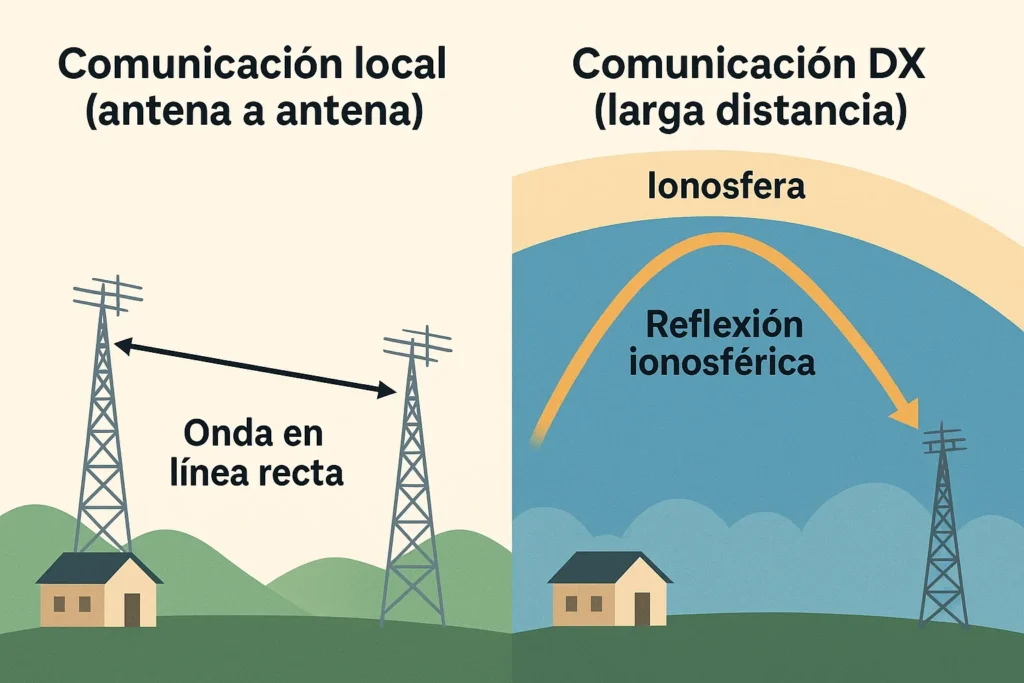
1. Local communication (antenna to antenna)
Ideal for talking to people in your city or area. The signal travels in a straight line between antennas, which means it can be affected by physical obstacles like buildings, mountains, or even the Earth’s own curvature. That’s why the higher and clearer both your antenna and the other person’s are, the better the communication.
2. DX communication (long distance)
Thanks to ionospheric reflection, the signal can bounce off the ionosphere and travel hundreds or thousands of kilometres. That way, it’s often easier to reach Brazil than the next town over.
Ionospheric propagation on 27 MHz behaves in a peculiar way. Waves at this frequency can bounce off the F layer of the ionosphere, especially during solar cycle peaks. This lets a signal transmitted from Spain reach South America, for example, while another signal on the same band might not even reach the next town over due to local propagation conditions. These “bounces” enable long-distance communication, but they also make it unpredictable and dependent on the time of day, the season and solar activity.
Modulation modes: AM, FM, USB, LSB, CW
Although many people mistakenly call them “bands”, they’re actually transmission modes — different ways of modulating and sending your voice or signals over the radio:
- AM (Amplitude Modulation) / FM (Frequency Modulation): These are the simplest, most common modes. Ideal for local contacts because they offer clear, direct audio, although their range is more limited to antenna-to-antenna communication.
- USB (Upper Sideband) / LSB (Lower Sideband): These are the true kings of DX. They make better use of power and bandwidth, letting you reach further with less energy. That’s why most long-distance contacts happen in these modes.
- CW (Morse): This is Morse code telegraphy. Much less used on CB, but still possible. It offers very efficient transmission under weak-signal conditions, though it requires learning the code and plenty of practice. It’s the most classic mode of all.
Two ways of living the CB life

You can follow the rules to the letter, or… bend them with a bit of flexibility. Here at Acuántico Power we don’t encourage going outside the rules, but we’re not going to pretend it doesn’t exist either. The reality is probably that there’s more activity on the so-called “highs” than on the “mids” (CB), yet only transmitting on the mids is legal in Spain. Weigh up which lines you’re willing to cross. Depending on your choice, your whole view of CB can change. For more on this, check out our article on the 11-metre band.
What you need to get started
1. Enthusiasm
This is the most important thing. Without it, none of this makes any sense.
2. Power supply
Any power supply capable of delivering 13.8V and 20A will be enough to get started. That said, the ideal choice is a power supply made specifically for radio gear: it’ll save you a lot of headaches, especially with noise on the signal.
There are plenty of decent budget models on the market, and several clones of those models sold under different brands. If you’re lost and don’t know which one to pick, I’d recommend this one: it’s compact, sturdy and pretty affordable. I’ve seen some criticism of it, but personally I have no complaints, and I don’t know anyone who does either.
3. Radio
This is the heart of the matter. If you’re serious about getting into CB, invest in a radio with sidebands (USB/LSB). I’ll be blunt: an AM/FM-only radio has pretty good odds of ending up gathering dust on a shelf or listed for sale online.
Models like the President George II, or even a modern clone of the Super Star 3900, are safe bets. And if you’re one of those willing to cross certain lines, rigs like the Anytone 5555 or similar (designed for amateur radio operators but also used on CB by the more “adventurous” types) give you more power and a lot more flexibility. Just watch out for the legal side of things.
4. Coaxial cable and jumpers
Coaxial cable is what connects your radio to the antenna, and this isn’t the place to cut corners. Use quality cable (like RG58, or better yet RG213 for longer runs). Avoid the thin, bargain-bin type cables that end up leaking signal everywhere.
Jumper cables are short cables used to connect accessories like SWR meters, amplifiers or filters. Always with well-soldered or well-crimped PL-259 connectors.
5. Antenna
This is the most critical component. The higher, clearer and longer, the better the performance.
- For a vehicle: The classic Super Santiago 1200 or HP 4000 are pretty much safe bets. Sturdy, easy to mount and good performers.
- For a base station: If you have the space and permission, put up a good vertical. But if you’re limited by neighbours or space, there are balcony antennas that can get you out of a bind, like the ones we reviewed here.
- Portable: For trips to the mountains, camping or temporary activations, a Gain Master replica is a gem. Check out this tutorial if you want to build one yourself.
6. SWR and power meter
Even though many modern radios come with a built-in SWR meter, having an external one is pretty much a must if you’re serious about tuning your station. It lets you:
- Measure how much of your signal is being reflected back (and therefore lost).
- Check your actual transmit power.
- Catch installation problems before they fry your equipment.
There are very affordable models that are accurate enough to get started. You don’t need a professional lab-grade unit, but don’t buy the cheapest one in the bargain bin either.
Setting up
Once you have all the gear, it’s time to set up your station. And this is where a lot of beginners trip up by not understanding a few basic concepts.
SWR (Standing Wave Ratio)
This measures how much signal is reflected back from the antenna toward the radio. If it’s high, it means there’s a problem: it could be a bad connection, a poorly tuned antenna, or damaged cable. Ideally, SWR should be as close as possible to 1:1. A reading of 1.5:1 is acceptable, but if it goes above 2:1, you need to check the installation before transmitting. Transmitting with high SWR can damage your equipment.
Ground plane
Many antennas, especially verticals, need a proper ground plane to work well. This can be the car’s roof (for magnetic antennas) or metal radials on base antennas. Without a good ground plane, the signal gets lost and the SWR shoots up.
Fine-tuning
Take your time adjusting the antenna length, position and connectors. Use the SWR meter, try different heights if you can, avoid running the coaxial cable near noise sources (like routers or transformers), and don’t hesitate to ask other operators for help if you get stuck.
Getting on the air
Once you’ve got everything set up and ready, you’ll be itching to get on the air. Before anything else, think about two things: the name you’ll give your station to identify yourself to other operators in local or more personal contacts, and a call sign for DX contacts.
Your station name can be something creative, like White Laundry Station. Try to be at least a little original and avoid repeating what hundreds of other stations already use. The call sign, on the other hand, is more formal, and you’ll use it to introduce yourself in long-distance contacts. If you don’t know how to create one, check out this tutorial, which will walk you through it.
Once you’ve “christened” yourself as an operator, turn on the rig and browse through the channels. If you hear someone talking, wait for a gap and ask for a break. It doesn’t matter if it’s two friends talking about work: ask for a break and tell them you’re new, that it’s your first contact, that you prefer peach juice over pineapple, or that you used to be a Backstreet Boys fan. What matters is breaking the ice.
Remember: to transmit on CB you don’t need to study, take exams, or get permits. All you need is to be respectful and want to connect with whoever’s on the other end. The rest will come naturally: you’ll end up saying “QSL” and “Roger” like you’ve been operating for 40 years.
Activities on the air
Digital modes are revolutionising the world of amateur radio. Systems like FT8, ROS or JS8Call let you make contacts with weak signals, making better use of the available spectrum and enabling connections even when propagation conditions are poor. Plenty of operators also prefer them for their efficiency and low bandwidth use.
To use them on CB, you need an audio interface between the PC and the radio, plus software like WSJT-X or aprStar. If you want to know more about connecting a CB radio to your computer, I go into detail in this article.
Beyond casual chats, CB also hosts activities that can bring a lot of energy: contests, special zone activations, themed events, and even the classic fox hunts, where operators try to track down a hidden signal using direction-finding techniques. These activities strengthen the community and help you grow as an operator while having fun.
And speaking of community: you’re not alone. We recommend looking for groups and channels on Telegram, Discord, specialised forums, or even networks like Facebook. There are local, national and international communities eager to help, answer questions and share the passion for radio. Joining one of these networks can be the difference between getting bored on your own or getting hooked for good.
Dare to discover the magic of CB radio
CB is a free, open and exciting gateway into the world of radio. You don’t need a licence, just curiosity and a bit of initial investment. And if you get hooked, consider yourself warned: some people came in just to try it out and ended up building stations that look like NASA’s.