Listening to amateur radio satellites and the ISS with a walkie: SSTV, FM and telemetry within everyone’s reach
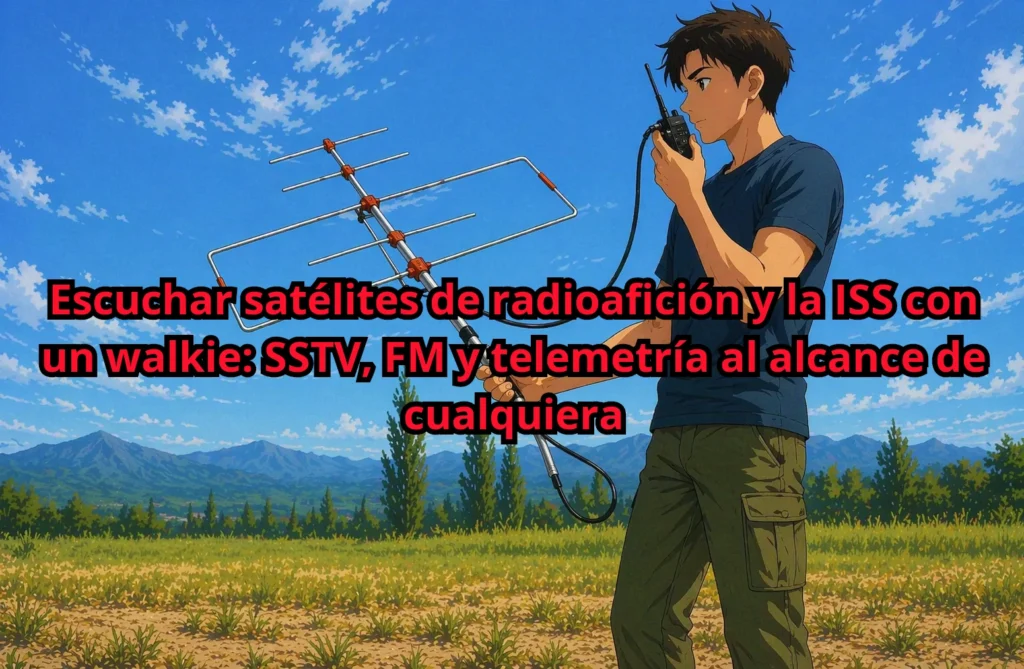
It’s a pleasure to share this article by Guillermo, EB2GGT, one of those people who, over the last few years, has passed on to me that rare and valuable mix of excitement, curiosity and the urge to dive into the world of satellites.
And that takes real skill. Because knowing about radio is one thing, and being able to pass on the spark that pushes you to try, to listen and to look up at the sky holding an antenna is a very different one.
A text born from real experience and that fascination so many of us share with discovering that, with simple gear and a willingness to learn, the sky stops feeling so far away.
I hope this article shows you a fascinating side of amateur radio. And I hope it also stirs up enough curiosity that you want to head outside with your walkie, look up at the sky and start listening.
LITTLE SINGING BIRDS THAT CHARM THE SAILORS OF THE SATELLITE HERTZIAN WAVES LIKE BEAUTIFUL SIRENS.
Greetings, fellow hams. My name is Guillermo and I’ve been radio-crazy since the 90s, when I started on 27 MHz, with a diploma and licence since 1996 as EB2GGT. Yes, quite a few years now, but my real “awakening” happened not that long ago.
One of the sides of the hobby I enjoy most is satellite communications, both reciprocal ones (SAT contacts with other enthusiasts) and simply “passive” listening.
Where you simply wait and listen for these little artificial birds sitting up there, each with its own specific job, but which also have a HAM side where we can, amazingly, receive them, decode their transmissions and get beautiful images both in SSTV (Slow Scan TV) and in SSDV.
It’s very similar, but it’s no longer an analogue transmission, it’s a DIGITAL one.
These “nightingales” can also send us messages in CW (TELEGRAPHY, MORSE) and other digital transmissions carrying plenty of data about their components and their current status.
For example, their battery charge, temperature, the strength or power they transmit with, the signal strength their ground station receives from them, even the SWR of their transmitters, whether these or other functions are enabled… and so on, and so on.
Doesn’t it seem incredible that we, with so little gear and so little know-how, can receive, decode, see gorgeous images, know whether the little bird is “cold or hot”, running “low on energy” or “strong as a bull”, “hoarse” or singing like a full-voiced tenor?
I find it fascinating.
How my passion for amateur radio satellites began
In life there’s always something that strikes a chord and pulls you toward whatever caught your attention.
In my case it was a walk… yes, really, just a walk.
I knew the ISS (International Space Station) existed, and I also knew it communicated with amateur radio operators and sent images and so on, but I knew little else about its HAM side.
Anyone who already knows me knows that SSTV, especially sent from a “contraption” orbiting the Earth, still leaves me amazed to this day.
Anyway, let’s get to it, I tend to ramble, hehe.
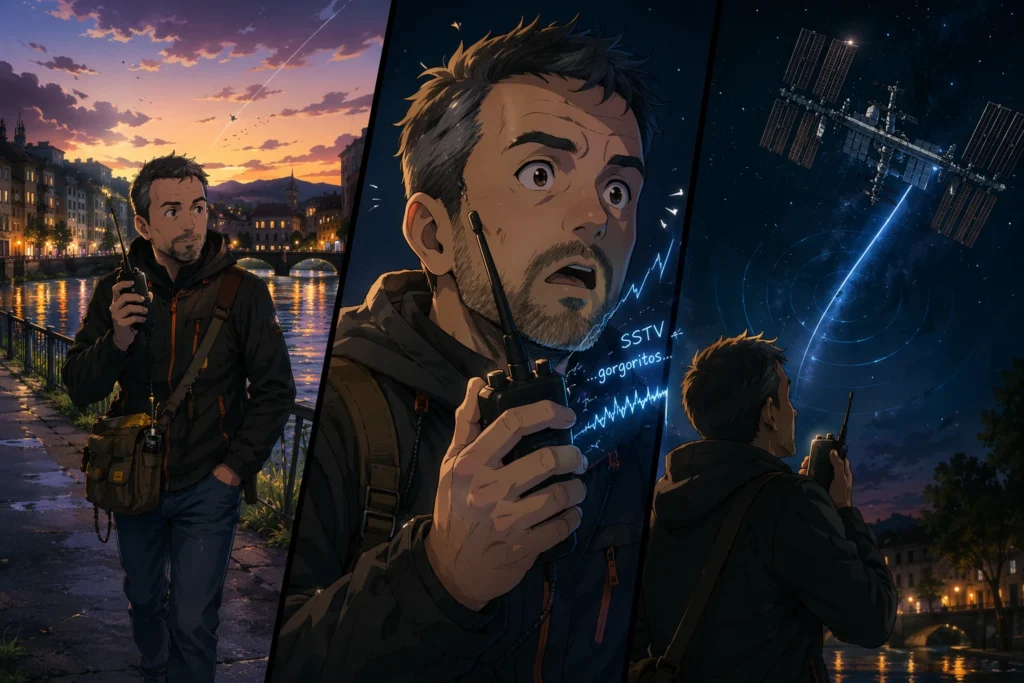
So one day I was out walking along the riverbank in my city (Pamplona) and, like a good radio nut, I had my VHF walkie talkie scanning, and one of the memorised frequencies happened to be exactly the ISS SSTV downlink frequency, which had been sitting in my walkie’s memory for ages, but I’d never heard anything on it.
And on that walk, BINGO, I start hearing the typical “warbling” of SSTV transmissions.
My mind went blank, I couldn’t believe it.
Then you start asking yourself questions and your brain kicks into gear: “I’m holding a walkie with its stock little antenna and I’m listening to the ISS???”.
And that’s exactly what it was.
So… if something this basic could pick up the ISS, then it would be within my “reach”, right?
I’d always thought that receiving the “little birds” would require an insane amount of technology and, in turn, an outrageous price tag — basically, you’d need a minister’s salary or you’d have to be a crook, which come to think of it amounts to the same thing, right? Hahaha.
From that moment on I started looking into it, and the excitement grew at the thought of actually being able to reach something that fascinated me and had seemed utopian, or at least out of reach.
Turns out I was very, very wrong.
Which amateur radio satellites you can listen to with modest gear
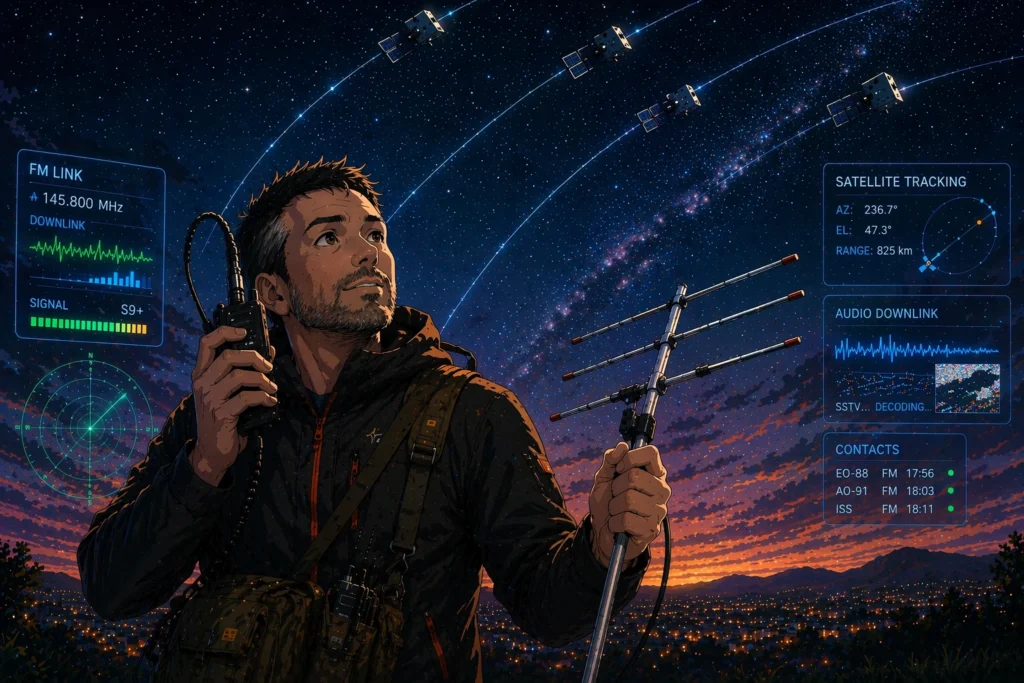
What kind of info do you need to “get started”?
Low-orbit satellites, the so-called LEO satellites, that transmit in FM
Which satellites can we actually listen to — and with many of them, even transmit and make our little contacts — using “conventional” gear at a very low cost?
Well, low-orbit satellites, the so-called LEO satellites, that transmit in FM.
Why? It’s very simple: who doesn’t have a VHF-UHF walkie talkie?
We already have a transceiver, so what do we need now? Well, an antenna… but which antenna?
For example, for the ISS, with just about any old stock antenna, as I mentioned above, you can actually receive it, but… it’s not the right tool for the job.
I always say a directional antenna. Which one? Well, there are hundreds of models and classes.
Are you handy and can you build your own? Sure, of course. In my case I started with a Moxon-yagi.
Actually, I’m lying — I started from the car, with the rig I carry in my car and a ⅝ antenna, but I don’t recommend it, even though at first you’ll get some results.
The results won’t be spectacular, but you would get your first contacts.
I don’t recommend it because, besides not being able to “operate at 100%”, you’ll end up bothering the rest of the community.
And you’ll think, why would I bother anyone?
Just think about it for a second… you’re going to try to make contacts in a mode where a conventional antenna isn’t the right tool.
Why isn’t it, if it’s still an antenna?
Yes, it’s an antenna that receives, but not with enough gain, and on top of that factors like polarisation come into play — a vertical antenna mounted on the car’s base doesn’t let you change polarisation, and at certain moments you won’t hear absolutely anything.
So you won’t hear a thing, and you’ll call anyway.
Your signal will probably reach the ISS just fine, because — even if you don’t realise it — you don’t need hundreds of watts to reach the ISS; 5 W is more than enough.
The result is that, since you can’t hear anything, you’ll start calling thinking you’re alone, and you’ll get in the way of, disrupt and override other stations that are making their own contacts — contacts you simply can’t hear.
Every amateur radio operator should get it into their head that being able to listen matters more than being heard all the way to Saturn.
Let’s see… what’s the point of pumping out watts like crazy and being heard from far away if I’m not even able to hear past my own nose?
I honestly don’t think it’s worth anything, do you?
Well, actually yes: filling the frequency with junk that won’t do you any good and bothering the rest of the community. Think about it!!!
Yes, I did it too, but I realised I wasn’t operating the way it should be done, and I stopped.
That’s why I’m telling you this — so you don’t make the same mistake, or at least so you know the trouble you could cause.
Homemade Moxon-yagi antenna for satellites
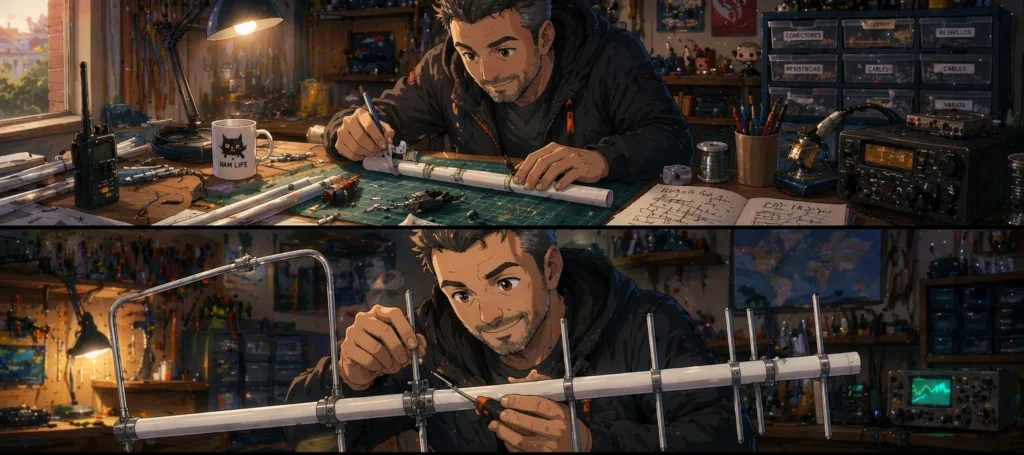
Did I buy an antenna and empty my wallet? Nope — I built myself a Moxon-yagi.
What is a Moxon-yagi?
This little antenna is suuuuuuuper easy to make and costs less thaaaaan… I’d say around 10 or 15 euros, no more, and it works wonderfully well.
It’s a directional antenna with a Moxon-type element for the VHF side and a yagi for the UHF side.
All of it built on a 20mm-diameter PVC boom, with a total length of 120cm.
The aluminium elements are rods no longer than about 30cm, 15cm on each side of the boom, except for the Moxon loop, which is 70cm on its longest side, 35cm on each side of the boom.
I’m giving you these measurements so you get an idea of its size and bulk.
The weight is a joke, if you build it with PVC pipe and aluminium rods.
If you build it with lead pipes, it’s a good way to fill your heart with lead — the hard way, hahahahaha.
If you’re not handy, or your time and lack of experience building this or a similar antenna don’t allow it, or you’re simply too lazy for your own good, hehe, all that’s left is to open your wallet — and yeah, it stings, it really does.
How to know when a satellite will pass overhead: day, time, path and pass duration
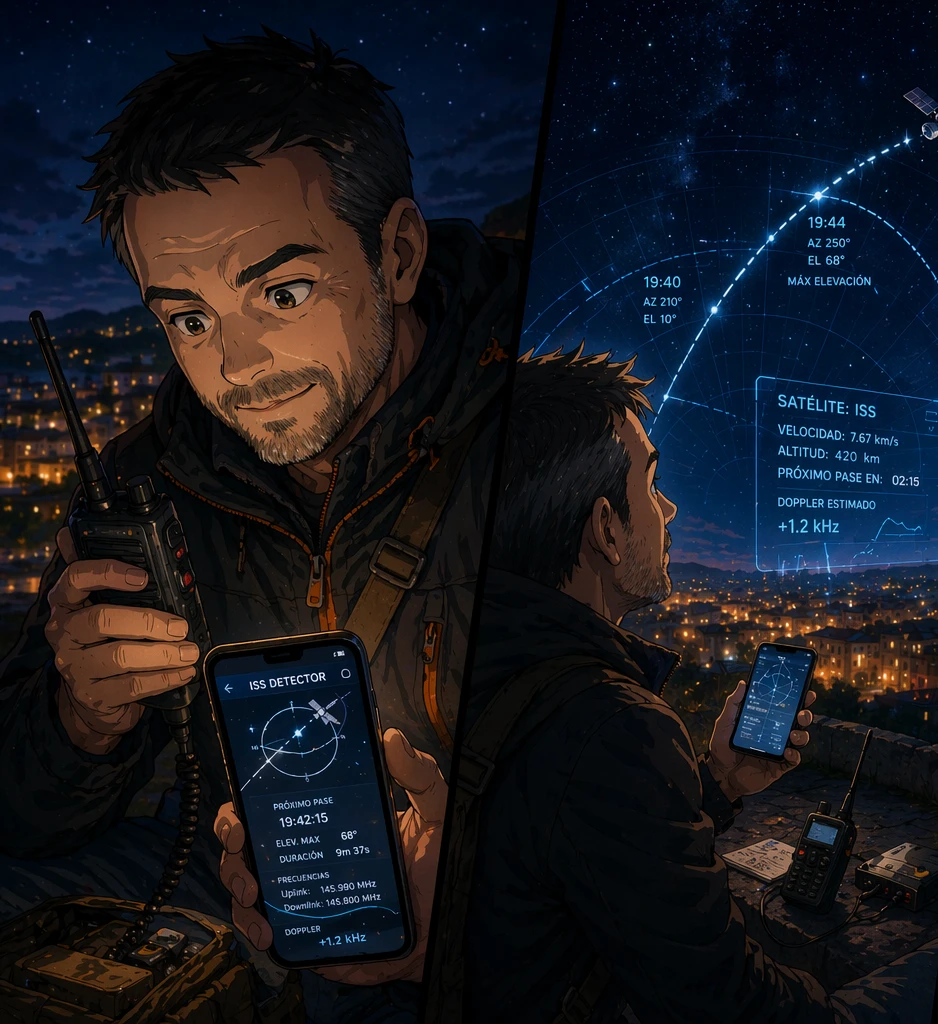
All satellites are tracked, and with data called TLEs you can know exactly where they are at every second, and when they’ll be within our coverage so we can contact them.
There are tons of programs, from Android apps like “ISS DETECTOR” or “LOOK4SAT”, to online programs and pages that give you that info, like the old “ORBITRON” — old but still fully functional — “GPREDICT”, “SATPC32” and many more.
Since I always operate portable, I use both “ISS DETECTOR” and “LOOK4SAT”.
They give you the info mentioned above, and some of them also tell you the doppler correction to apply — in some cases, with radios that have wireless connectivity, they can connect directly to the app, and the app itself corrects the doppler on the radio automatically.
It’s not strictly necessary, but it definitely helps.
I don’t use these “automations” myself.
Paying attention to how the satellite sounds, plus the experience I’ve built up along the way, tells me when I need to correct for doppler.
It’s true that sometimes it slips past you, and in an SSTV transmission, if you have to shift the doppler right before the “warbling” starts, in the middle of an image transmission, the audio starts to distort and you hear the “frequency drift” from the doppler effect — it can ruin an image you were always trying to get perfect.
It’s happened to me a few times through carelessness, and having a stripe ruin the image never feels good — yeah, it really stings.
(Alright, this is already touching on some small technicalities — the doppler effect — that I won’t explain right now; at the end I’ll say why I don’t want to get into these small technicalities just yet.)
Other modes to keep growing into satellites
Linear transponder satellites
Well, up to this point we could say this is the simplest and most affordable part.
It doesn’t require stuffing yourself with information either, to be able to operate both SAT FM contacts and SSTV reception — but there’s more, yes, yes, there’s more.
But other, more complete gear is also required, as is the case with linear transponder satellites.
Because, besides needing gear that can receive and transmit in SSB, these are no longer satellites with a single uplink frequency and a single downlink frequency.
Things get more complicated here, but complicated doesn’t mean impossible.
It’s about having the right gear for it and learning to move around that range — a frequency band wide enough to let more stations operate at the same time, in SSB, CW and even digital modes like FT4.
Tempting, isn’t it?
But first you have to crawl, then walk, and we’ll start running once we know how to stand on our own two feet.
Satellite telemetry
Another mode I personally love is catching telemetry.
Satellites transmit in “weird” modes, ones we’re not that used to hearing, right? AFSK, FSK, BPSK, QPSK, GMSK, etc., etc., and they transmit in bursts.
For example, the UMKA-1 satellite, a very active Russian SSTV satellite, transmits its telemetry in “GMSK USP 9K6”.
Every 30 seconds it sends a burst lasting a few milliseconds, but packed with a lot of info.
Sometimes it seems to be “chatting” with its ground station, and the bursts come more often — you hear them every 5 or 10 seconds.
It’s something I also find very appealing, but by this point you need a PC and some software.
To receive it, an SDR works best — there are some very affordable SDRs out there.
Then a program that acts as a modem, turning the audio the SDR receives into data, which another program — working together with the modem — later turns into readable, understandable data, called a decoder.
SSTV SAT
We also have SSTV SAT — the International Space Station’s transmissions in this mode are very, very well known.
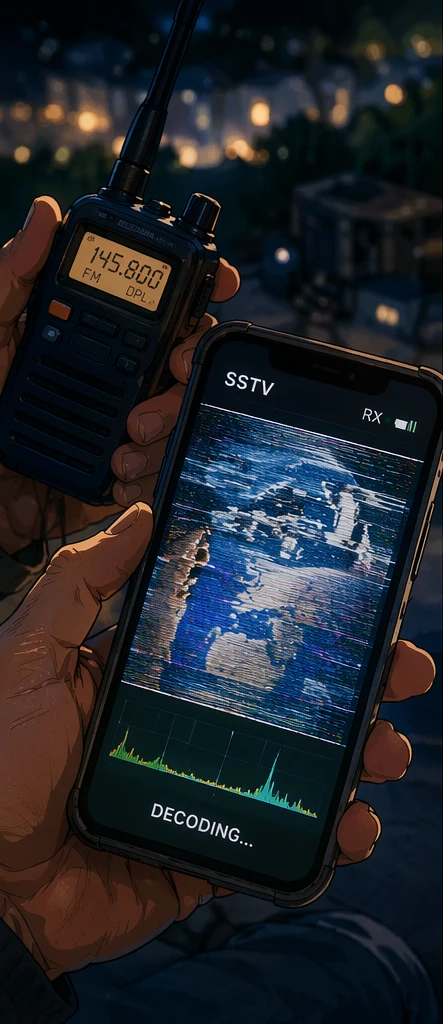
If you work portable, there’s an Android app, “ROBOT36”, that decodes the “warbling” into images.
It’s not just the ISS — there are many, many more satellites that transmit in this mode and delight us whenever they’re activated.
I love it!!!
A very easy and very affordable mode — all you need is a receiver and a “semi-smart” phone.
SSDV on satellites
Then there are the images, but in SSDV.
Now we move into the digital era, and there are only PC programs that can decode it, so you already need to carry a PC around with you.
One piece of software could be Radioconda, but that’s yet another fiddly little program you have to learn to use — but as the saying goes, if you want the fish you’ve got to get your feet wet, so you’ll just have to learn how to use it.
Actually, there’s already an app that works in a similar way to ROBOT36, but it’s very recent and it seems to only decode at 1200 baud.
The app’s settings let you set it to decode at 9600, which is what these satellites usually use, but it doesn’t work well.
The app is very new, and hopefully improved versions will come out.
It would be really, really — but really — great to be able to decode this type of image as easily as we do with ROBOT36 for SSTV.
I always work portable, with the antenna in one hand and, in the other hand, the phone to track the pass and decode the SSTV (in this case).
And as you can imagine… how on earth do I scratch my nose when the “nightingale is singing”?
That’s all for today
Well, I can’t think of anything else to add.
But hold on, there’s plenty of stuff, and plenty of ways to do it too.
But this wall of text I’ve written… which, by the way, I rewrote, scrapped, edited and corrected a hundred thousand times, because I kept bringing up topics and concepts that can choke you up and scare you off when you don’t already know them.
I don’t think that was the point of being asked to write this little article.
I hope I got it right and managed to motivate you.
As I was saying, this wall of text only aims to give you an idea of what’s possible, without dragging in technicalities or anything that might feel overwhelming.
The whole point was to strike a chord, get you excited, get you moving — to show you this isn’t just for engineers, hahaha.
Me, an engineer?
Even my own shadow laughs at that — no surprise there, it’s known me for a long time now, hahahaha.
At first, when you start getting into this stuff, everything seems complicated and makes you want to back off.
Noooooooo, wroooooong, push forward instead — and if people enjoy this and need more technical help, I promise to write a more detailed, more instructional piece.
Cheers, folks — see you around, hear you around, 73.