The Connected V16 Beacon in 2026: The Umpteenth Legal Scam on Spanish Drivers
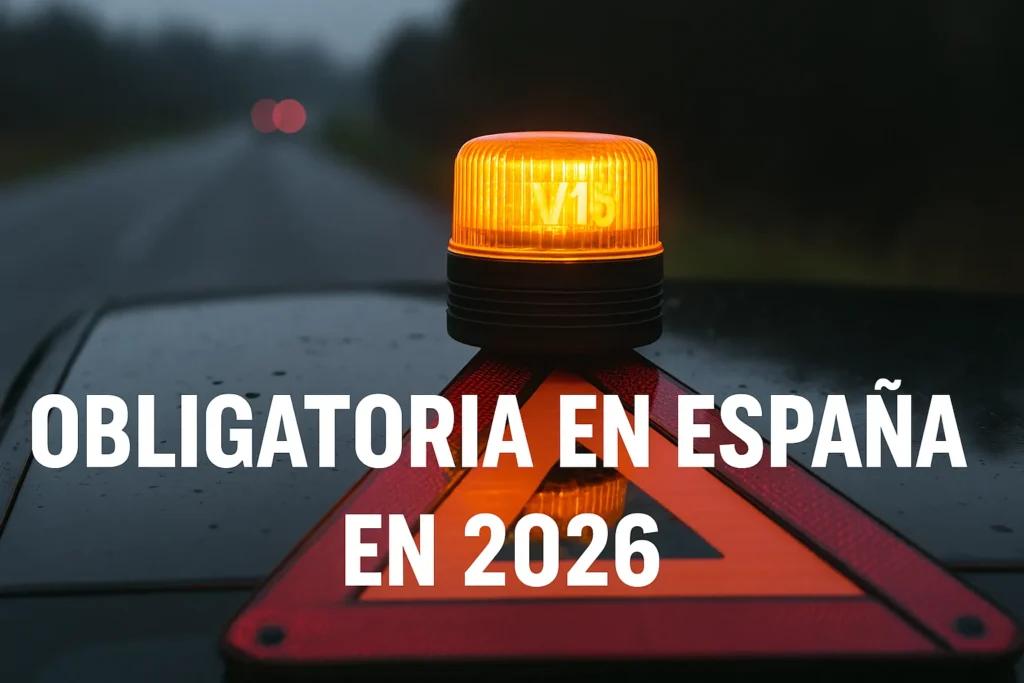
Sounds familiar, doesn’t it: first the reflective vest, then the warning triangles, then the V16 beacon, and now the connected V16 beacon.
That same beacon you bought “for your own safety” two years ago, the one Spain’s traffic authority (the DGT) sold as the big new thing, stops being valid on January 1, 2026.
Why? Because the government has decided that if the beacon isn’t connected to the DGT 3.0 platform, it doesn’t comply with the law.
And to top it off, they rushed through a last-minute decree exempting foreign drivers from having to use it, citing international treaties.
Result: the German driver keeps calmly using his triangles, while you, dear Spaniard, go buy another light so a ping can reach a server somewhere.
Spain, a pioneer in express reforms: today you buy it because it’s mandatory, tomorrow you throw it out because it’s no longer valid.
Timeline of the shell game
- 1999 → The General Vehicle Regulation (RD 2822/1998) makes warning triangles mandatory equipment.
- 2004 → The reflective vest becomes mandatory (RD 1428/2003). Another forced purchase for the trunk.
- July 1, 2021 → The non-connected V16 beacon is authorized as an alternative to triangles. The transition begins.
- July 1, 2023 → Triangles are no longer required on motorways and dual carriageways. Only on conventional roads.
- January 24, 2025 → The DGT issues an instruction to comply with international treaties: foreign vehicles can keep using their triangles.
- January 1, 2026 → Only the approved connected V16 beacon will be valid. The old V16 is now officially obsolete.
Sound familiar? Same as the anti-smoking law: first bars were forced to renovate to separate smokers from non-smokers (2006), and five years later it was all banned anyway.
Money down the drain, the rules changed, and a sense of being played.
Behind the scenes: who profits from the V16
The original idea came from two Civil Guard officers from Galicia, Jorge Costas and Jorge Torre, who created the Help Flash, a magnetic warning light that quickly caught on.
They patented the design, brought it to market, and from there the market evolved toward the connected version: a light that talks to the cloud.
That’s where operators like Vodafone and companies like Netun Solutions stepped in, managing the data and the connectivity.
Every connected V16 means type approval, servers, connectivity and maintenance: a nice, tidy business model.
What the law requires and how the connected beacon works
The connected V16 is an emergency light that flashes visibly up to a kilometer away, but with one mandatory extra: it has to send your real-time GPS position to the DGT 3.0 platform through the manufacturer’s server.
To be legal, it must:
- Comply with the MOV 3/2022 technical protocol set by the DGT.
- Guarantee 12 years of active connectivity.
- Be type-approved by labs such as LCOE or IDIADA.
- Clearly display its approval number on the casing.
If it doesn’t have a real connection, or if its server stops working, your beacon is no longer valid.
And yes, you’ll have to go buy another one.
Safety: what’s claimed, and what’s never been proven
The official argument is reducing the risk of being hit while getting out to place triangles.
Sounds logical, but there are no verifiable public studies showing that a connected beacon actually improves road safety.
The DGT talks about “visibility” and “faster alerts,” but it hasn’t published any comparative data between connected beacons, non-connected beacons, and triangles.
In reality, the factor that saves lives is not getting out of the car — not so much whether your light is chatting with a remote server.
So the claim of “more safety” is, for now, a promise with no evidence behind it.
Visiting Europeans: open bar
Thanks to the Vienna Convention on Road Traffic, Spain can’t impose extra technical requirements on foreign vehicles.
That’s why the DGT had to rush out an urgent instruction in 2025 clarifying that tourists can keep using their triangles.
Translation:
- A French driver can drive in Spain with triangles.
- A Spanish driver can’t drive in Spain with triangles.
International sucker status: expert level.
But cars are already “connected”
Since 2018, every new car sold in the EU includes the eCall 112 system, which sends the vehicle’s location and automatically places an emergency call in the event of a serious crash.
In other words, emergency connectivity already exists.
There are also private apps and systems that do the same thing without forcing you to buy yet another piece of plastic with an antenna.
The difference here is that this connectivity isn’t optional: it’s imposed by decree, and you’re the one paying for it.
Europe is sticking with its triangles
While here we’re arguing over whether our beacon needs a SIM card or 5G, the rest of Europe is still using triangles.
Neither Germany, nor France, nor Italy, nor the UK has any plans for a mandatory connected beacon.
So if you drive abroad, you’ll need to carry triangles again.
Safety or business — you decide
Twenty years of “road modernization” could fill a dark comedy novel:
- Vest (2004)
- Triangles (1999)
- V16 beacon (2021)
- Connected V16 beacon (2026)
Every change comes with its own forced purchase, its own legal expiration date, and its own dose of propaganda about “safety and progress.”
The reality: a chain of improvised decrees that benefit manufacturers and connectivity operators.
Road safety deserves respect, but not at the cost of squeezing citizens every couple of years.
Are we really safer… or just more obedient?