Your first amateur radio rig
Your first amateur radio rig
All of HF in the palm of your hand

When you get your amateur radio licence there’s a strange mix of excitement and vertigo.
Suddenly you can do all sorts of things… but you’re not quite sure where to start.
And if you start looking around, reading forums, Telegram groups or listening to conversations, the feeling is almost always the same:
rooftop towers, impossible antennas, expensive gear, a pile of costly accessories, and the more or less explicit idea that if you don’t come in like that, you’re not really coming in.
I want to suggest exactly the opposite.
A way to start from the minimum, the most basic, without stress, without pressure and without unnecessary complications.
A way of doing radio that doesn’t intimidate, that invites you to learn and, above all, that fits every budget.
There’s no single correct way to start in amateur radio
Amateur radio is so vast that there’s no single truth.
Some people enjoy extreme DX, some chase awards, some tinker, some program, some experiment with propagation, some barely talk on air… and some prefer to just listen a lot.
Never let anyone tell you what counts as “real” radio and what doesn’t.
What radio means to you is your call.
And this matters especially right after you get your licence.
It’s that moment when you want to try everything, when a thousand different paths pull at you and you’re not quite sure where to start, or which ones you’ll actually end up enjoying most.
CB as a natural entry point
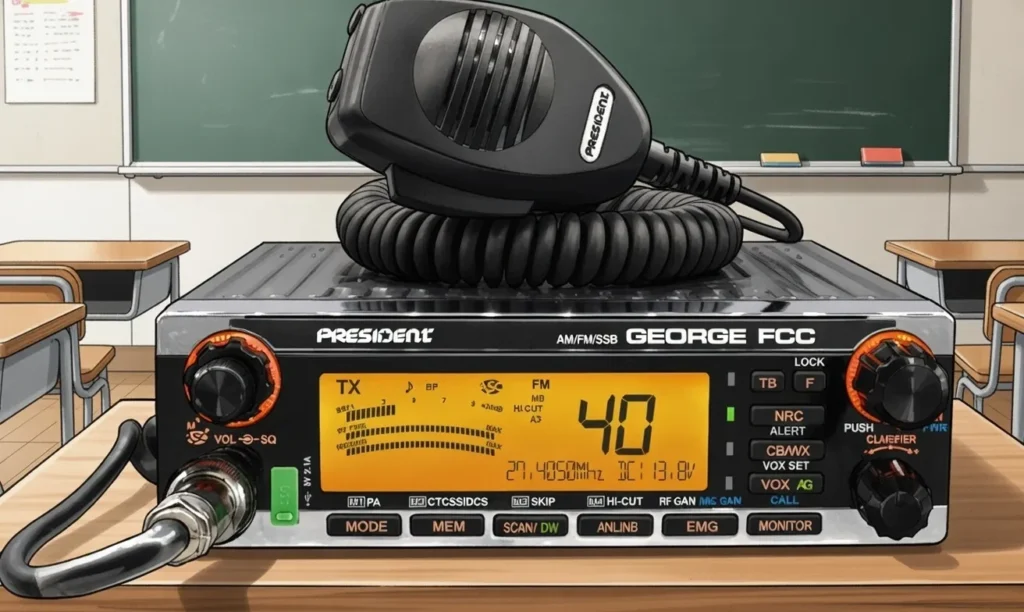
Before I ever thought about HF as a licensed amateur, I spent a good while just on 11 metres.
And the more time goes by, the clearer it gets to me: CB is a brutal school.
Real HF, propagation, antennas, SWR, tuning, contests, activations, experimentation…
All without pressure, without complexes and without needing a licence.
By the time I finally got my callsign — a bit like when the vet tags a cow’s ear — I already had a pretty good idea of what drew me to this world… and what didn’t.
The exact moment the HF itch hit me
As a licensed amateur, when I’m on air and propagation allows it, my favourite playground is still 11 metres.
Add 10 metres, where I can get on air with the same gear, and a €25 Quansheng to mess around with APRS and satellites, and for a good while I felt no real need to get on any other band.
The itch for a full HF rig came from one very specific reason.
Fellow hams from District 1 were activating with a special EG callsign.
I was right there, listening, following the activity… and I couldn’t take part.
That’s when I thought:
I need an HF rig, even a simple one.
My plans were modest. A second-hand Yaesu FT-747, one of those that could be found for a bit over €200 a few years back. But the market had gone completely wild. I like old gear, sure… but not paying more than it cost when it was new.
So I set myself a clear limit: an FT-891 as a self-gift for Epiphany.
An unexpected gift

A few days before Christmas, when I’d more or less settled on what my next step in radio would be, one of those unexpected things nobody wants — but that don’t leave room for argument — showed up at home.
The piggy bank emptied out overnight.
And it was time to start saving all over again.
The HF rig could wait. No big deal. Radio has always involved a bit of knowing how to wait.
So when a package arrived on January 7th from somewhere on the mainland — not from the Far East, but from right here — I wasn’t expecting anything like it.
Inside was a note, a box, and something wrapped in bubble wrap.
I won’t tell you exactly what the note said, but it ended with a simple: “Hope you enjoy it a lot, my friend”.
First I pulled out the box.
A multiband handheld, with all its accessories. Perfect for testing, experimenting and tinkering without worry.
Then there was still the bubble wrap.
Unrolling it, turn after turn, I started to make out the shape.
It looked like a big SDR receiver.
And when it was finally uncovered…
that’s when it really caught me off guard.
It was a uSDX, one of the first ones that became popular.
A gift I treasure a lot.
For who it came from.
For when it arrived.
And for exactly what it meant at that specific moment.
The uSDX as a first amateur radio rig
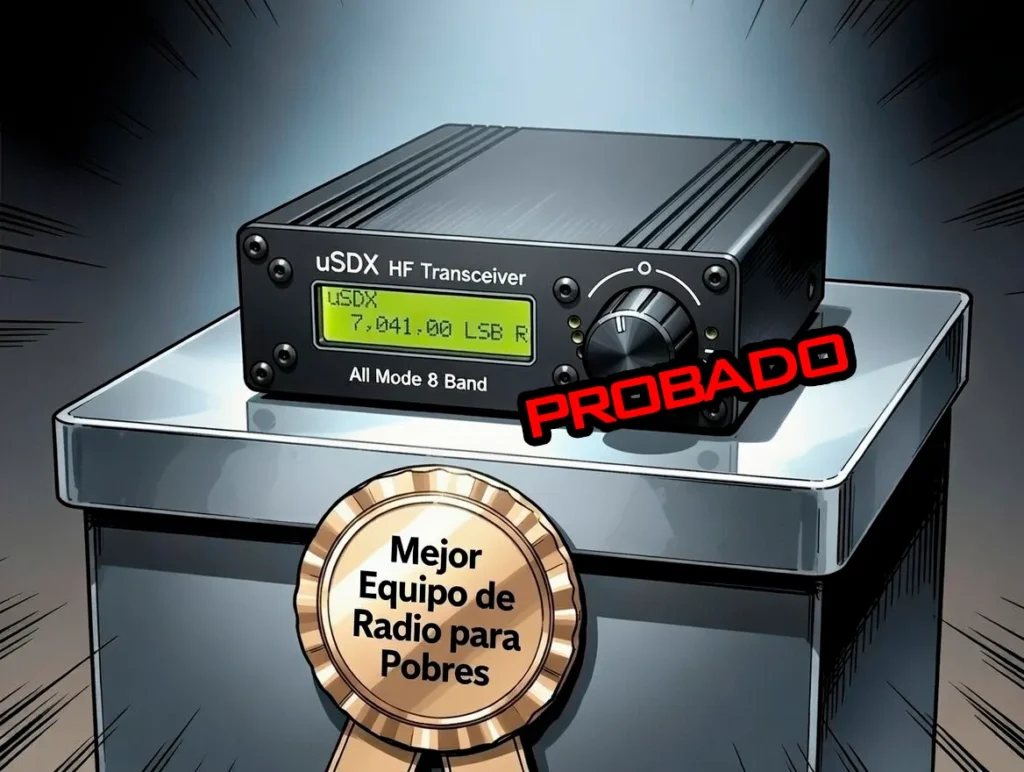
Let me be very clear here.
The uSDX isn’t a “perfect” rig, nor is it for everyone.
But as a first amateur radio rig, for a lot of people, it makes an extraordinary amount of sense.
Especially for:
- Tight budgets.
- Anyone who can’t set up a classic fixed station.
- Anyone who still isn’t sure which direction to take in amateur radio.
- Anyone who wants to learn how radio actually works, not just log contacts.
- Tinkerers, makers and technically curious minds.
Full HF, and a direct relationship between power, antenna and propagation.
Don’t be fooled by what people say about the uSDX
I actually considered buying a uSDX myself, back in the day.
And I didn’t.
Why? Because if you read or watch content about it online, you end up scared off:
that reception sounds awful, that TX audio distorts badly, that it’s a poorly built mess…
There’s a lot of confusion around this rig.
There are many different models, revisions and clones, and not all of them perform the same. Lumping them all together is a mistake.
The reality is much simpler than that:
with a bit of care and an understanding of their limitations, these little gadgets can perform really well.
It’s not a plug-and-forget rig.
It’s a rig for tinkering, adjusting, testing and learning.
And that’s exactly why, for a certain kind of amateur, it makes a lot of sense as a first rig.
Not giving up on the SDR experience
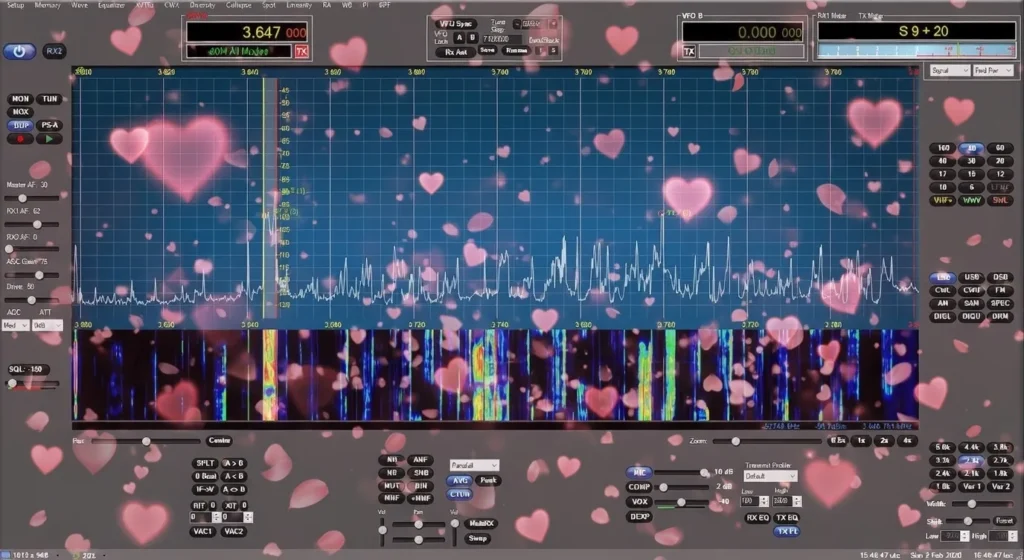
I like operating in SDR.
Even though I don’t own a proper SDR rig.
I like seeing what’s actually happening, not just imagining it.
I like handling the audio, tuning it, understanding why a signal comes in clean or goes out bad.
I like having control, not turning knobs blindly and hoping for the best.
If the hardware is limited, ingenuity doesn’t have to be.
So I did what amateur radio operators have always done when something doesn’t quite fit:
I started tinkering.
That’s how PoorSDR4All was born.
PoorSDR4All as a natural extension of the uSDX

PoorSDR4All is the solution I built to extend and improve the uSDX’s capabilities using the computer as support, until it delivers an operating experience closer to much more complete rigs.
It doesn’t replace the uSDX.
It doesn’t turn it into something it’s not.
What it does is add everything the hardware can’t offer on its own:
comfortable control, advanced audio handling and a clear view of the spectrum.
The result is a station that, while modest, behaves like something far more serious than it looks.
Control and precision where it matters most
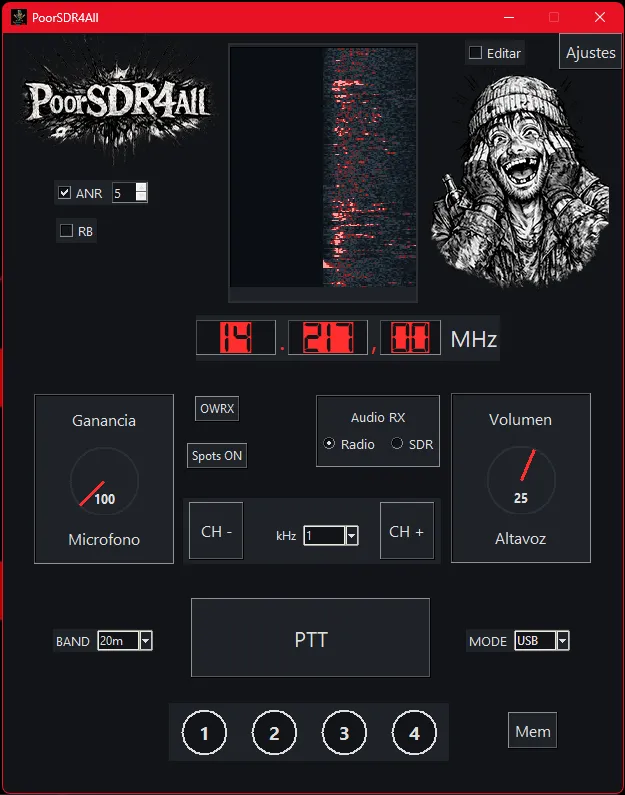
Through PoorSDR4All I control the uSDX directly over CAT: frequency, mode, PTT, bands and tuning steps.
Editing the frequency from the keyboard, with real precision down to MHz, kHz and Hz, and having the change apply instantly, makes a huge difference when you’re operating on HF with little margin for error.
It’s not flashy.
It’s efficient.
And that, in the end, is what makes you operate as if you had a rig in a whole different class.
Audio treated the way it deserves
Another of the uSDX’s big limitations out of the box is how it handles audio.
This is where the solution makes even more sense.
With PoorSDR4All I manage the whole audio chain from the PC: receive, transmit and levels, with configurable ANR to clean up noise in tough conditions, plus the ability to customise details like the roger beep.
This doesn’t improve the radio “just because”.
It improves how I hear and how I’m heard, which is exactly what matters.
Seeing the band changes the way you operate

Integrating OpenWebRX+ into the workflow is probably the point where the step up becomes most obvious.
Going from operating almost blind to seeing the waterfall, the frequency scale and the activity around you completely changes how you decide where to call, when to keep trying, and when to move on.
This is where a simple rig starts playing with an advantage, because you’re making decisions with information you’d normally only get on much more expensive SDR rigs.
Cutting friction to operate better
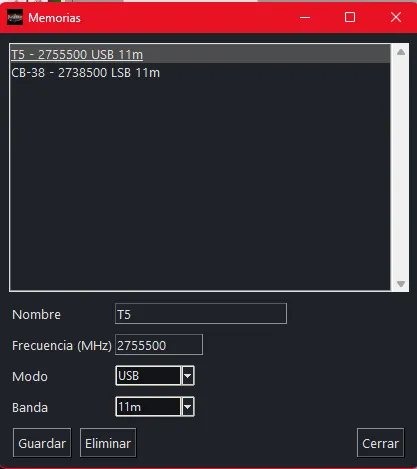
PoorSDR4All also lets me use memories, calling macros and keyboard shortcuts for repetitive tasks.
Not to automate the radio or turn it into something artificial, but to cut friction: fewer clicks, fewer distractions, and more attention on what’s actually happening on the band.
You set it all up once, and then it disappears from your mind.
The tool becomes invisible, which is exactly how it should be.
With patience and a little spit, even the impossible gets done
Over time you find your own place, trying some things and dropping others.
No rush. Without comparing yourself too much. A hobby made for the long game.
In my case, today the station is simple.
A uSDX.
A modest balcony antenna.
A computer next to it.
And with that, I do radio. My way.
Some will say it’s not enough.
Some will prefer other paths.
I keep enjoying squeezing the most out of what little I have, understanding what’s going on, and learning something new every time I switch the rig on.
No shame.
No hang-ups.
And no need to show off.