What is a subtone in a walkie (CTCSS and DCS) and how it works in PMR and amateur radio
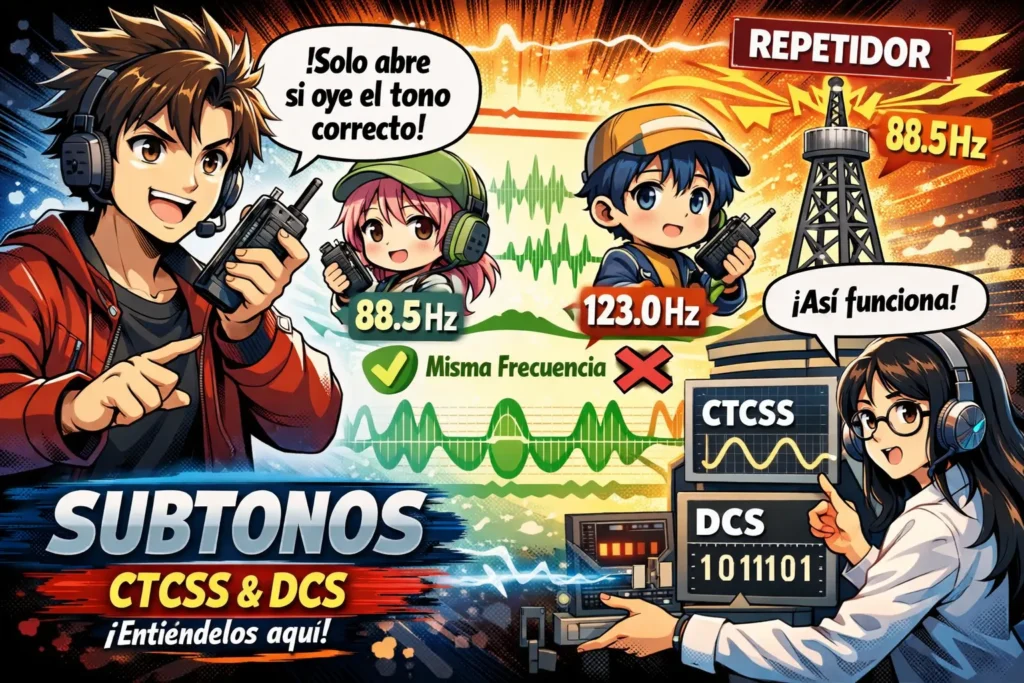
If you have a walkie in your hand, sooner or later you encounter this:
CTCSS.
DCS.
Subtone.
Subchannel.
Another adjustment inside the menu.
You activate it because they tell you it is better.
Because “so nobody gets in”.
Because “you are on your channel”.
And you continue using the equipment.
Today we stop there.
I will explain exactly what a subtone is.
What your equipment does when you activate it.
What really changes in PMR.
And why in most amateur repeaters it is not optional, but an essential part of the system.
Origin of technical content
The technical base used in this article proceeds from the work of
Fernando Fernández de Villegas (EB3EMD).
My thanks for the original material published on his blog, which has served as technical reference for the development of this content.
What is a subtone
A subtone does not create a new channel.
It does not change the frequency.
It does not encrypt the communication.
It does not reduce power.
You continue transmitting exactly on the same frequency as any other station that is in that channel.
The only thing that changes is an internal condition in your receiver.
A subtone is a system of selective squelch.
That is: a mechanism that decides when the speaker opens.
Nothing more.
But that “nothing more” is key.
How the normal squelch works (without subtone)
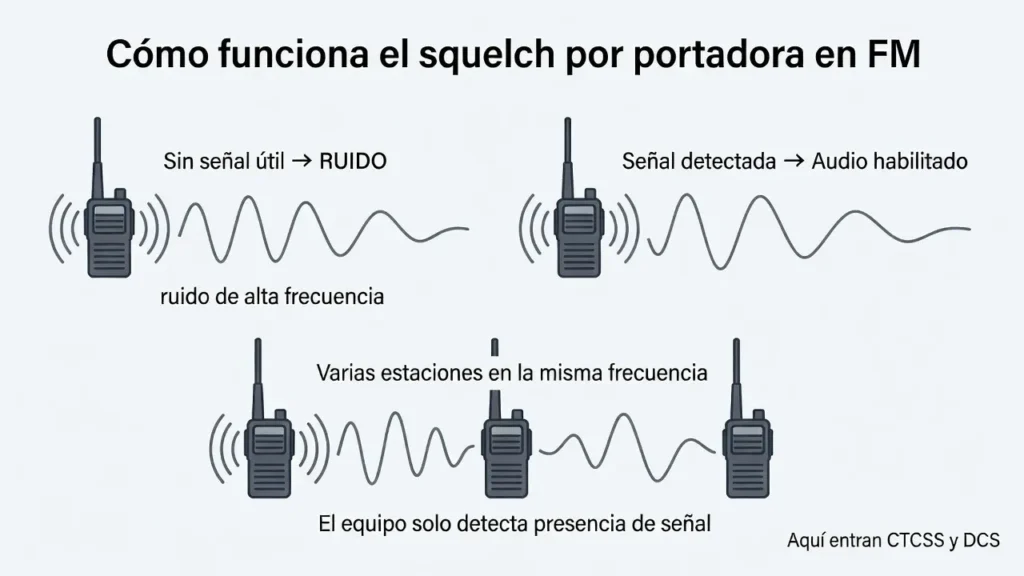
In FM, when there is no useful signal, the discriminator delivers high-frequency noise.
When a valid signal appears:
- The noise level drops.
- The circuit detects it.
- Audio is enabled.
That is carrier squelch.
It works correctly while the channel is clear.
But if several stations share frequency, the receiver will open with any of them.
The equipment does not know how to distinguish.
It only detects signal presence.
That is where coded systems come in.
What is CTCSS and how it works internally
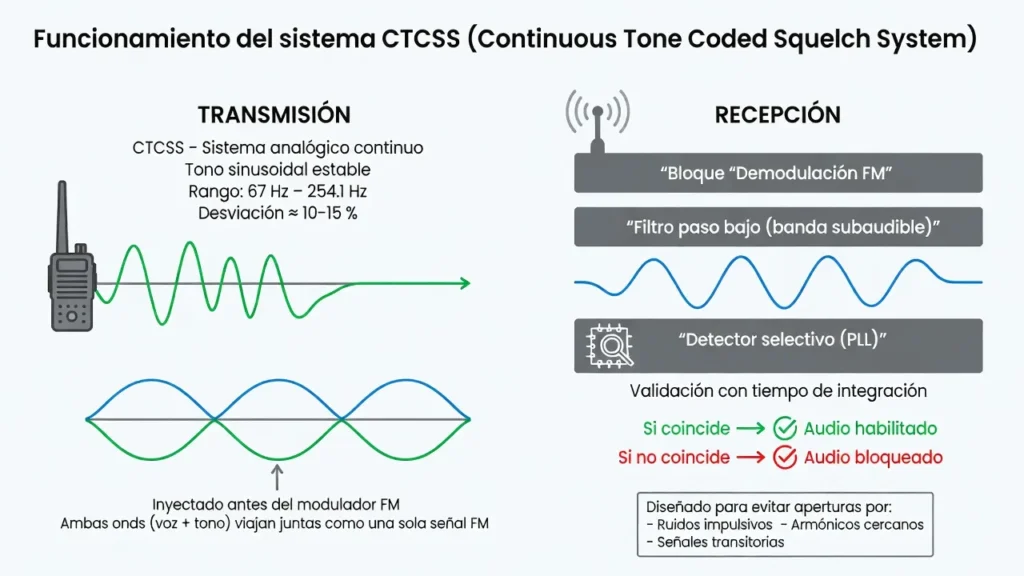
CTCSS means Continuous Tone Coded Squelch System.
It is a continuous analog system.
When you transmit with CTCSS activated:
- A stable sinusoidal tone is generated.
- Usual range: 67 Hz to 254.1 Hz.
- It is injected before the FM modulator.
- Its deviation level usually stays around 10-15% of the allowed total deviation.
That tone travels along with the voice.
In reception the following occurs:
- The FM signal is demodulated.
- Audio passes through a specific low-pass filter to isolate the sub-audible band.
- A selective detector (normally based on PLL or high-selectivity active filters) analyzes the received frequency.
- If it matches the programmed one and remains stable during a minimum integration time, the audio circuit is enabled.
That validation time avoids:
- Openings due to impulsive noises.
- Nearby harmonics.
- Transient signals.
It is not instantaneous because it cannot be one.
It is designed to be robust.
What is DCS and what changes compared to CTCSS
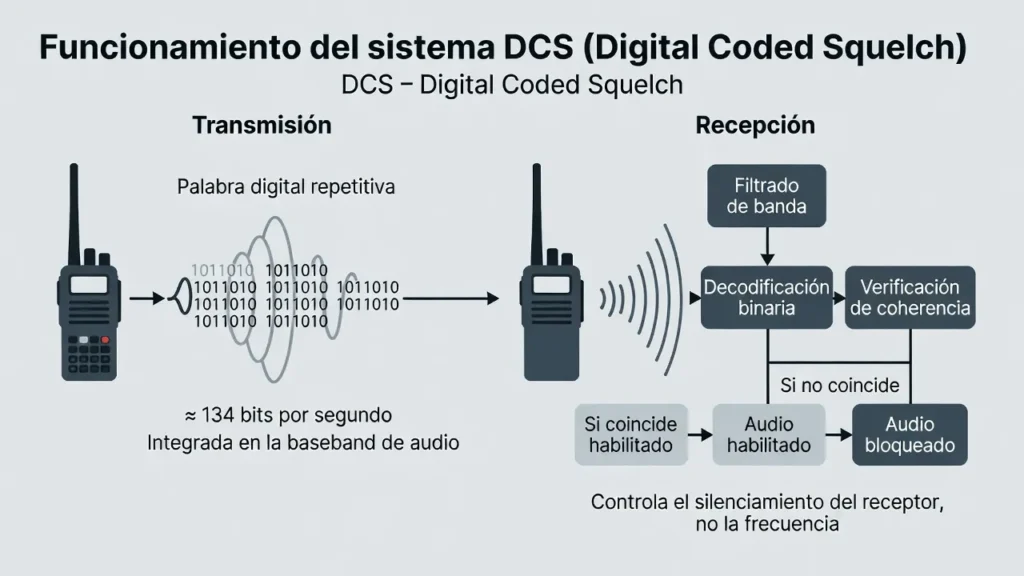
DCS (Digital Coded Squelch) fulfills the same function, but using digital signaling.
Instead of a continuous sinusoidal tone:
- A repetitive digital word is transmitted.
- Approximate speed: 134 bits per second.
- Integrated into the audio baseband.
The receiver:
- Filters the corresponding band.
- Decodes the binary pattern.
- Verifies coherence and repetition.
- Only then does audio open.
DCS offers:
- Greater number of combinations.
- Lower probability of false activations.
- Better immunity against certain noisy environments.
But the principle does not change:
It controls receiver muting.
Not the frequency.
How subtone behaviors in PMR
In PMR446 everyone shares fixed frequencies.
If you are on channel 3 and another group also, you are physically on the same frequency.
Example:
Group A -> Channel 3 + 88.5 Hz
Group B -> Channel 3 + 123.0 Hz
Both transmit on the same frequency.
The signals mix in the air.
The difference is that your receiver only opens if it detects its configured tone.
That’s why the channel seems clear.
But it is not.
If you remove the subtone in reception and leave carrier squelch, you will hear everything that is really happening on that frequency.
The subtone does not create physical isolation.
It creates listening filtering.
What happens if two signals enter at the same time
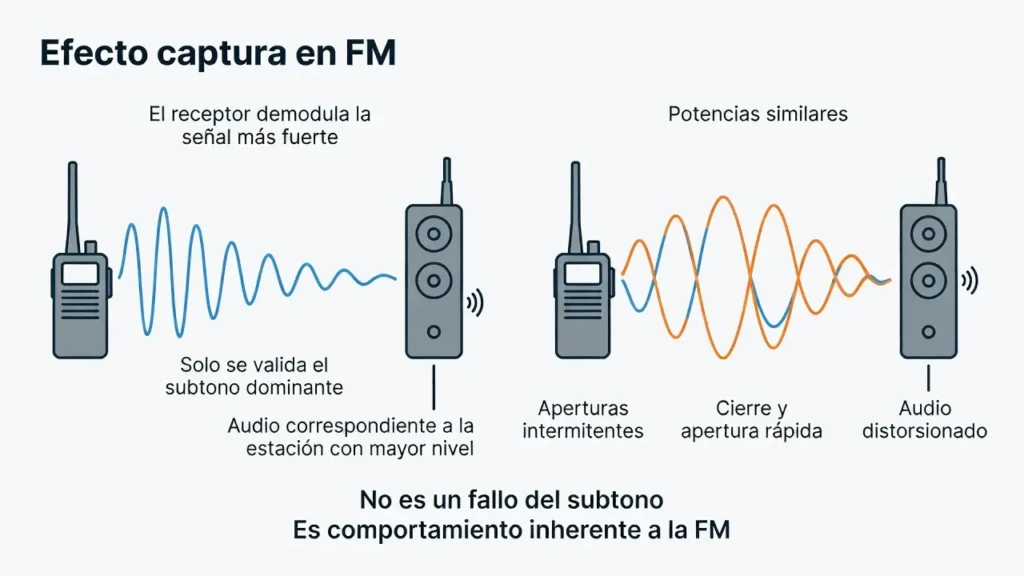
Here comes in the physics of FM.
In FM the capture effect occurs:
The receiver will tend to demodulate the stronger signal when two carriers are present simultaneously.
If both carry different subtone tones:
- Only the dominant signal’s tone will be validated.
- The audio will correspond to the station with higher received level.
If power is similar, unstable effects can occur:
- Intermittent openings.
- Closing and rapid opening.
- Distorted audio.
This is not a failure of the subtone.
It is inherent behavior to the FM system.
Subtones in amateur repeaters
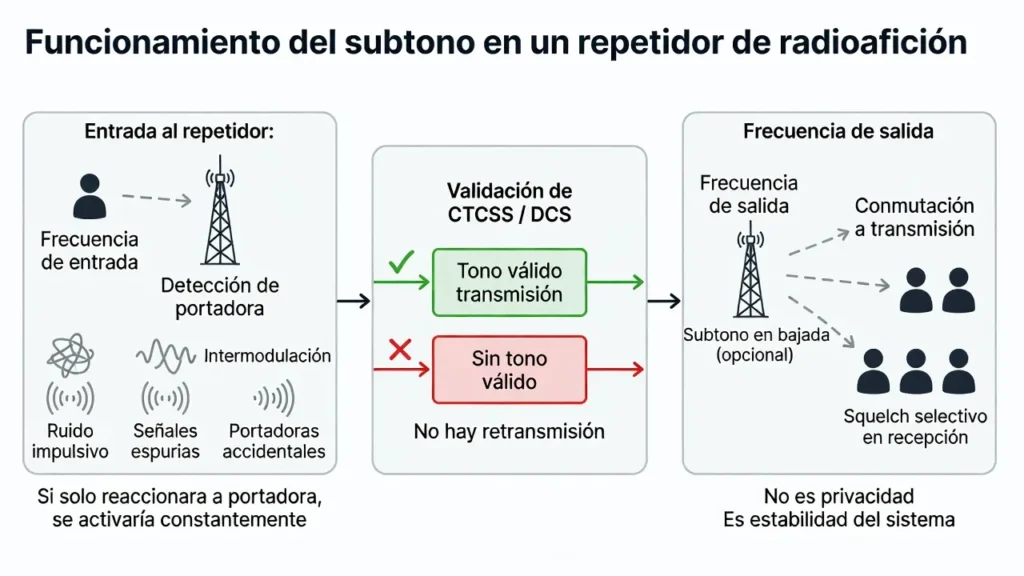
In a repeater the subtone ceases to be optional.
The repeater is permanently listening on its input frequency.
If it only reacted to carrier:
- Impulsive noise.
- Intermodulation.
- Spurious signals.
- Accidental carriers.
It would activate them constantly.
That is why an access tone is required.
Real functioning sequence:
- Carrier detection on the input frequency.
- Validation of configured CTCSS or DCS.
- Switching to transmission on the output frequency.
Without valid tone, there is no retransmission.
Some repeaters additionally transmit subtone on downlink.
Why?
So that users can apply selective squelch in reception and avoid hearing residual noise when the input signal disappears.
It is not privacy.
It is system stability.
Real problems that can appear
There are several critical technical factors:
Incorrect tone level
If the deviation of the subtone is too low:
- It may not be detected in weak signals.
If it is too high:
- It can degrade audio quality.
- It can affect modulation linearity.
Marginal signals
In weak signals:
- The carrier can be detected before the tone.
- The receiver may take time to open.
- Intermittent opening and closing can occur.
DCS and synchronization
If the digital stream loses coherence:
- The receiver can close audio even if the carrier remains present.
Intermodulation
In environments with strong signals:
- Components that simulate nearby frequencies can be generated.
- A deficient design can cause false openings.
Nothing of this is visible from the menu.
But it is happening in every transmission.
Subtones do not give privacy
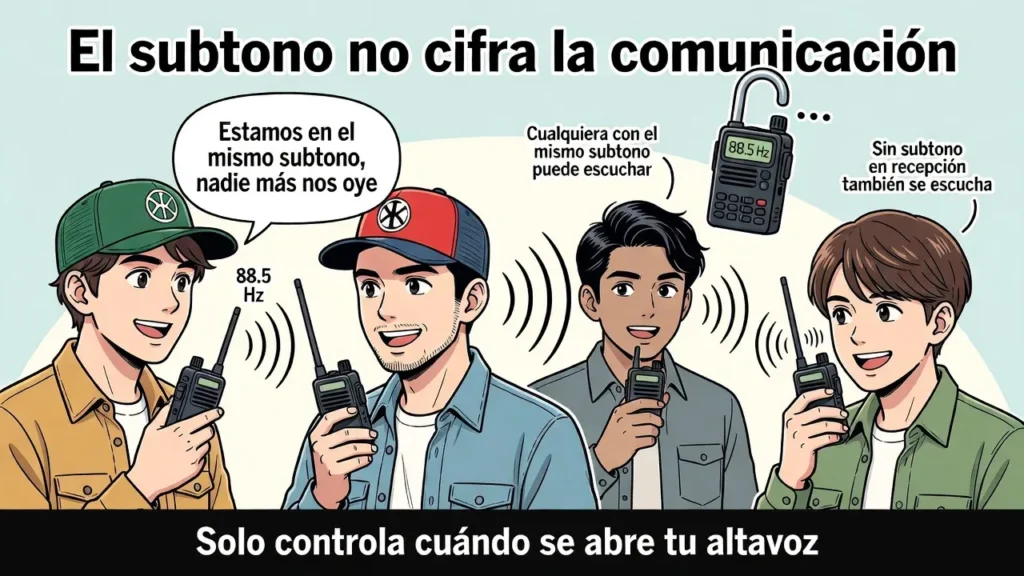
If you transmit with 88.5 Hz:
Anyone who programs 88.5 Hz will hear you.
Anyone who removes the subtone in reception too.
The silence in your equipment does not mean that the channel is empty.
It means your receiver is filtering what does not match its criteria.
And that difference completely changes the interpretation of what happens in the band.
What changes when you understand this
When you understand how subtone systems work:
You stop thinking in “subchannels”.
You start to think about:
- Detection.
- Validation.
- Temporal integration.
- Audio control.
You start to understand that the walkie menu is not an ornament.
It is the interface of a selective signaling system.
And when you understand that, you no longer use the equipment by repetition.
You use it with criteria.
That is what marks the difference between simply talking on the radio… and understanding the radio.