Who controls the electromagnetic spectrum?
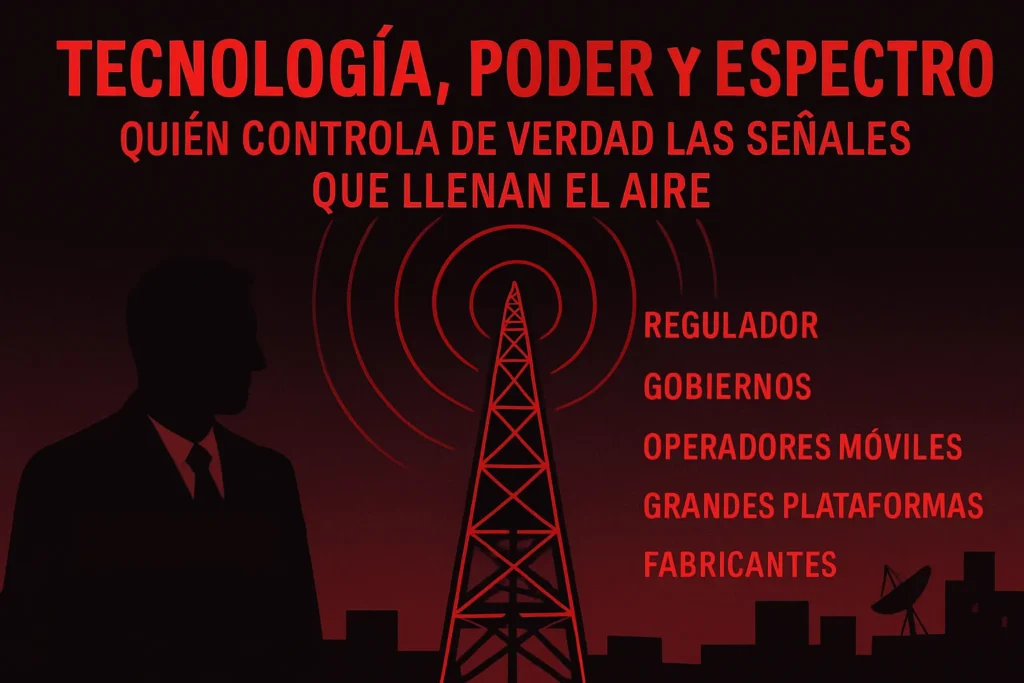
At first glance, the air seems a simple site: birds, planes, pollen, and your WiFi waves sneaking around there.
But none of that is as free as you think.
The electromagnetic spectrum—that invisible space through which your WhatsApp, Digital TV (TDT), 5G, maritime beacons and your SDR signals travel—is so regulated that sometimes it seems like a building with more doors than neighbors.
And like everything that seems simple, behind there is a power ecosystem: governments, regulators, corporations, international organizations, manufacturers…
All putting their hand in that natural resource which, in theory, “is everyone’s”.
Today we will walk through that building frequency by frequency.
Come with me; the gatekeeper puts it (the door).
1. The ITU-R — The global gatekeeper of the building of waves
On the ground floor is the International Telecommunication Union (ITU), the world arbiter that decides what can be done in each band.
The Radio Regulations they maintain is an international treaty that all countries sign and must comply with.
Every few years, at the World Radiocommunications Conferences (WRC), countries renegotiate the global distribution.
Nothing is definitive in this board.
The ITU does not build antennas nor gives licenses, but defines the plan of the electromagnetic city.
Without that plan, everything would clash with everything.
2. The Spanish State — Legal owner of the air
We go up to the floor of the State.
In Spain, the spectrum is declared state public domain, according to the Telecommunications Law 9/2014.
That means you cannot set up your home transmitter at 2 kW because you feel like it.
The State distributes the spectrum as it distributes plots: with order, papers and licenses.
That enters the National Frequency Allocation Board (CNAF).
It is basically the road map of the air: which band serves for mobile, which for satellites, which for emergencies…
It is the ground floor where we will see all other actors move.
3. Regulators — The guardians who prevent the invisible chaos
Higher up is the team that watches that everything works, and I am not referring to those radio police everyone knows:
the State Secretariat of Telecommunications and Digital Infrastructure (SETELECO).
They inspect, sanction, review interferences, measure powers, authorize stations and give permits.
Like someone watching that neighbors do not drill at 3 in the morning, but here we talk about signals of 800 MHz crossing with others of 5 GHz.
They divide the uses of the spectrum into three groups:
- Private: mobile, TV, defense…
- Special: amateur radio operators, research…
- Common: WiFi, Bluetooth…
If a service invades the band of another, regulators act.
Although you don’t see them, interferences are as real as a hammer on the adjacent wall.
4. Operators — The ones who raise the city of antennas
We arrive at the high floors, where live those who really move traffic: the operators.
They are not owners of the spectrum, but pay millions in auctions to rent it and then build the real network: towers, repeaters, fiber, 5G stations.
You see a coverage bar.
They see money, obligations, maintenance, regulations and mountains of permits.
The fever of 5G — the auctions of the century
Band 3.5 GHz
It is the main highway of 5G.
Starting from 2018 blocks of this band were auctioned, key piece for advanced mobile services.
Band 700 MHz
The crown jewel: it goes far, crosses walls and covers rural areas.
But it was occupied by the TV.
Result: channel reorganization, national retuning and goodbye to the old TV in that band.
Nothing of this exists without the operators.
The governments distribute bands, but those who make reality the connection are them.
5. Manufacturers — The ones who decide which bands exist in your mobile
The State can open a band, but if your mobile does not support it…
for you it does not exist.
Each router, base station or smartphone must comply with technical regulations of electromagnetic equipment: electromagnetic compatibility, powers and allowed bands.
Here the power is silent: the manufacturer chooses which bands to support and which not.
And that affects millions of users without anyone protesting, because they don’t even know.
6. Platforms — The ones who influence without touching a single antenna
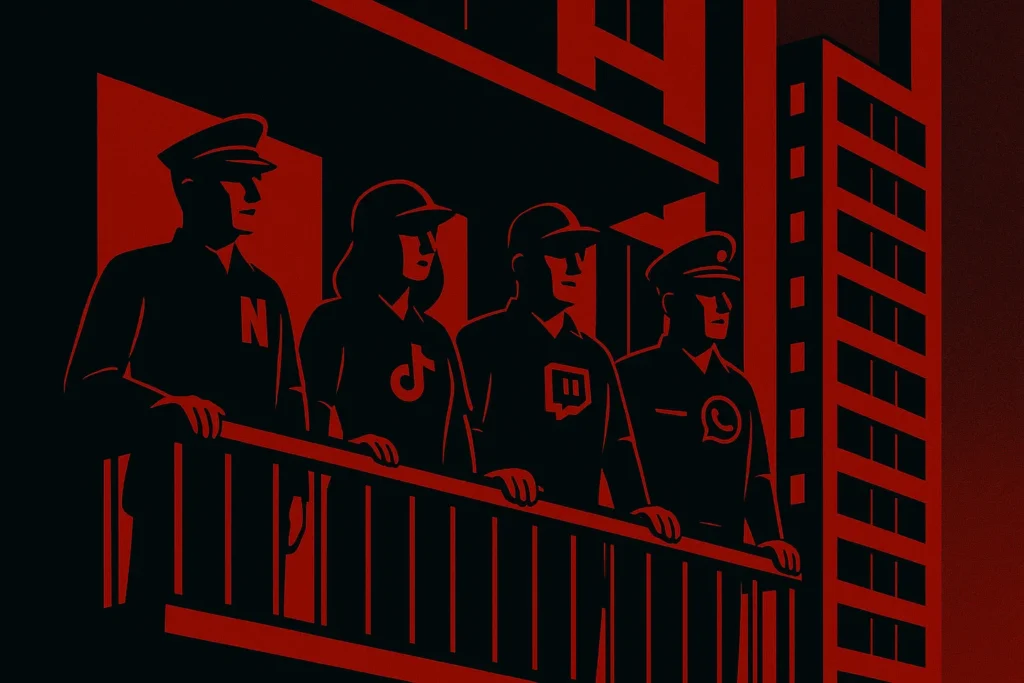
Then there are the big players of traffic: TikTok, Netflix, Twitch, WhatsApp.
They do not manage spectrum, but they mold it.
When they change the habits —more video, more streaming, more online games— regulators see themselves obliged to reallocate band, open new frequencies or push denser networks.
They do not touch even a wire, but they move the board.
7. Interference conflicts — when two signals do not want to share hallway
Sometimes the spectrum gets tense.
And appear the conflicts.
5G vs TV (700 MHz)
The second digital dividend forced to reorganize antennas and retune televisions to avoid conflicts.
Thousands of community installations had to adapt.
Aviation vs 5G
International reports have alerted about possible interactions between some 5G deployments and aviation altimeters.
A reminder that the aviation bands do not want noisy neighbors.
When the air fills up, someone has to yield.
8. The most controversial bands — the hot zones of the spectrum
Medium Wave (AM) — The silent blackout that almost no one is counting
During half a century, the Medium Wave was the queen band to reach far without complicate life: huge coverage, robust, cheap, audible at hundreds of kilometers with a simple transistor.
But in Spain it is being turned off.
Disconnected transmitters, closed centers and migration towards FM and internet.
A slow process, administrative, almost without headlines… but unstoppable.
The public and private stations justify the withdrawal by energy costs, little audience and need to modernize networks.
And the State authorizes the terminations, because the band is no longer strategic.
What is the destination?
The push towards models of digital broadcasting like DAB/DAB+, which allows grouping several stations in a same multiplex and use the spectrum in more efficient way, although the implementation in Spain goes very behind other European countries.
The AM is a perfect example of how a country can leave die an entire technology of the spectrum without a big decree: only with staggered turn-offs and silences every time longer on the dial.
2.4 GHz — The band that holds everything
Between WiFi, Bluetooth, IoT sensors and the microwave, this band is the staircase meeting noisiest of the building.
It is the band where everyone has sneaked in because it was “easy” and common use.
The result: saturation, interferences and misunderstandings between routers, devices and various cars fighting for the same space.
6 GHz — The battle of the future
Europe has started to open the lower part of the 6 GHz for WiFi 6E.
The upper part looks at mobile industry for future networks.
It is the most coveted plot for the next decade: wide, juicy and still in dispute.
26 GHz — The Forgotten Promise
High capacity, short range.
Perfect for stadiums, fairs, stations and very dense areas.
On paper it is the band that was going to give to 5G absurd speeds.
In practice, its real deployment goes much slower than expected.
A half-empty lot waiting for its big moment.
9. Amateur radio — The free spirit inside the labyrinth
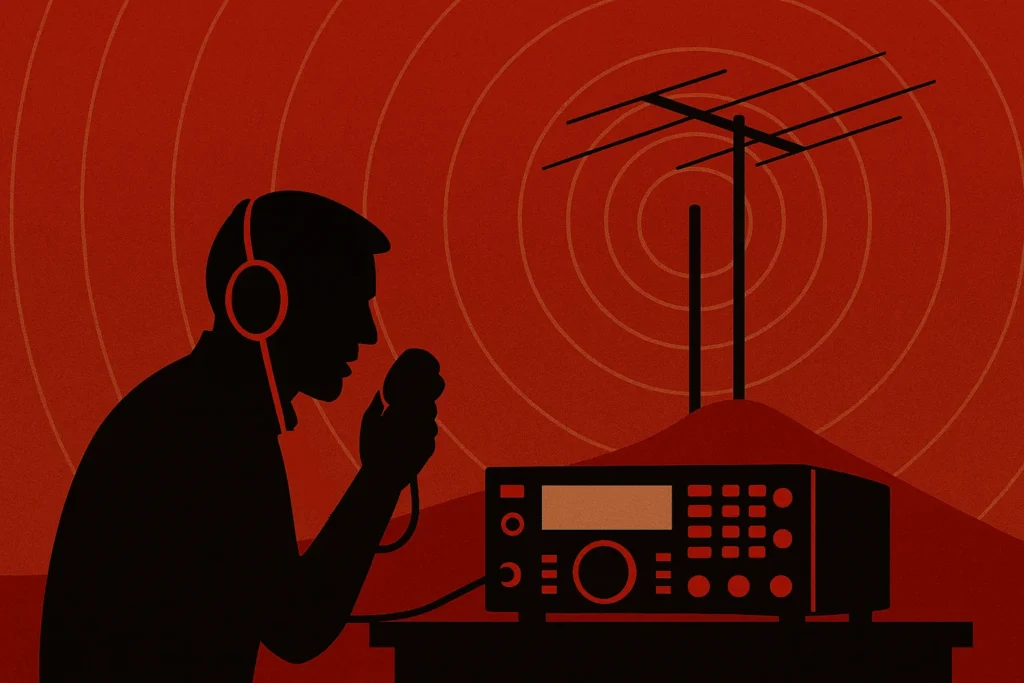
By luck there exists a corner where curiosity still commands: the amateur radio.
People who examine themselves, obtain license and explore spectrum with passion.
They communicate from any side, experiment with propagation and create community.
All within clear limits of power, modes and bands.
It is one of the few activities where spectrum is lived from inside and not from a data contract.
10. The map of power — a tower with many keys
If we look everything from above, the control of spectrum is a choreography:
- The ITU traces the global design.
- The State owns the resource.
- SETELECO administers and watches it.
- The operators build the real network.
- The manufacturers decide which bands you see.
- The platforms push the demand that it reconfigures.
There is not a single owner.
It is an equilibrium of forces, interests and needs that it maintains because, otherwise, would reign the chaos.
11. The natural and the regulated
The electromagnetic waves exist since always.
They are not human, they are not political, do not understand of borders nor licenses.
They are a natural part of the universe: light, heat, background radiation.
Their original home is the cosmos, not an official bulletin.
But when we use them to communicate, to coordinate planes, to transmit data or to order a pizza…
then we need order.
We have converted a natural phenomenon into a regulated resource.
And that regulation is necessary, yes, but also reminds us one thing:
The waves belong to the universe.
The use belongs to society.
And the responsibility —watch, question, improve— belongs to us.
Meanwhile, the air continues full of invisible signals, traveling silently between towers, satellites and roofs.
And behind each one there is a story, a rule, a license… and a little bit of power.
Related Articles:
How it works SIRDEE, the State’s digital network
Why the Police can seize your walkie even if you do not transmit