How SIRDEE Works, the Spanish State’s Digital Network
When a disaster, a terrorist attack or a movie-style chase happens, the noise you don’t hear is the most important one: the communications. In Spain, that orderly, encrypted silence is called SIRDEE, a digital network that for more than two decades has let the Guardia Civil, the National Police, the UME (Military Emergencies Unit) and other state bodies coordinate without relying on commercial networks or private carriers.
This network is now in the middle of a major overhaul: from a robust but limited architecture to a high-speed platform that brings in mobile technologies like LTE and eMBMS. In other words: they are going from a digital walkie-talkie to a smartphone on steroids. But let’s take it step by step.
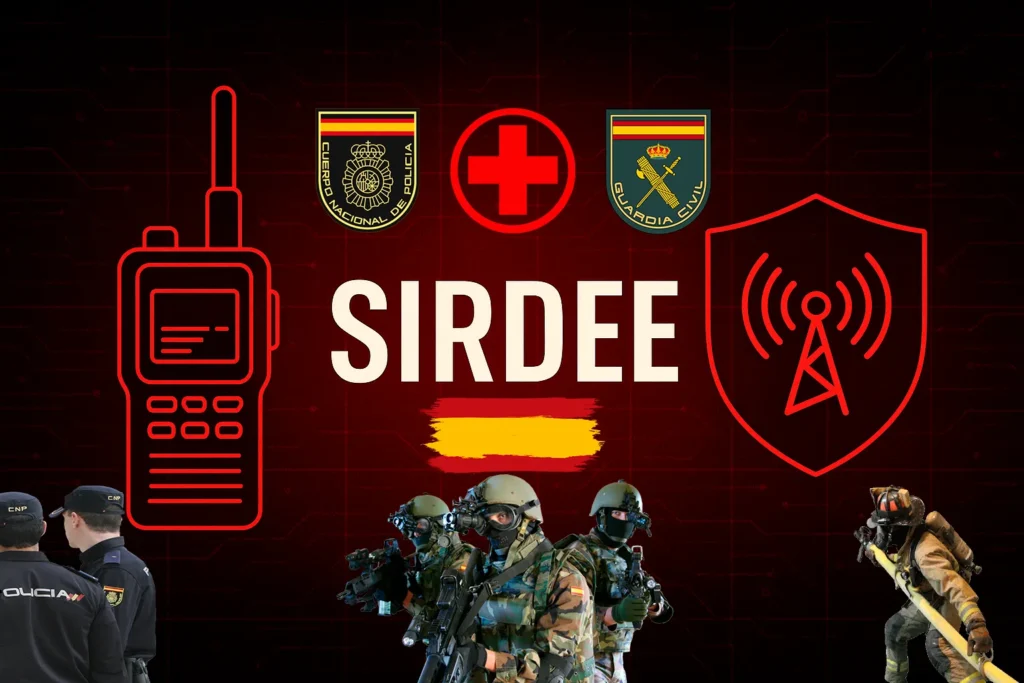
What SIRDEE is
The State Digital Emergency Radiocommunications System (SIRDEE) was created in the year 2000 in response to an obvious need: to unify communications between police and emergency services, which until then had been using disconnected analog systems.
SIRDEE was built on Tetrapol, a digital trunking technology developed for environments where failure is not an option. Trunking? Picture a taxi dispatch center where several stations share channels intelligently. Same thing, but encrypted, automated and with nationwide reach.
The result was a secure, self-contained network with coverage across the whole of Spain, including remote areas, islands and coastlines. More than 150,000 users rely on it every day: from the prime minister’s bodyguard to the DGT (national traffic authority), along with military units, local police and emergency medical staff.
How SIRDEE works on the inside
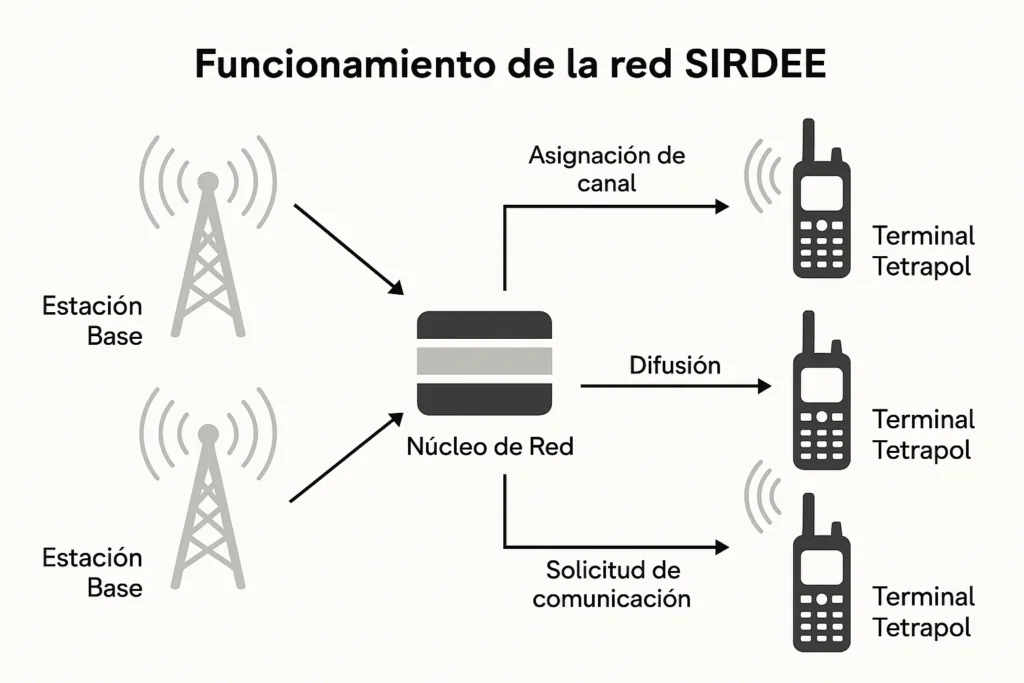
SIRDEE is a digital trunking network running on Tetrapol. Think of a highway with smart tolls: the “cars” are the calls, the “lanes” are radio channels, and the “toll booth” is a control channel that decides, in milliseconds, which lane each group travels in. Everything is encrypted, with priority for whoever is in the biggest hurry.
Radio layer and access
The Tetrapol radio interface uses FDMA (each communication occupies its own carrier) with narrow channel spacing of 10 or 12.5 kHz and GMSK modulation at 8 kBd, giving a raw throughput of about 8 kbit/s. That choice buys long range and power efficiency in the handhelds, at the cost of modest data rates. On the air, a control channel (CCH) coexists with several traffic channels (TCH) carrying voice and data; the signaling organizes the frames into periodic cycles that handle paging, synchronization and assignments. It is like a traffic light opening and closing lanes without the driver noticing.
Trunking and resource management
When an officer presses PTT, their radio first requests a slot on the control channel: the network checks identity and permissions, picks a free TCH and switches over to the talk group involved. If the group is spread across several cells, the network replicates the carrier wherever needed so that everyone receives the same call. There are priorities, preemption (if a critical alert comes in, it drops the lower-priority call) and late entry (if you switch your radio on mid-conversation, the network hooks you in on the fly). All of this happens in fractions of a second; there is no “ring tone”, just an instant enabling of the voice channel.
Security and authentication
The network applies mutual authentication between the radio and the infrastructure, and end-to-end encryption (E2EE) on certain voice and data services, on top of the Tetrapol air-interface encryption. Key management is centralized, and the user’s credentials live in a secure module inside the radio (a kind of professional “SIM”). The keys are updated periodically and securely over the network itself, and compromised units can be revoked. To the user it is invisible; to an attacker, a wall.
Operating modes and resilience
Besides the normal “network” mode, Tetrapol supports Direct Mode (radio-to-radio) for when there is no coverage, and Repeater Mode to extend range in difficult areas. There is also Gateway Mode, which joins Direct Mode to the network — handy for bringing an isolated patrol “back” to the main group. At the site level, if a base station loses its link to the core, it keeps up local operation within its cell so groups can carry on talking. It is a built-in plan B, no improvising.
Voice and data in mission-critical work
Voice is king: it is half-duplex and has very low latency so the back-and-forth feels natural. For data, the narrow channel is enough for short messaging, status updates and telemetry (positions, check-ins, lightweight forms). Video, heavy maps or biometrics? That comes from the LTE broadband layer the Interior Ministry is layering on top of SIRDEE (efficient broadcast with eMBMS), leaving Tetrapol as the backbone for voice and signaling.
What happens in a real call
- The officer presses PTT. 2) Their radio encrypts and sends a request over the control channel. 3) The network authorizes it, assigns a TCH and alerts every member of the talk group in that area. 4) The base station switches to traffic and the voice flows with the priority set by operational policy. 5) If the officer crosses into another cell, the network reallocates resources to keep the group together. 6) When PTT is released, the channel returns to the pool, ready for the next turn. To the user it is “push and talk”; underneath, it is a ballet of signaling and encryption.
The jump to LTE and broadband
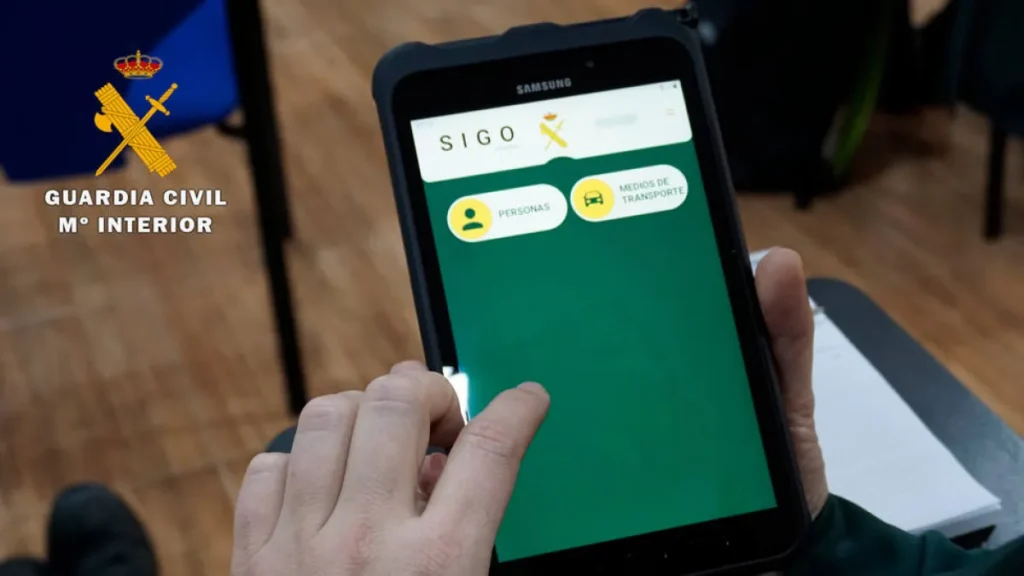
For all its reliability, SIRDEE had certain technical limits. For police operations that call for real-time video, interactive maps and portable biometric systems, that is clearly not enough.
That is why the Interior Ministry has begun a transition toward mobile broadband, keeping the system’s mission-critical spirit but bringing it up to date:
- Private LTE technology (Long Term Evolution, or 4G in plain terms): closed networks, run by the state, with absolute priority for emergencies.
- eMBMS (Evolved Multimedia Broadcast Multicast Services): lets video or data be broadcast to many radios at once, a sort of “police digital TV”.
- Ruggedized smartphones, like the Crosscall Core-X5, which can switch networks on the fly between the private LTE and the public network without dropping the call.
This is no longer just radio: it is multimedia tactical communication. An officer will be able to record and send encrypted video in real time to a command center, receive map updates, and use apps designed specifically for field operations.
Who is behind this transformation
The rollout is led by a consortium made up of:
- Telefónica, providing the network and the carrier expertise.
- Airbus Secure Communications, responsible for the mission-critical network core and the eMBMS systems.
- Crosscall, the maker of the “battlefield” smartphones.
- The Interior Ministry, which directs the project and signs off on the security standards.
Pilot tests are currently running in provinces such as Alicante and Albacete, with a gradual rollout expected through 2026.
What happens if SIRDEE goes down
We are not talking about WhatsApp outages here. If SIRDEE goes dark, a key part of the national emergency-response system goes with it. That is why there are plans to integrate it in the future with satellite networks like SpainSat NG (in service from 2025) and IRIS² (a European program still being deployed), as well as to interconnect it with the so-called “Malla B” (Mesh B), a strategic layer of resilient communications for extreme situations.
On top of that, the system is designed to work in local mode: even if the national network fails, the radios can keep talking within a local range, like analog walkie-talkies but with military-grade encryption.
Can SIRDEE be hacked?
Good question. Because of course, if all this sounds so armored, so encrypted, so “military grade”, the wise guy we all have inside will be wondering: “What if I rig up a homemade antenna, grab a cheap Chinese SDR and listen in on what the cops are saying?”
SIRDEE uses end-to-end encryption, with Tetrapol‘s proprietary algorithms and keys that are rotated periodically. In other words, even if you intercepted the signal, all you would hear is encrypted digital noise. And we are not talking run-of-the-mill encryption: this is state grade, with extra layers of physical, software and identity-management security.
Now then… is it infallible? No system is 100% secure, not even SIRDEE. There have already been attempted attacks, especially in border areas or during international events. The difference is that here, every component is designed to detect, isolate and respond. And if something is compromised, the system can drop into local mode, cut off remote access and reset keys with no outside help. Like your router having a “self-destruct” button, but without the smoke.
Besides, the move to LTE introduces new attack vectors: more complex software, more exposed devices and better-known protocols. That is why the new radios ship with hardened, managed operating systems, no user access and restrictions on the available apps, putting security ahead of consumer features.
In short: can it be hacked? In theory, anything can be hacked. But in practice, SIRDEE is built so that if you try… they get there first. And they will not be coming to add you on LinkedIn.
Critical conclusion – Invisible technology or silent power?
SIRDEE is a network you will not see advertised on bus shelters, but without it the state would literally be cut off. Its move to LTE is not a whim but an operational necessity in an environment where data is worth as much as bullets.
That said, this transformation also raises new questions: who really controls this network? What about technological sovereignty if we depend on foreign manufacturers and private companies? And what about privacy if these technologies one day trickle down to the civilian world?
Uncomfortable questions for a system designed precisely so that you never notice it exists. But there it is, listening… in silence.
Related articles:
Speed Cameras in Spain – From Road Safety to Revenue and Mass Surveillance
Why the police can seize your walkie even if you are not transmitting