From Sci-Hub to Sci-Net: The New Fight to Free Knowledge
Picture this: you are working on a paper, you need one key scientific article, you look it up, you find it… and they hit you with a €35 charge to download it. One PDF. 15 pages. Thirty-five euros. Welcome to a world where knowledge is held hostage by academic publishers. But this is where the story of a digital rebellion begins — one that has been running for over a decade. And now it has a new face.
The day a student said “enough”
In 2011, a young Kazakh researcher named Alexandra Elbakyan was fed up with not being able to access the science she needed for her work. She tried everything. Nothing worked. So she built something that did: Sci-Hub, a site for downloading scientific papers for free — no paywalls, no permissions and no apologies. Robin Hood, digital edition: more coffee, less forest.
The system was brilliant (and a bit piratey): when someone requested an article, Sci-Hub first looked for it in open repositories like LibGen. If it was not there, it pulled it straight from the publishers using leaked institutional credentials. And then it kept it forever. Its database already holds up to 88 million articles. It is not a library. It is a beast.
The publishers panic
The big academic publishers — Elsevier, Springer and company — hit the roof. Multimillion-dollar lawsuits, domain blocks, court orders. Sci-Hub had to keep hopping from address to address like a mole with Wi-Fi: .org, .io, .se, .tw, .do, .wtf…
But the damage was done. Researchers all over the world — from top universities to libraries in the Congo — used Sci-Hub as their secret Google. Because it worked. Because it was fair. Because nobody could understand why a paper funded with public money should cost more than a dinner out.
So what now? Sci-Hub freezes
In 2020, under so much pressure, Sci-Hub stopped uploading new articles. Its database is still there, but it has become a museum of knowledge frozen at 2020. Science moved on; the site stood still. It looked like the end.
But no. Enter act two.
Sci-Net is born: science for everyone, version 3.0
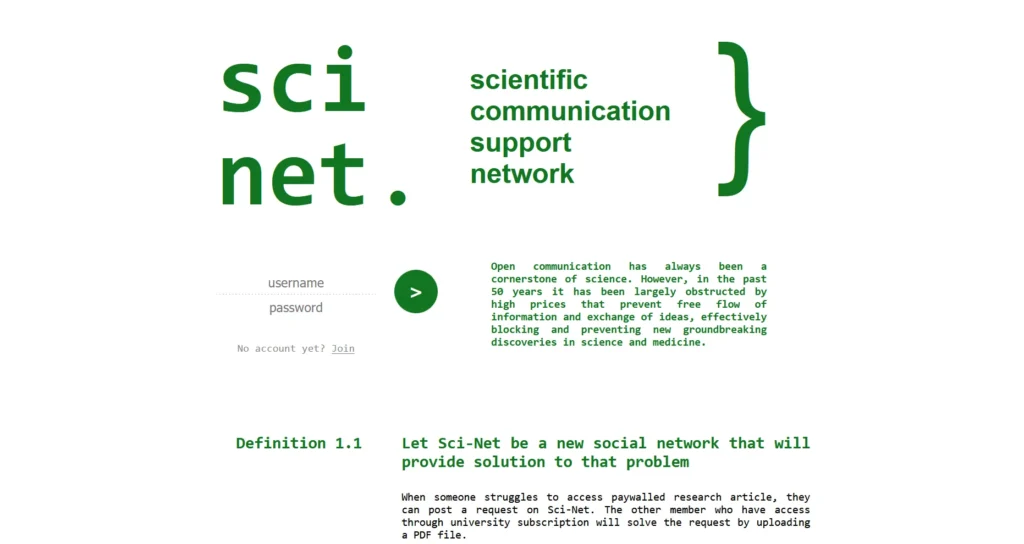
In 2025, something new showed up: Sci-Net, an odd mix of social network, digital bazaar and academic resistance. Its unofficial motto: “If you need an article, ask. If you have it, upload it. And if you do it right, you get paid (in tokens).”
Here is how it works:
- If you need a paper, you request it by pasting the DOI.
- If someone has it, they upload it.
- If it checks out, the system releases a reward in the form of a token ($SCIHUB) that goes straight to the uploader.
The file stays available to anyone. Free. And forever.
The trick: blockchain and anonymity
Sci-Net runs on the Solana network. Its token ($SCIHUB, or SCI) is a digital currency with real value. No karma points here. You can earn tokens, hold them, or swap them for other crypto. But for this to work, the system has clear rules:
- You only get paid if the uploaded article passes verification by the person who requested it.
- The whole process is anonymous. No email, no phone, no name. Nothing. Not a single detail.
- The file is automatically stripped of watermarks that could give away the original source (such as IP addresses or the university).
And although for now the files live on ordinary servers, the plan is to move to decentralized storage, IPFS-style, so no one can ever delete them. Censorship-proof science.
And the tokens? Are they actually worth anything?
Yes. The tokens are obtained on the Solana network, can be stored in a digital wallet (such as Phantom), and have a limited supply (888,888 tokens in total). You can grab one to get started, upload articles, earn more, or simply use them to request new papers.
It is a peer-to-peer rewards system. Whoever needs something asks for it. Whoever has it shares it. And they are paid in tokens. It is the collaborative economy — with a geeky twist.
Is any of this legal?
Ah, friend… Legal? No. Ethical? Debatable. Necessary? For many people, yes. The law says sharing a paywalled PDF is wrong. But scientific ethics say locking science away is wrong too. And that is where we live: in the tension between what is legal and what is fair. Between copyright and the right to knowledge.
The future: resistance or rebirth?
Sci-Net is the answer to a broken system. A system where universities pay millions in subscriptions while researchers work for free and the results are locked away behind paywalls. Does it have risks? Yes. Does it have holes? Plenty. But it is doing what no one else has done: reinventing access to knowledge.
And that, like it or not, is the kind of revolution that deserves our attention.