Digital armor with blockchain: protect your work with a timestamp
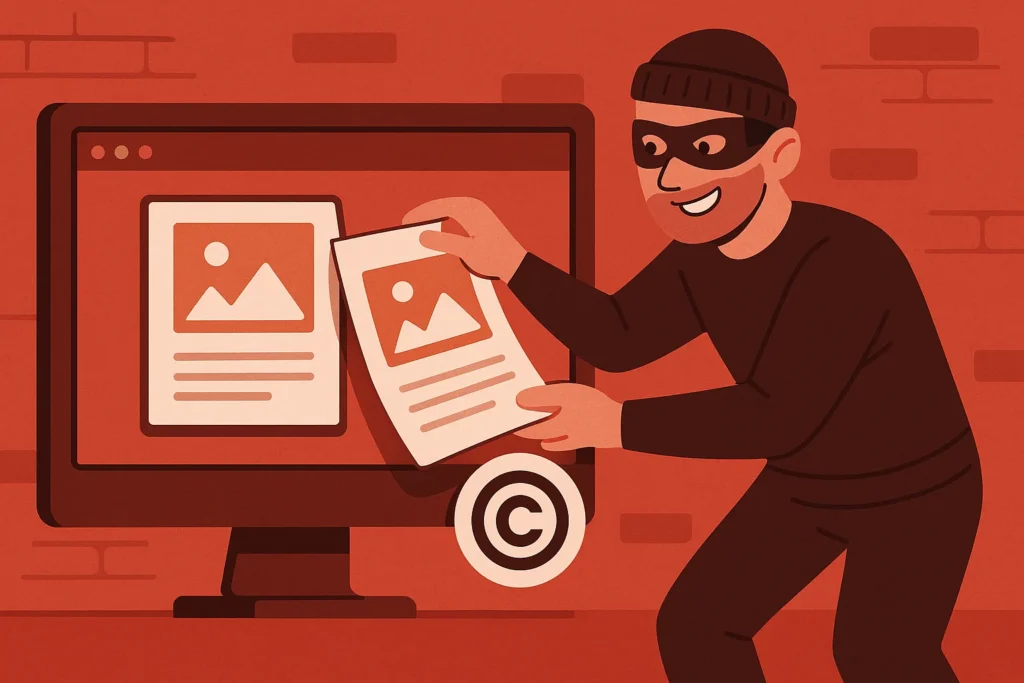
On the internet, your work travels faster than Game of Thrones spoilers. A song, a design, a poem… and bam, someone copies it and uploads it before you do. So now what? Well, if you have no proof, you are left with a crying-emoji face. But this is where the magic duo comes in: blockchain + timestamp.
Imagine putting a digital seal on your file, with a date and time, impossible to fake. Like an armored postmark shouting: “hey, I made this first!”. That is what a timestamp does. You turn your file into a kind of digital Rosetta Stone. An anti-plagiarism tool on steroids. Legal, elegant and headache-free.
What is a blockchain?
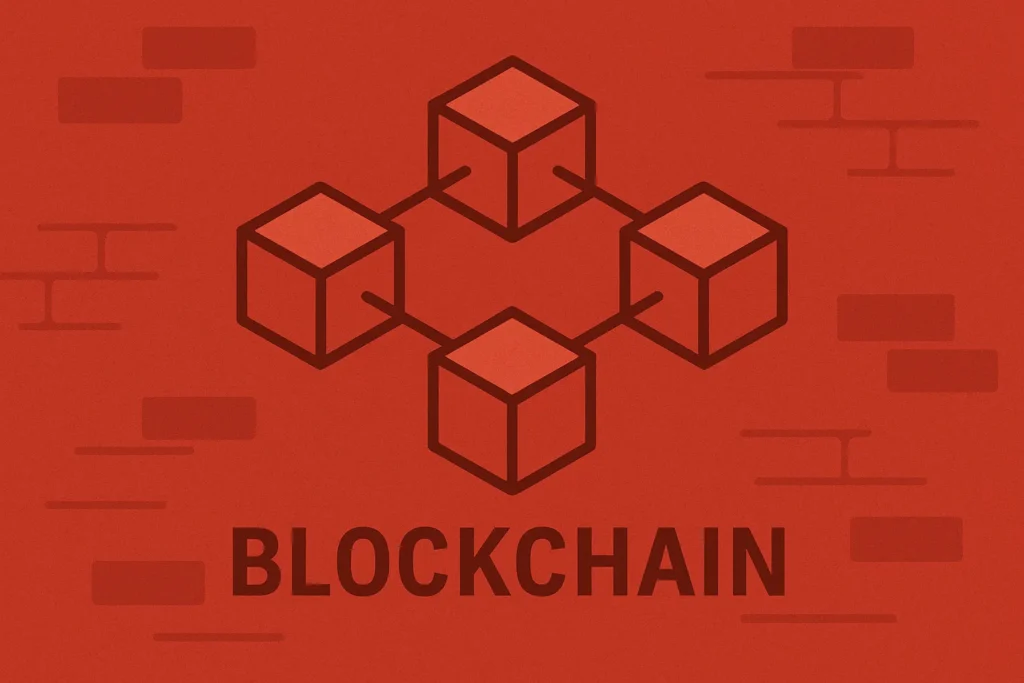
Think of a blockchain as the world’s biggest tattletale ledger. It forgets nothing, and on top of that everyone has a copy. Each page (or block) is chained to the previous one thanks to a hash — a kind of mathematical glue that not even paint thinner can loosen.
And what is so special about it? That you cannot tamper with it without the whole system finding out. Change one letter and pow, the chain breaks like you just lied to your mother. Every action is recorded with its own timestamp, and from then on it is immutable. There is no “edit” button.
In short: each block holds your info, is signed with a hash, and is nailed down with a timestamp. It is as if every line were written in digital blood. And because it is spread across thousands of nodes, not even the shadiest hacker could erase the evidence without raising suspicion. Total transparency, total security. Like a network of mathematical gossips who let nothing slide.
So what does blockchain have to do with registering a piece of work?
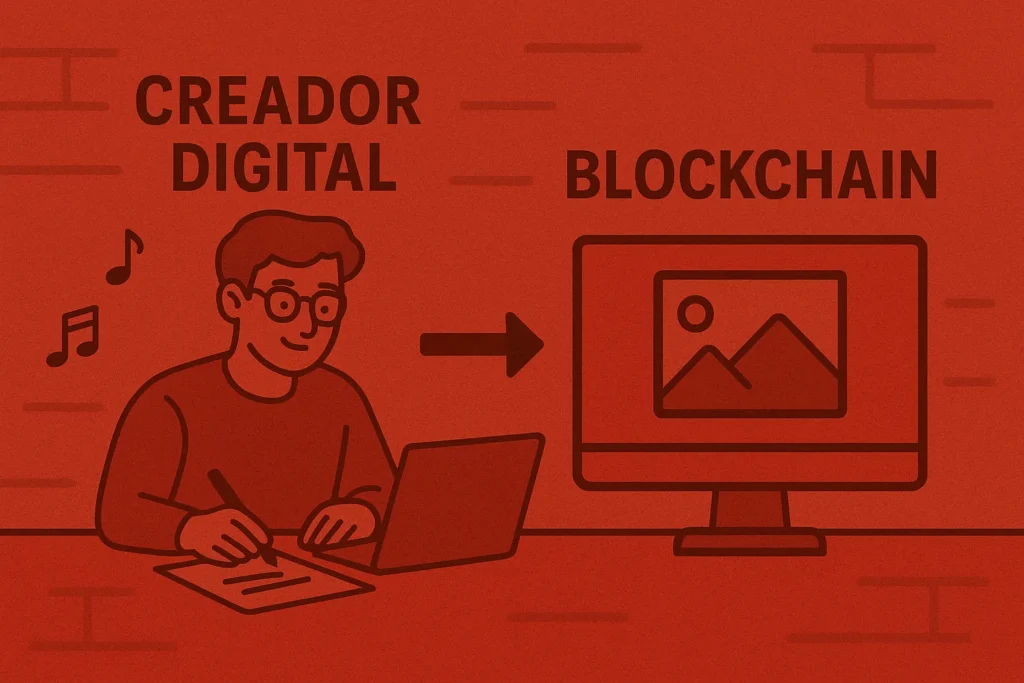
So far we have talked about blockchain as if it were the digital world’s private diary, impossible to fake. But how does all this fit with protecting your song, your design or your brilliant idea?
This is where it gets interesting: blockchain is not just for storing cryptocurrency transactions, it can also leave a record that your work existed at an exact moment. And that, my friend, is pure gold if you want to prove you were first.
The hash: your work’s fingerprint
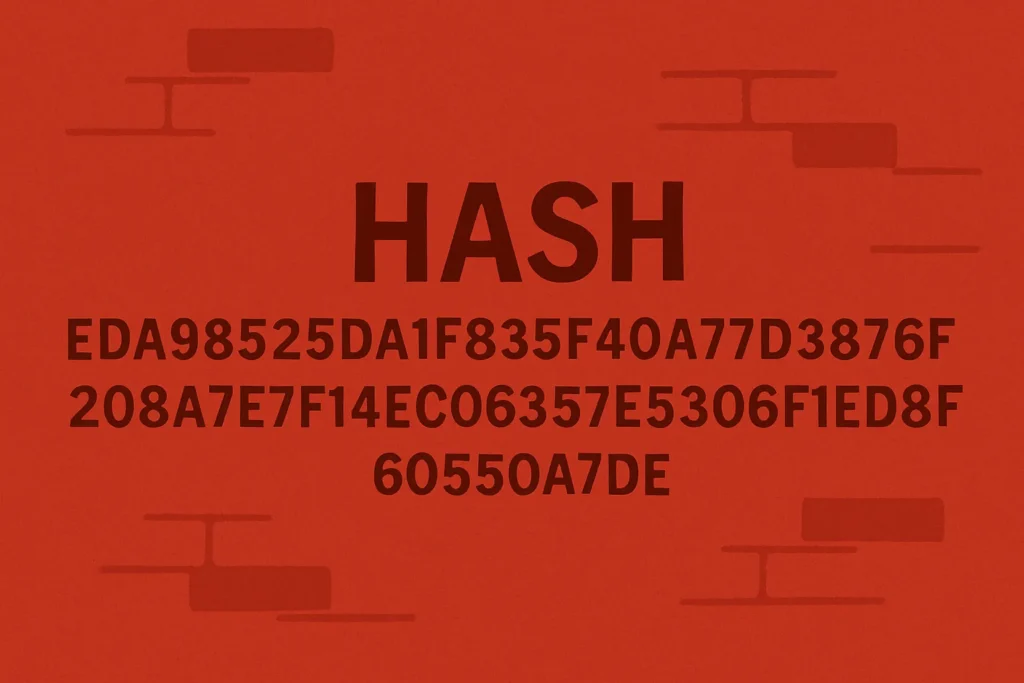
The hash is like your file’s ID card, Terminator edition. You take your document (a song, a text, whatever), run it through the algorithm, and out comes a unique string, something like: 3a2f4c....
That code represents your work. The cool part? If you change one comma, one pixel, one accent mark… the hash changes completely. It is like a car alarm: someone touches it and it goes off instantly.
So when you register your work, what we store is not the file (we do not even want to see it — privacy first), but the hash. Later, if someone tries to pull a fast one, you produce the original file, recalculate the hash, and voilà! It matches the one sealed on the blockchain. If it does not match… well, someone is selling you a pig in a poke.
Digital timestamp: your witness on the blockchain
The timestamp is the punctual friend who vouches that you were there. You take your work, get its hash, and stamp it with the date and time. That gets recorded on the blockchain and stays there for ever and ever, like a certified digital tattoo.
The best part: you do it once and it stays there, unmoved. Anyone can check it in the future. “You made this drawing in 2020? Show me the hash.” If it matches the record… point to Gryffindor.
With Acuántico Power the process is instant: you upload, the hash is calculated, it is sealed. Bing, bang, work armored. As if a cyberpunk notary signed it on your behalf.
Why does it hold up legally?
Because Europe says so. Literally. The eIDAS regulation (EU 910/2014) protects you: no electronic timestamp can be rejected in court just for being digital or “non-qualified”. You do not need to bring it on parchment, or have it signed by a notary unicorn.
Okay, there are qualified timestamps (from official providers) and non-qualified ones (like ours). The former are issued by a state-accredited provider, but both are admissible in court.
And in Spain, Law 6/2020 and the Civil Procedure Act are crystal clear: all evidence must be considered. You cannot just play dumb about a timestamp.
Case law? Of course, sweetie. The Supreme Court has already ruled in cryptocurrency cases, and recognizes the immutability and traceability of blockchain as valid evidence. If you go to court and present your digital seal, you can look the judge in the eye and say: “I made it first, Your Honor.”
Beyond Europe: the US case
If we cross the pond, the United States is just as switched on. In Arizona, for example, they changed the law in 2018 to recognize blockchain-based evidence. In Illinois, since 2020, it is even more explicit: evidence cannot be rejected just because it comes from a blockchain.
And several states are the same: Ohio, Washington, and so on. All accepting that this technology is just as valid as a handwritten signature. The legal future is heading that way: blockchain as legitimate evidence, no tricks, no gimmicks.
Analogies and practical examples
Picture it like this: you used to go to the post office, put a stamp on the letter and have it postmarked. Today you do the same with your digital file, but with a 21st-century postmark. And instead of the post office, it is the blockchain that records the date and time.
Real examples? A writer saves a draft with a timestamp. Years later someone “coincidentally” publishes something similar. No problem: pull out the original hash and bam, there is your proof. Or a musician registers their song before uploading it to Spotify. If someone does a copy-paste with autotune, they have something to fight back with.
It also works for designers, programmers, illustrators, photographers… This is not a tech gimmick. It is like having a virtual wax seal. Your work is marked, with its date and its digital DNA.
Why armor your work with Acuántico Power?
Because for less than the cost of a McDonald’s meal, you get a digital shield that can save you a lot of grief. You will have your “I made it first!” ready to play like a trap card if someone plagiarizes you.
✅ Affordable
✅ Private (you do not upload your file)
✅ Automatic
✅ Legally valid
✅ No technical hassle
If you are an artist, musician, programmer, designer or digital creator of any kind, this system should interest you more than a flash drive in the middle of a storm.
In short: it is your bulletproof vest against plagiarism. You may never get shot. But if you do, you will be enormously grateful.