ESPARGOS – The Wi-Fi Sensing Revolution
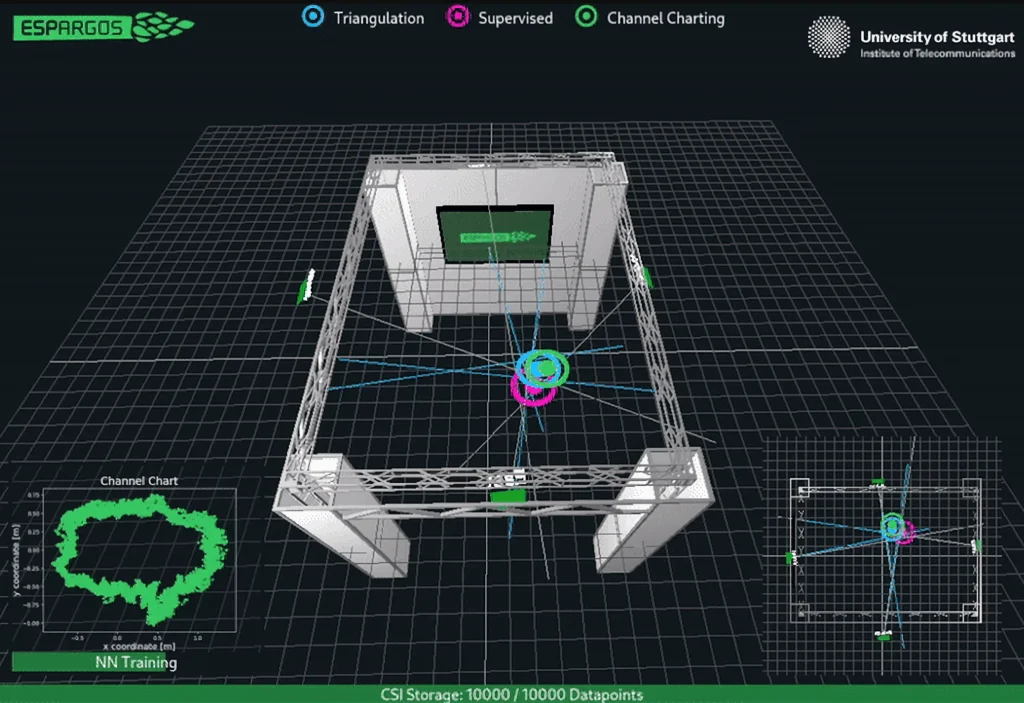
Imagine you could “see” the Wi-Fi waves around you, like ripples on water when you throw in a stone. Now imagine you could use those waves to tell whether someone is in a room, work out the direction a signal is coming from, or even triangulate a device’s location with no GPS. Sounds like science fiction, right? Well, it is not. It is called ESPARGOS, and it is here to transform the world of wireless sensing.
What Is Sensing?
Sensing is the process of gathering information about the environment through sensors. In the case of ESPARGOS, Wi-Fi sensing is based on analyzing the variations in wireless signals to get data about a space and the objects within it. This makes it possible to detect presence, motion or even estimate positions, with no need for extra hardware on the devices being detected.
What Is ESPARGOS and Why Does It Deserve Our Attention?
ESPARGOS is a low-cost, high-precision Wi-Fi sensing system that uses an ESP32-based antenna array. Its main job is to capture and analyze Channel State Information (CSI), enabling applications such as:
- Indoor positioning with no GPS.
- Presence detection through changes in Wi-Fi signals.
- Estimating the angle of arrival of signals, like a radar for Wi-Fi.
If you have ever used Google Maps inside a shopping mall and watched the signal drop out, you know how frustrating it is to locate something without GPS. ESPARGOS can change that, enabling precise indoor positioning using only the Wi-Fi networks that are already there.
How ESPARGOS Works – Hardware and Architecture
ESPARGOS is not magic, even if it looks like it. At its heart is an antenna array, which in this case is made up of eight ESP32-S2FH4 microcontrollers and eight 2.4 GHz patch antennas.
What Is an Antenna Array?
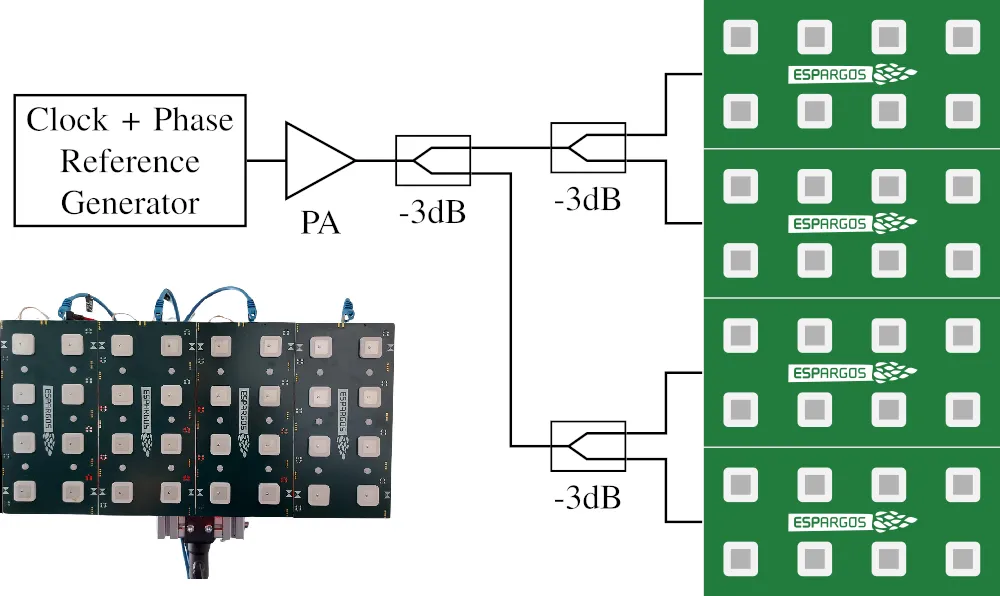
An antenna array is a set of antennas laid out in a specific configuration to improve signal reception and analysis. Working together, the antennas can pick up differences in arrival time and signal strength, which makes it possible to determine the direction of a transmitting source or detect changes in the environment with high precision.
In ESPARGOS, the antennas are laid out in a 2 x 4 configuration with half-wavelength spacing, which ensures accurate capture of Wi-Fi signals.
Think of a directional microphone: if you have several of them pointing in different directions, you can tell where a sound is coming from. Here, instead of sound, ESPARGOS analyzes Wi-Fi signals.
It also has a controller board with another ESP32 that:
- Synchronizes the clock and phase signals.
- Handles the transmission of CSI data over Ethernet.
- Is powered by Power over Ethernet (PoE), doing away with extra cabling.
ESPARGOS Uses Phase and Frequency Synchronization to Avoid Chaos
If you have ever tried to watch a live concert stream with friends in different houses, you will have noticed that the audio arrives with a different delay for each person. That happens because each device handles time in its own way. In ESPARGOS, something similar happens with the phases of the signals.
To avoid this chaos, ESPARGOS uses a synchronization system. Although all the ESP32s share a 40 MHz clock, they also need phase alignment. To achieve this, a Wi-Fi-based reference signal is distributed to all the antennas, making sure they all “hear” the signal the same way.
pyespargos Is the Python Library That Controls ESPARGOS
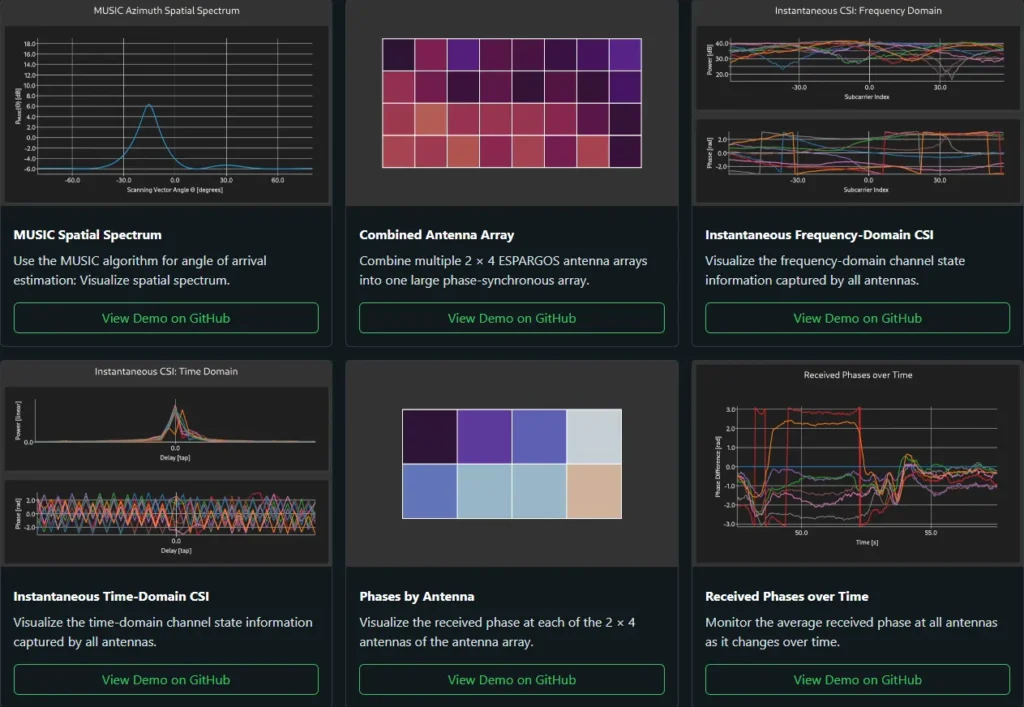
For developers, ESPARGOS would be nothing without its software. pyespargos is the Python library that lets you:
- Set up and control ESPARGOS easily.
- Receive CSI data in real time.
- Apply advanced algorithms for positioning and signal analysis.
pyespargos applications
- Spatial spectrum with the MUSIC algorithm:
- Estimates the angle of arrival of signals, useful for detecting devices.
- CSI visualization in time and frequency:
- Lets you watch how the Wi-Fi signal changes over time.
- Per-antenna phase tracking:
- Shows how the received phases vary over time.
- Integration of multiple arrays:
- Several arrays can be combined to extend coverage.
Think of pyespargos as a printer “driver”. Without it, ESPARGOS would just be a set of antennas with no use.
ESPARGOS, a Promising Newcomer
ESPARGOS not only puts Wi-Fi sensing within everyone’s reach, it opens the door to a new era of positioning and wireless network analysis. Its accessibility, combined with its precision, makes it a powerful tool for both research and practical applications.
From the casual user’s point of view, the idea of “seeing” Wi-Fi and using it for things like detecting intruders or finding lost objects sounds amazing. For technical people, being able to access real-time CSI data with a low-cost solution is a dream come true.
ESPARGOS is worth keeping an eye on, because everything suggests it is only at the start of its revolution.