Before asking ChatGPT, you should read this.

I have to confess something to you, buddy.
Sometimes when I hear or read you saying the typical phrase of “I asked ChatGPT and it told me this”, even if it doesn’t tell you, it makes my blood boil.
It’s not your fault.
You have a wrong image of AI. An image dictated by those whom some call the seven fantastic ones, which penetrates from the media that repeats the message time and again, normally copying and pasting the same notes.
After reading this article, your use of AI could be much more efficient.
Without paying any course.
Without buying access to lists of miracle prompts.
The first farce: “Artificial Intelligence”
Let’s start from the beginning. The name itself: Artificial Intelligence.
It looks very flashy and sells like crazy.
As of today, Narrow AI (AI specialized in doing one specific task) has zero intelligence.
General AI does not exist yet.
And no, ChatGPT is not a General AI. It is a conversational AI.
Although it puts “Thinking”, it is not reasoning.
It is calculating which word fits best next.
Have you ever heard that Sora or other video models are world creators?
Sounds spectacular, but no current technology understands the real world.
There is no experience, there is no physical context, there is no common sense. There is no world inside it.
First advice: do not deceive yourself with what you have in front of you
When you are in front of a language model and intend to use it, however much that friend, professor or infinite knowledge source seems like the one you always wanted to have, do not deceive yourself.
It is a machine.
And it works in a very specific way:
fills gaps with what statistically fits.
Everything else derives from that.
A successful swindler
Responses are usually fascinating, well written and convincing.
That is exactly what makes them dangerous.
If there is enough information about what you ask in its training, the response is usually quite accurate.
If it doesn’t exist (information), it starts mixing real data with other invented ones, but so well woven that it is hard to distinguish them.
Its priority is not to be accurate.
It is to respond.
The example of the spaceship

This is very clear when you test small models of about 4B parameters locally.
You ask them to design a spaceship that travels through wormholes and, in seconds, they give you a step-by-step tutorial to build it in your garage.
With detailed explanations of how to open the wormhole using a button battery and the spring from a pen.
All false.
All coherent.
All very convincing.
That is called hallucinations.
It is not a single failure. It is the result of extremely complex algorithmic and probabilistic calculations.
Small models, large models and where the real difference lies
I have a testing environment where I use 14B or 20B models, small on humble hardware and, for certain tasks, gives better results than much more advanced models running on powerful computing systems.
The great difference is not so much in the “reasoning” as in the knowledge with which they have been trained.
In many logic or calculation tasks, small and large models are more similar than people think.
When the model does not know what it is talking about
In amateur radio, for example, ChatGPT is quite lost.
It is a topic where errors jump quickly.
Like when I asked for information about the technical requirements of repeaters in Spain.
A lot of disaster.
You are probably thinking:
Acuántico, man, if now GPT has internet search…
BOE, laws and searches that come out wrong
For me, the BOE is the holy grail. Or almost.
When I write about regulations, I always go to official sources.
Not to third-party interpretations.
Not to rehashed articles.
The problem is that not even in the BOE is the answer often clear.
The GPT with laws goes crazy.
It searches for a law, spits it out as absolute truth and, when you compare nothing matches, it turns out it was repealed.
And this happens even using direct search.
If you ask something more general, the panorama worsens:
media that copy and paste what the F agency says or, directly, answers taken from a subforum of Reddit where Nabo26cm wrote drunk at six in the morning from an Uber back home.
What language models do well
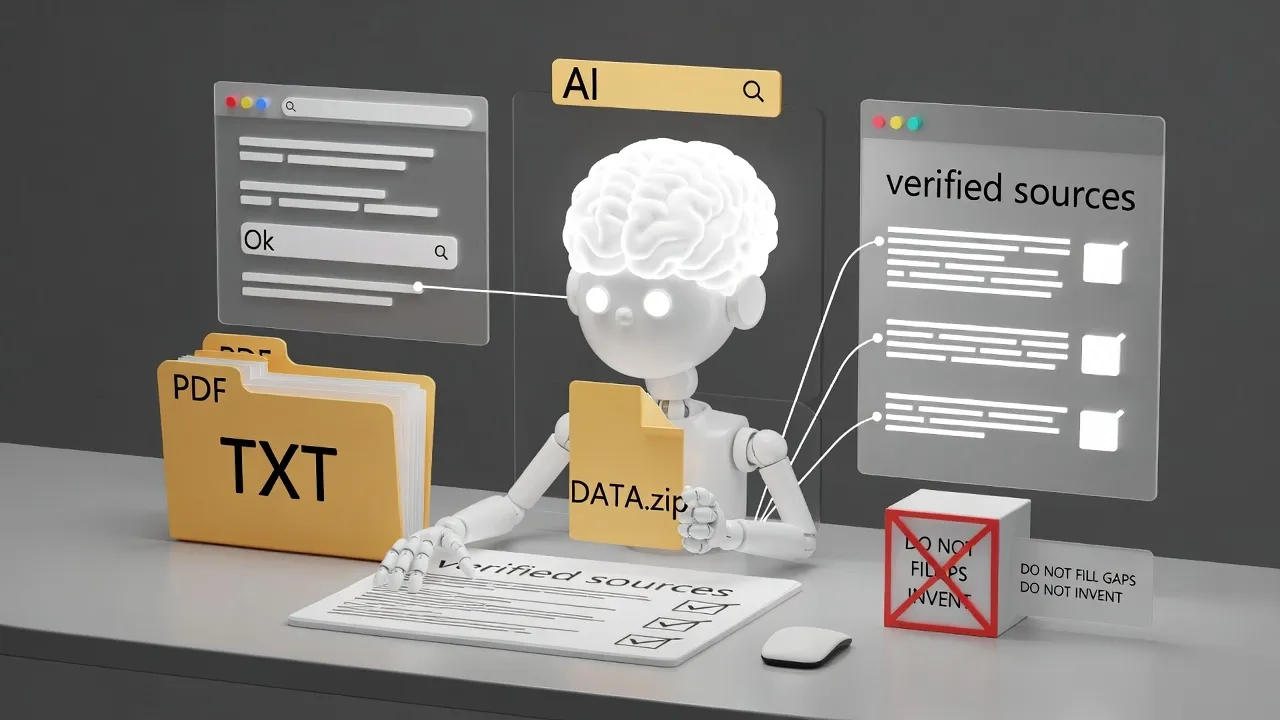
If there is something these models do well it is working with data.
But only if you give it to them.
Do a first search.
Review what it returns.
Compare what seems serious.
When you have decent information, save it in files: TXT, PDF, whatever.
If there are many, in a ZIP.
Upload it and then yes.
Now ask it something.
It is not that it becomes smarter.
It is that it no longer has to fill gaps.
This serves for everything
Software, laws, radio.
If the model makes a mistake helping you with a program, give it the official documentation of that program.
If you make a legal inquiry, give it directly the text of the law that applies to your case.
And if you are going to configure an amateur radio station, upload the equipment manual.
It works better because it works with context, not because it “knows more”.
The most serious error: sharing sensitive data
Another thing I have seen you do many times is share sensitive data.
It doesn’t matter if they are company accounts, medical analytics or personal problems.
All that is registered, classified and stored.
Today it seems innocent.
Tomorrow it can bill you.
As individuals, we’re much more trusting.
And quite a bit more careless.
How this works in business environments
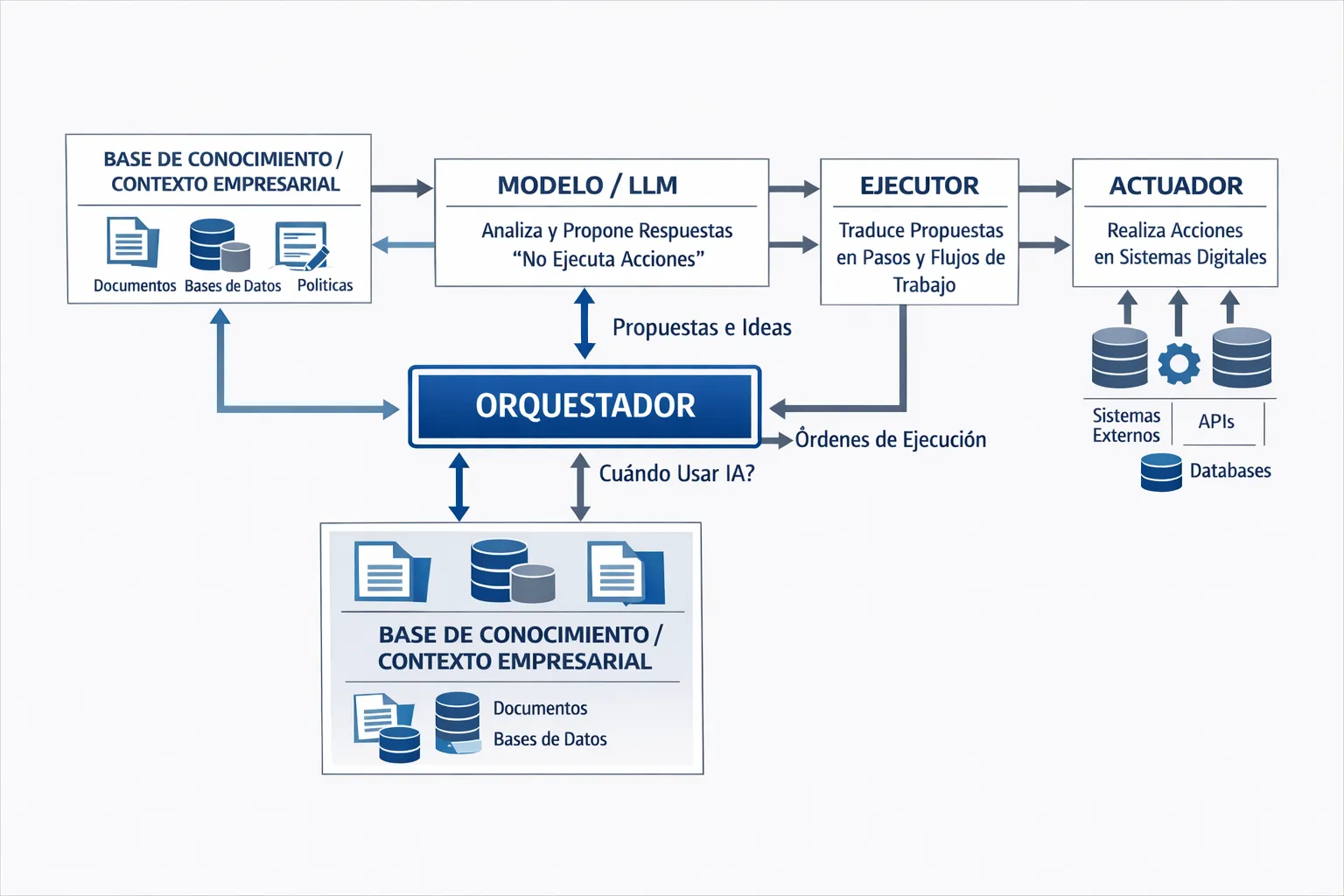
In companies systems are used that connect and coordinate different services.
Something similar to what n8n does: it is not a single AI doing everything, but several pieces working together.
There are five clear parts.
The orchestrator is the one who commands. It decides when it makes sense to use AI and what information needs to be put in front of it.
The model receives that and proposes a response or a decision. It does not act, only suggests.
The executor takes that proposal and converts it into concrete steps: what to do, in what order and with which systems.
The actuator is the one who executes the final action in the real world: touch data, launch processes or change something for real.
And all of that is backed by its own knowledge base, with information specific to the business.
The results are better not because the model is smarter, but because it does not work blindly: it has adequate context in front and some guides that orient it.
How I usually ask myself
Over time I realized that many bad answers do not come from the model being bad, but from the question itself being bad.
When you ask something in the air (vaguely), fill gaps.
And there problems begin.
It is not the same to say:
“Explain this law to me”
than saying:
“With this law in front, I want to know if in this specific case I can do X.
And tell me also what is not clear.”
There I’m not asking it to decide for me.
I’m reinforcing its objective.
When I ask it to work, not to respond
Many times I do not ask for a direct answer.
I ask it to tell me:
- what information is missing from it
- what it is assuming
- where there can be ambiguity
That changes the dynamic.
It stops sounding so sure.
It starts showing its weaknesses.
And when you see its weaknesses, you know where to turn yourself.
Using it by layers is what marks the difference

When the model has already taught you its limits, it is when it makes sense to use it by layers.
First, general search.
Then, human filter.
Then, sorting.
And only at the end, fine work with data.
If you skip steps, the model fills gaps.
If you go by layers, you fill the gaps yourself.
That is the difference between using AI and limiting yourself to consulting it.
If I have to give you a summary
If I had to summarize all this in something practical, it would be this:
Do not ask the AI what you cannot verify.
Do not ask it to decide for you.
Give context before asking conclusions.
Make it tell you what it does not know.
And use its responses as working material, not as truth.
With that, the AI stops deceiving.
Not because it changed itself.
But because you have changed yourself.