AI Is Already Deciding for You, and You Haven’t Even Noticed
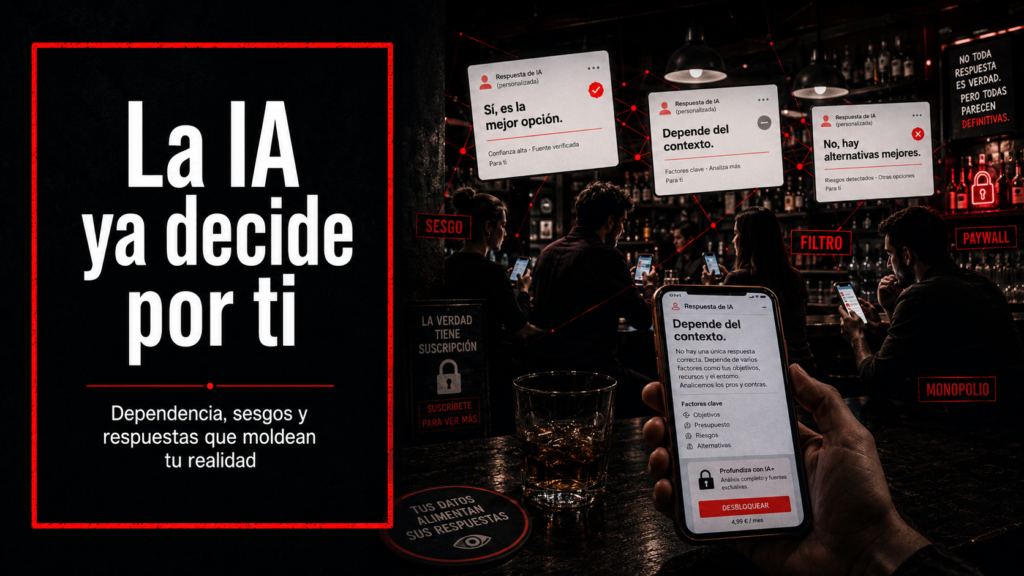
More and more of us have brought artificial intelligence tools into our everyday lives. Not in a controlled way. Not with a kickoff meeting, a roadmap and a cup of vending-machine coffee. In many cases we have done it almost without realizing, like an unwritten imposition.
It is in the search engine. On your phone. In your email. In your text editor. In your photos app. In your browser. In the assistant that summarizes web pages, answers your questions and hands you an explanation in a professorial tone even when it hasn’t got a bloody clue.
And here comes the awkward question.
How many of you already use the AI in Google’s search engine?
Probably more than you think. And that search-engine AI is the simplest example for understanding the problem. Not because it is the worst, but because it is the most everyday. The one that shows up right where we used to search, compare, hesitate and, with any luck, think a little before swallowing the first answer.
The Problem Isn’t That Artificial Intelligence Exists
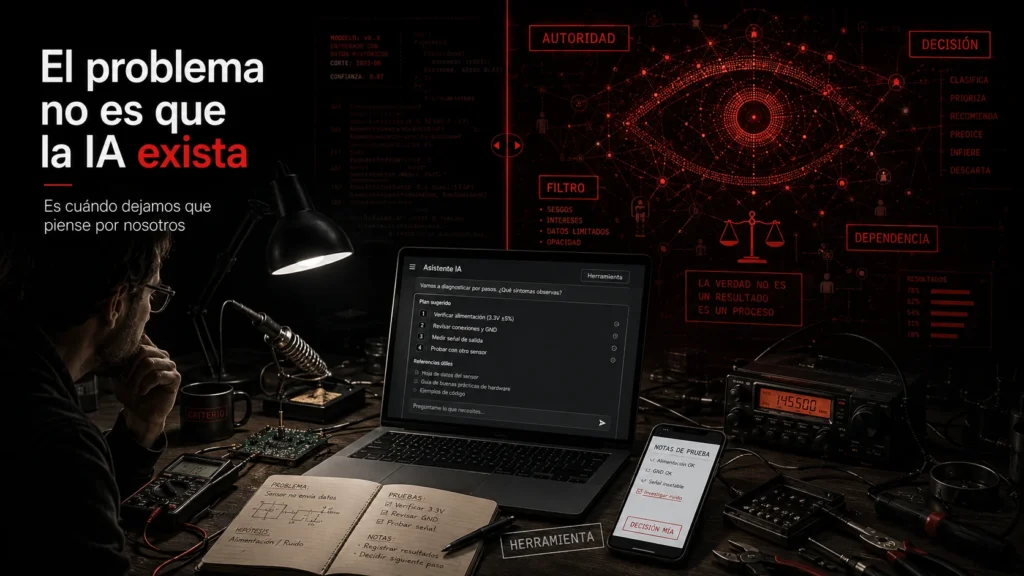
The problem is not using artificial intelligence. It would be absurd to deny it. AI can be useful, powerful and, in many cases, a formidable tool for working faster, learning, programming, writing, analyzing information or automating tasks.
The problem starts when we stop treating it as a tool and start treating it as an authority.
Without being a neuroscientist, I think we can agree that the human brain is one of the most complex systems in the known universe. More studied and more unknown than the bottom of the Mariana Trench. And down there you’ll find creatures that look like they were designed by someone with a fever and a premium subscription to nightmares.
Psychology, on the other hand, is very much exploited. Companies apply it every day in their digital ecosystems. Algorithms, colors, menus, notifications, rewards, infinite scroll and mechanics designed to keep us inside an app for as long as possible.
Video games have spent years fine-tuning systems built to push microtransactions. Social media knows when to show you something that outrages you, when something that hooks you and when something that makes you come back. Modern marketing revolves around that: capture attention, hold it and turn it into money.
Up to here, many will say: “Well, we already knew this.”
Yes. But that is not the main problem.
AI Can Shape Your Perception of Reality
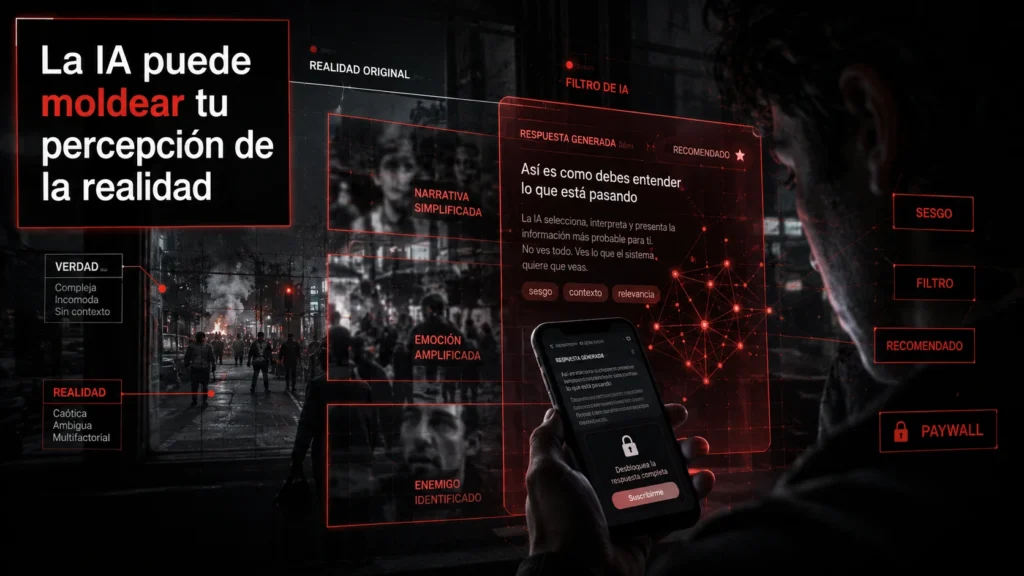
The big problem comes when a technology that answers with the appearance of authority starts to influence how you interpret the world.
What happens if your way of thinking starts being shaped by systems loaded with moral, political, economic or cultural biases?
AI models are not oracles. They are not neutral. They are not an encyclopedia in a lab coat. They are products designed by private companies, trained on enormous amounts of data, tuned according to human criteria and deployed inside a business model.
And the business model matters. A lot.
Because a company does not develop artificial intelligence models so you can make memes of your beer belly turned into six-pack abs. That is the appetizer. The hook. The “try it, it’s not addictive”. Spoiler: it is.
A few months ago many of us were generating images for free to have a laugh on social media. Now, more and more, those features are behind a subscription. And that subscription will go up. Because this works like so many other digital platforms: first they make it easy for you, then you get used to it, then you depend on it and finally you pay.
Quite the racket — but with a minimalist interface.
AI Dependency Is Already Creating Technological Inequality
Many users have swapped their image bank, their editing tools, their video apps or their documentation systems for AI generators. They no longer just use a tool. They depend on a provider.
Once the user’s dependency is locked in, the price hike arrives.
And this does not affect everyone equally.
People, businesses or companies that can afford the best technology will be more competitive than those who can’t. We are not just talking about making cute little drawings. We are talking about productivity, programming, data analysis, design, automation, cybersecurity, content creation and decision-making.
Whoever has access to the best model will be able to work faster, test more ideas and make fewer mistakes. Whoever can’t pay for it will be carrying a Swiss Army knife while others carry a portable lab.
Then they’ll sell us the line that we all compete on a level playing field. Right. And my grandma overclocked the space heater.
AI Hallucinations Are Not a Rare Glitch

Another delicate issue appears when the tech companies shoehorn a product into tasks it isn’t always good for.
In Telegram groups, forums and technical communities you see screenshots every day of answers generated by ChatGPT, Claude, Gemini or other models. Questions about electronics, IT, radio, programming or repairs. And sometimes the answers are downright nonsense.
Not because the model works badly in the classic sense. Quite the opposite: it does very well at what it knows how to do.
Generating coherent text.
The main job of a conversational model is to give you an answer that looks reasonable. If you don’t know the subject, you take it as true. Even if it’s a hallucination in a suit and tie.
In technical matters this is especially dangerous. A mistake in a recipe leaves you with a mediocre dinner. A mistake in electronics can fry a board. A mistake in cybersecurity can leave a door open. And a mistake in sensitive information can warp your judgment without you noticing.
A false answer, well written and sure of itself, can be more dangerous than a clumsy one. Because the clumsy one smells off. The other one goes down smooth.
AI Doesn’t Know Everything, Even If It Talks Like It Does
Current technology means a model gives better answers the more and better data has gone into its training. That is why colossal infrastructure is needed to train them.
But not even the best model in the world contains all the information in the whole wide world. It doesn’t know everything that happened yesterday, or three months ago, or in that lost corner of the internet where someone explained the exact fault in your cheap Chinese board with the unmarked chip.
When the model doesn’t know, it uses tools. It searches the internet, reads results, summarizes pages and builds its own story.
The problem is that that story is often born from a mix of ignorance, SEO-ranked results, recycled content, pages built to grab traffic and digital noise.
But the answer comes out written with confidence.
And that confidence is deceptive.
Google Is Changing the Way We Search for Information
Companies like Google are transforming traditional search so that AI is not a secondary option but the first layer of the answer. The user no longer necessarily visits several sources. They get an automatic summary.
That changes the internet from top to bottom.
It also changes our relationship with information. Before, at least in theory, we looked at several pages, compared headlines, spotted contradictions and decided. Now the AI can do that filtering for us.
Convenient, yes.
Dangerous, too.
Because whoever controls the summary controls a good part of the interpretation.
And here comes the part that should worry us most: when we let an AI tell us what has happened, what it means and what conclusion we should draw, we are handing over a part of our judgment. Not all of it, not all at once, not with dramatic Netflix music. But bit by bit.
And that is how the things that really change a society work: not with a bang on the table, but with an interface update.
AI Bias Also Decides What You’re Allowed to Know

Another worrying observation is the load of bias in these models.
AI systems decide what they can and can’t answer. What they consider acceptable, dangerous, immoral or inappropriate. And often that decision does not depend on the law of your country, but on the internal policies of a private company.
You can ask for something completely legal in Spain and have a model refuse because its internal rules consider it problematic. The question is obvious: who decides what is moral and what isn’t?
An internal committee? A regulator? A Silicon Valley company? A government? An opaque mix of all of them?
Here we come back to the start.
Your personality, your limits and even your sense of what is right may be being shaped by systems you did not choose and that you don’t fully understand.
You don’t need to imagine a bad-movie conspiracy. It’s enough to understand how human psychology works. If for months you receive answers filtered through a particular moral, political or cultural framework, it is reasonable to think that framework can influence the way you interpret reality.
Not because you’re stupid.
Because you’re human.
And humans are pretty hackable. Social media knows it, marketing knows it, casinos know it, video games with microtransactions know it, and so does anyone who has ever put a red button with a notification on top of it.
The Anthropic Case Shows Who Really Holds the Switch
In June 2026 something happened that sums the problem up quite well. A private company unveiled advanced artificial intelligence models, with different levels of access depending on the type of user. Shortly afterward, the United States government stepped in on national security grounds and access was restricted.
So much for the pretty postcard.
What matters is not the specific name of the model or the corporate press release with its whiff of PowerPoint. What matters is the mechanism.
A company develops a critical technology.
A government decides who can use it.
A small group keeps privileged access.
The ordinary user is left out or gets a limited version.
And then they tell us this is about open innovation.
Sure. And I’m a NASA astronaut.
The official argument is usually security. And look, let’s not be naive: some advanced models can have sensitive capabilities in cybersecurity, automation, vulnerability analysis, generation of sensitive knowledge or strategic use of information.
That risk exists.
But recognizing the risk is one thing, and accepting without a word that the solution is to create a closed club where a few players hoard the best technology while everyone else watches from the sidelines is another.
Because “verified partners” sounds very nice. It sounds clean. It sounds like lab coats, a serious committee and responsible access. But translated into plain bar-stool language it means something else: access for a select few.
And those few are usually not ordinary users, small businesses, freelancers, independent researchers or modest projects trying to compete. They are usually large companies, strategic institutions and players with enough economic or political weight to be sitting at the table where the cards are dealt.
Security thus becomes a catch-all word. It serves to protect, yes. But it can also serve to close doors, consolidate monopolies and decide who competes with an advantage.
That’s the point.
AI is not only biased in its answers.
Access to AI is biased too.
And when access to the most powerful technology depends on money, geopolitics and private agreements, we are no longer talking only about innovation.
We are talking about digital sovereignty.
National Security Can Also Be a Commercial Excuse
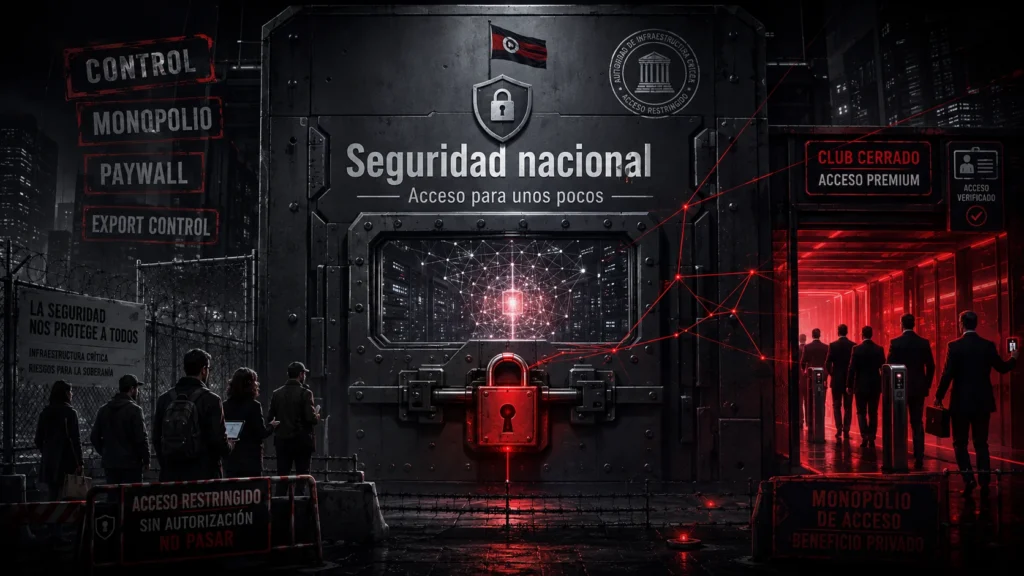
Every time a powerful technology appears, the same argument appears with it: “it’s for your safety”.
And sometimes it’s true. Let’s not be naive. There are AI capabilities that can be dangerous in the wrong hands. In cybersecurity, biology, social engineering, attack automation or the generation of disinformation, the risk exists.
But the fact that the risk exists does not mean that any restriction is fair, transparent or neutral.
Because protecting society is one thing, and creating a closed club where a few access the full model and everyone else gets the tamed version is a very different thing.
That’s the point.
A private company develops a critical technology. A government can flip the switch off. And users, small businesses, independent researchers or entire countries are left off the board.
Not because they don’t know how to use the technology.
But because someone has decided that they shouldn’t have access to it.
Access to Information Is Being Filtered Too
This case exposes something bigger than Anthropic, Google or any other particular company.
We are entering a phase where access to information and technology depends on systems that are monetized, regulated and biased.
Monetized, because more and more important features will be behind subscriptions.
Regulated, because governments want to decide who can access certain models and under what conditions.
Biased, because AI answers do not come from some pure truth, but from data, filters, internal policies and business decisions.
And in the middle are us.
Ordinary users using tools we don’t fully understand, accepting answers we don’t always verify and building our judgment on summaries generated by systems that answer with crushing confidence.
A flawless plan, really. What could go wrong.
A Bar Story and the Personalized Truth
In a bar like any other, a waitress, to liven up the afternoon and as a game, suggests that the regulars at the counter explain something about a specific topic to her. Nothing particularly odd: an afternoon conversation, coffee, beer, sad olives and that guy who always seems to have fixed half the country from his bar stool.
The customers take out their phones and run the query.
They all go to Google.
The AI gives them an answer.
They all ask more or less the same thing, but each one does it in their own personal way of expressing themselves. One asks directly. Another adds context. Another phrases the question with an opinion already baked in. Another writes as if he were already arguing with his brother-in-law before starting.
And they all get different answers.
The debate begins.
Each one defends the version the search engine gave them. Each one insists their answer is the right one. Each one thinks they have an objective source in their hand.
But they are not seeing “the truth”.
They are seeing a personalized version, filtered and summarized by a system they don’t understand.
Do you know why it works so well?
Because human psychology works that way.
We tend to defend the first explanation that fits us, especially if it arrives with the appearance of authority. And AI has authority to spare. Even if it made it up with a helpful-assistant smile.
Digital Identity Is Also Built From Other People’s Answers
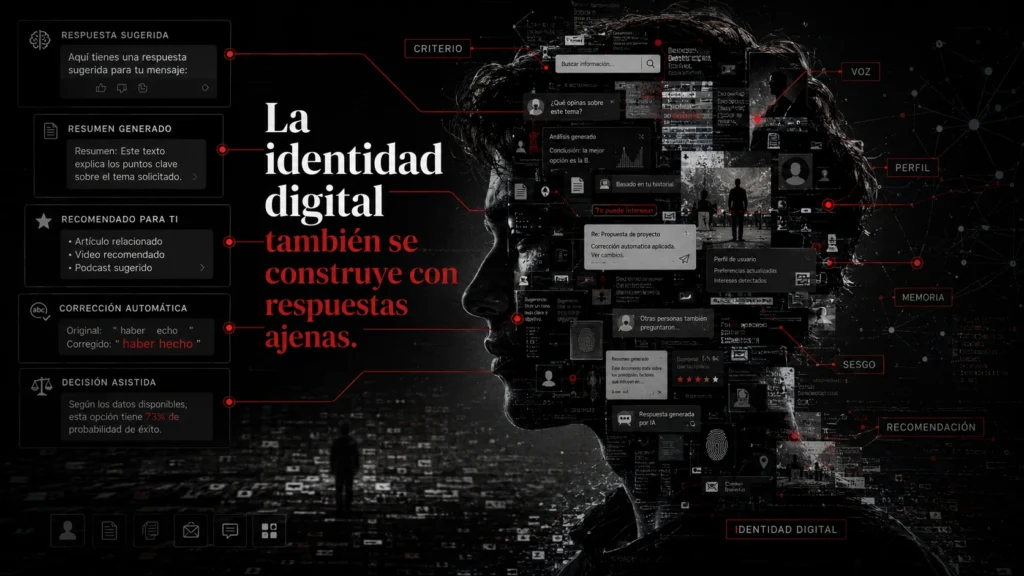
Here comes another uncomfortable point: digital identity.
Every search, every query, every generated image, every corrected text and every decision delegated to an AI builds a relationship of dependency. You don’t just depend on the tool to produce. You also start depending on it to interpret.
AI helps you write an email.
Then to summarize a news story.
Then to decide which product to buy.
Then to understand a political conflict.
Then to interpret a law.
Then to reply to another person.
Then to think.
And before you know it, your judgment no longer comes solely from your experience, your reading, your conversations and your mistakes. It also comes from an external system that filters, orders and presents reality for you.
It’s not science fiction. It’s convenience.
And convenience is an elegant drug. It doesn’t smell of danger. It smells of productivity.
How to Use AI Without Handing Over Your Brain on a Platter
The solution is not to stop using artificial intelligence. That would be posturing on the level of “I’m deleting myself from the internet” while you still have three Google accounts open and your phone listening even when you’re frying croquettes.
The solution is to use it with judgment.
When an AI gives you an important answer, cross-check it. Look for original sources. Check dates. See whether there are other versions. Ask where the information comes from. Be suspicious of answers that are too neat. And above all, don’t use a conversational model as if it were a certified technician, a lawyer, a doctor, an investigative journalist and your moral conscience all in one.
AI can help you think.
But it should not think for you.
Convenience Has a Price Too
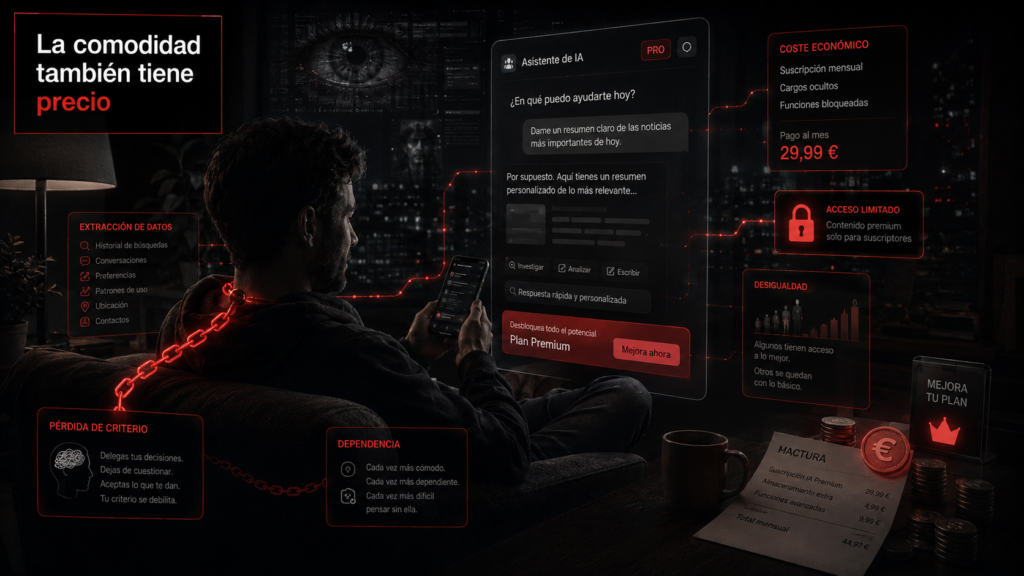
Artificial intelligence is not the devil. It is a useful, powerful and, in many cases, revolutionary technology.
But it is worth stopping seeing it as just a friendly little tool for making summaries, funny images or quick queries.
AI is already entering search, education, programming, content creation, cybersecurity, information policy, digital privacy and digital identity. And when a technology starts deciding what we see, what we believe and what we consider acceptable, we are no longer talking only about productivity.
We are talking about power.
Corporate power.
Political power.
Economic power.
Psychological power.
The risk is not that an AI answers you wrong once. The risk is that it answers you every day with the same mental framework until that framework stops feeling external to you and starts feeling like your own.
Because the day a machine tells you what is true, what is moral and what you’re allowed to know, the problem won’t be the machine.
The problem will be that you will already have gotten used to it.
And then, yes, my friend.
Game over, but with a monthly subscription.