Digitizing an Old CB Radio
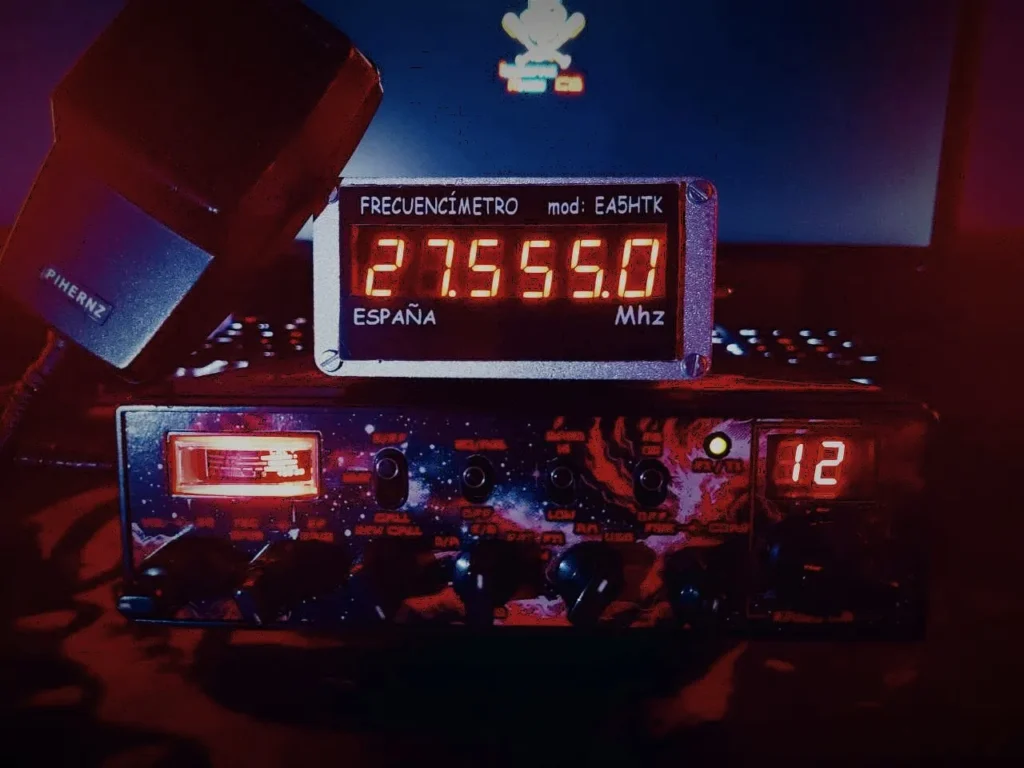
Welcome, fellow tinkerers. In this article I’m going to walk you through, in full detail, the project that has been exciting, entertaining and motivating me the most lately. I’ll explain how a crazy idea is taking shape and becoming reality, step by step.
You can come along with me the whole way, and witness the failures and small victories I pick up along the road. The end goal is to digitize a 1992 CB radio so I can do whatever I want with it. The outcome is uncertain, yes, but that doesn’t stop us enjoying the journey into the unknown.
This project has become something very personal, so I’m going to allow myself to tell you the whole story from the beginning, in full detail. Get comfortable — you’re going to need to.
The video that got me into radio
As with any story worth telling, we have to go back to the beginning.
A few years ago I spent a good while hooked on SDRs. Whole nights scanning the spectrum for odd signals, or trying out every piece of software I could get my hands on. Almost without noticing, the idea of going from RX to RX/TX started creeping into my head. I wanted to talk to people who were out there, on the frequency, like me.
The practical thing would have been to buy a PMR walkie-talkie, but the idea of sending out a wave that bounced off the ionosphere and came back down thousands of kilometers away struck me as pure magic.
Like any good internet dweller, I went to YouTube to see how CB radio was doing in Spain. I had always been surrounded by radios — CB, VHF, UHF — but I had no idea of the potential they held.
While looking for information online, I came across a video by someone called coquemalla. I exchanged messages with Lobo Solitario and ended up taking the plunge: I bought a CB radio. I had no idea what a habit I was getting myself into.
Appearances can be deceiving
To find my first rig I turned to Wallapop. After several days of searching, I found a 1992 Super Jopix 1000 for €85. I spoke with the seller, told him I was a beginner looking for a radio with sidebands for DX work, and he told me his was ideal. He sent me a video of some needles moving and, trusting him, I bought it.
The guy seemed nice, attentive, with experience in Citizens Band (CB) and radio foxhunting.
That same day I also ordered the antenna, a Super Santiago 1200. A few days later I had the whole setup assembled and made my first contact with the Relámpago station in Tenerife, activating a Christmas award.
But something didn’t add up. I bought a meter and confirmed my suspicions: on AM it put out 10 W, but on SSB it never went above 4 or 5. I was shouting myself hoarse trying to make contacts and hardly anyone could hear me. I thought maybe I had broken something… but another possibility was gaining ground: I had been sold a faulty rig.
The scam that started it all
I looked for a technician who could check the radio over. It sounds easy, but for a beginner like me it was an ordeal. I consulted two repair shops — hundreds of kilometers away — and both agreed: the finals probably needed replacing, which would cost more than the rig itself had.
I lost all enthusiasm. I was about to shove it in a drawer for good. But several buddies on Telegram recommended I talk to Rubén — now EA5PR, back then EA5HTK. I did, and his reply was different: warm, clear and no nonsense. I got my hopes up, sent him the radio and waited.
The diagnosis was clear: “They sold you a broken rig with some terrible botch jobs. It has two finals but one has been disabled, so it only works on the other one.” Repairing it was going to be hard and expensive.
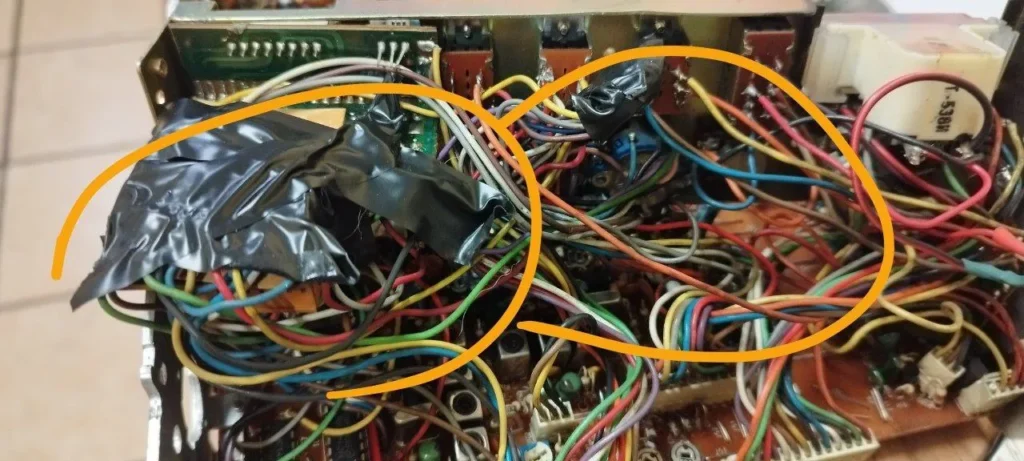
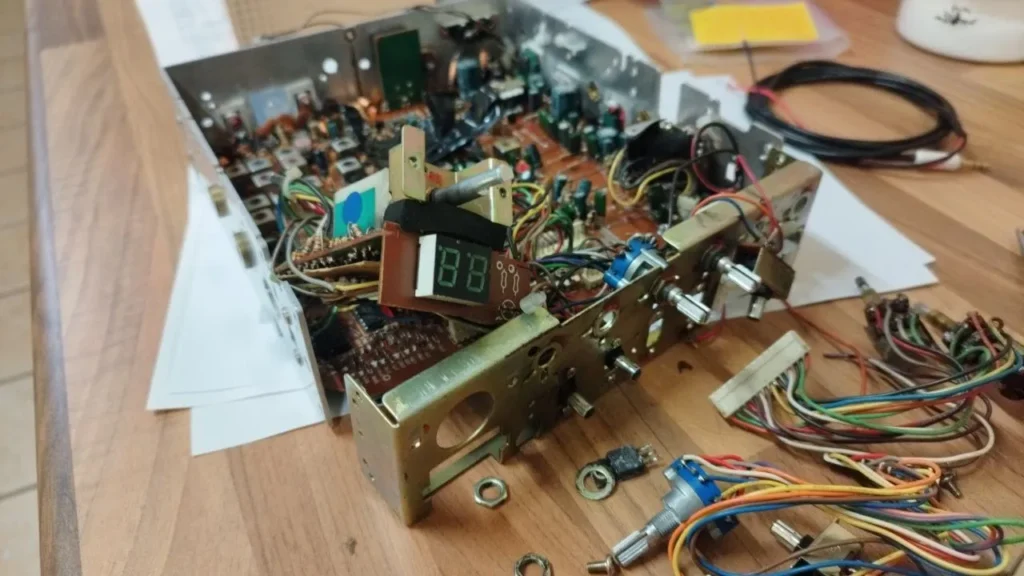
I was ready to throw it away, but Rubén suggested something else: fitting a board he had lying around the workshop, at no extra cost, so that whenever I used it I would not think of the Wallapop swindler, but of how nicely he had set it up for me. I added a frequency counter and an S-meter LED swap to the job. It was the least I could do, given how well he was treating me.
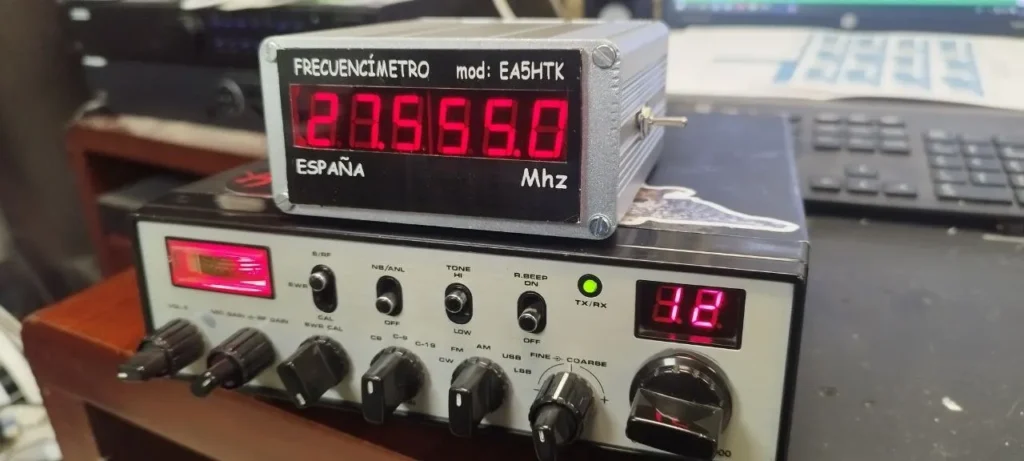
I want more toys
Rubén is a key figure in this journey. While I was doing DX and getting hooked on the scene, I started taking an interest in digital modes. I would have videos from La Net de la Tecnología or Riojanos por la Radio playing in the background, and all those strange signals I was catching with the antennas I built for the SDR started to make sense.
Without a license to operate on the ham bands, I looked for alternatives on 27 MHz. JS8Call seemed the most accessible.
To connect the radio to the PC, Rubén sent me an interface.
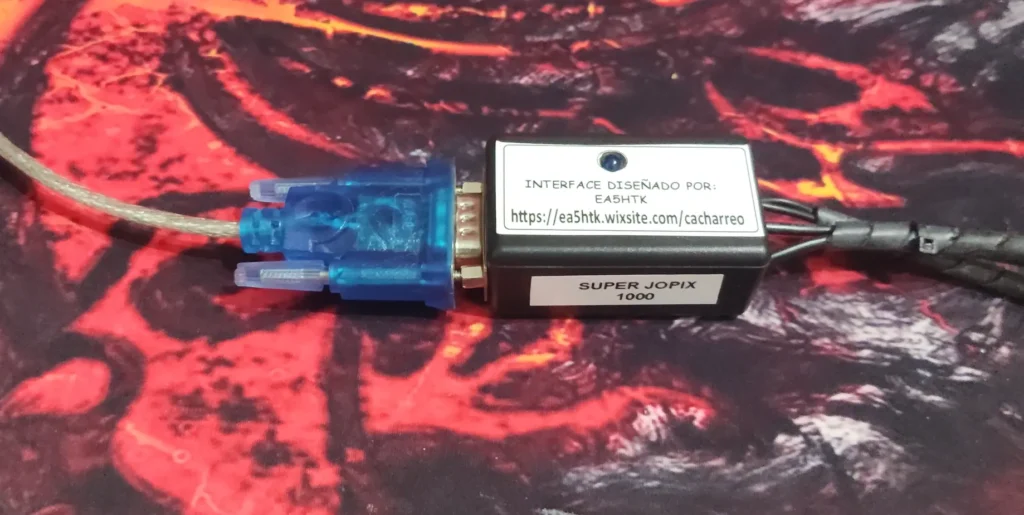
That first interface was, without a doubt, what drove this whole madness. With it I started experimenting with digital modes and looking for programs that would let me use the radio from the computer for voice. I tried several, but none of them quite won me over. They either did too much or too little, but none really fit my needs.
IRCB
Right around then ChatGPT was starting to make a lot of noise. And I thought: what if I build my own program to control the radio from the PC with the help of AI? That is how IRCB was born.
I started with ChatGPT version 2.5 and it took me more than a year to develop and release the program. In that time, AI went from making promises to delivering.
The program is now constantly evolving. In fact, I already have a beta with remote control from your phone or PC over the internet that I will release soon. Depending on when you are reading this, you may already be able to download it.
What if we add another level to the game?
Also in the oven is a new version of IRCB for personal use, designed for modern CB radios that let you change channel from the microphone, so I can use that system to change channel from the computer too.
For that I turned to Rubén again. He loved the idea and offered to build me an interface that would allow channel switching. He recommended using a home-automation relay board and building the rest on top of that.
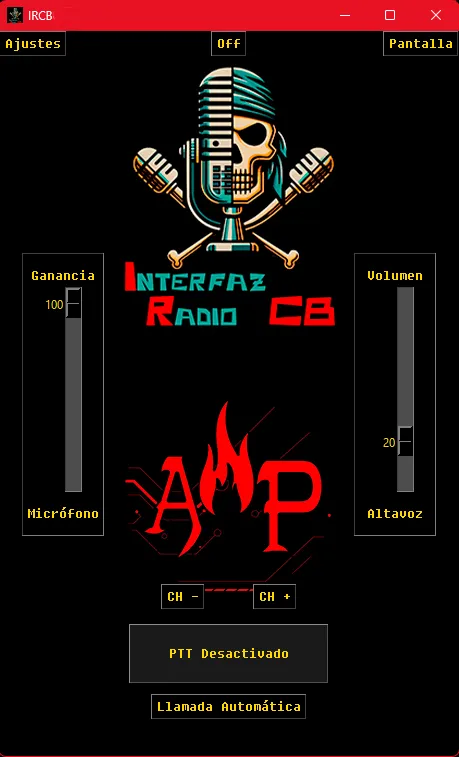
This version of IRCB with channel switching is a personal-use prototype, since it is hard to replicate or share publicly because of the mix of hardware and software, but it is a first step toward controlling a rig entirely from the computer.
Super Star 3900 DDS — what’s that?
One day, browsing YouTube, I saw a video of a Super Star 3900 modified with two little digital displays. I wanted one instantly.
I tried to find someone in Spain who could do something similar on my Jopix 1000, with no luck. I was happy with my Jopix and its frequency counter and all its little red lights… but those displays had me obsessed.
Some time later I saw a video by Carlo showing one of his works of art. That is when I told myself: “this is my thing.” Digitizing an old CB to run it from the computer, with a waterfall, filters, displays and features it does not come with from the factory… it was a golden opportunity to learn.
Months of digging for information
I set out to fit the displays to the Jopix and started looking for how to do it. I contacted several video creators, but most of them led to the same place: pay for information or buy their modules.
Once again browsing YouTube, watching videos about Arduino and RF, I realized it was time to move from thinking to acting.
I decided to do it from scratch, my way, whatever the outcome. I wanted it to be a real project, not just a copy-and-paste job.
AI as a tool for personal growth
I am not going to get into philosophical debates. I know that when it comes to artificial intelligence there are opinions for every taste, and here I am only going to share mine.
People say AI is coming to take our jobs, to make us lazier or dumber. But I see it as a tool. Like a calculator or a knife.
A knife can be used to cook or to stab, just as a calculator can save time but not solve math problems for you. It is not the object, it is the intent. Nobody complains that a chef uses sharp knives, or that a mathematician uses a calculator. It is the same with AI: in clumsy hands it is a toy; in good hands, a formidable tool.
In my case, it has let me develop software and electronic circuits that two years ago were science fiction to me. I do not know whether it will make me lazier or less smart, but I do know that thanks to AI I am learning more than ever and doing things I never even dreamed of before.
DC-DC Power Module
Throughout this project we will run into a common limitation: the ESP32 works at 5 V, but most radio equipment — like the CB rig I am modifying — runs at 12 V.
To solve this, I built a simple board with a DC-DC converter that steps the voltage down safely and stably. You can integrate it directly into any module that needs 5 V, or do what I did: keep it as a standalone module that powers everything digital in the project.
Building the Digital S-Meter for the Jopix 1000
In this chapter, we will focus on building a digital S-meter for the Jopix 1000.
This module has a life of its own. It adapts to almost any radio, it is cheap, accurate and relatively easy to build if you follow the steps to the letter.
You will not find blueprints designed by NASA engineers here. This is made with logic, patience and trial and error, using components anyone can order for next to nothing and a handful of lines of code.
Replacing the original display with a screen showing frequency and other information
The adventure continues soon…