Social Media With No Owner? The Fediverse Isn’t Just for Nerds Anymore
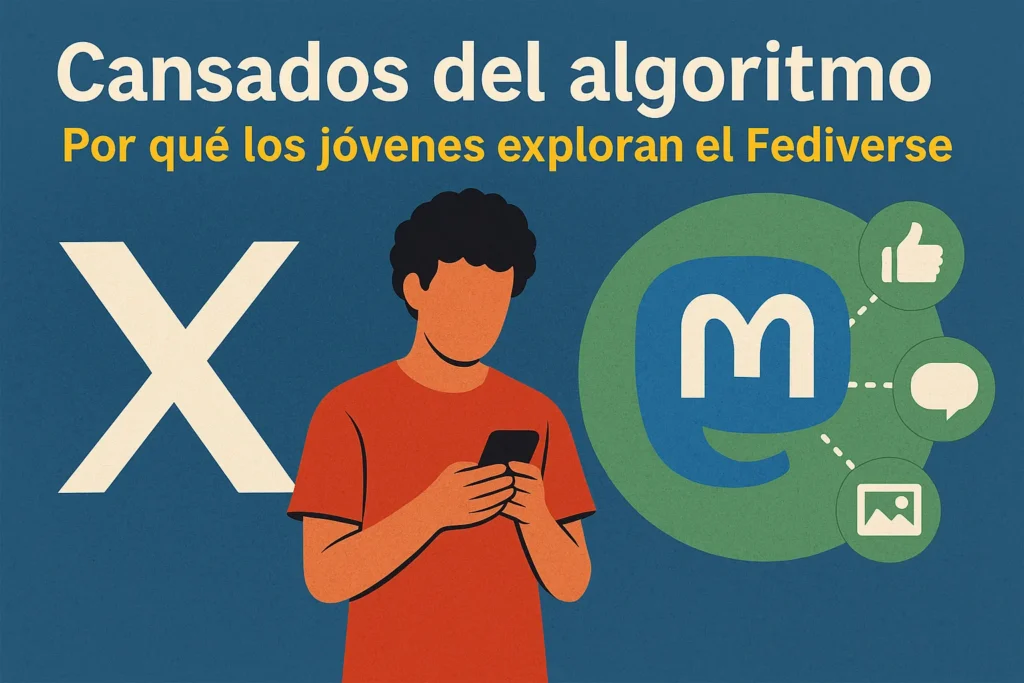
Twitter isn’t what it used to be. Ever since Elon Musk rebranded it as “X” and filled it with ads, bots and algorithmic chaos, plenty of young people have started looking for something more… human. Less noise, more community. Less surveillance, more control. And that’s how they’ve landed on the Fediverse, that free corner of the internet that feels more like a utopia than a social network.
What the Fediverse Is
The Fediverse (from federation + universe) isn’t a single platform — it’s an entire ecosystem of decentralized networks that talk to each other. Each server, or “instance,” is independent, but compatible with the others thanks to open protocols like ActivityPub.
There’s no billionaire owner deciding what you see here. No algorithm pushing viral content. No single company hoovering up your data like there’s no tomorrow.
The best-known platforms in the Fediverse are:
- Mastodon (Twitter-style microblogging)
- Pixelfed (similar to Instagram)
- PeerTube (video, a YouTube alternative)
- Lemmy (Reddit-style)
Each with its own vibe, its own community, its own rules. And all of them interoperable.
The Fediverse’s real growth
It may not be mainstream yet, but the Fediverse is more than just hype. There’s data showing steady growth, especially since X started turning into a festival of algorithms and ads:
- Mastodon already has more than 10 million registered accounts.
- It has between 1.5 and 2 million monthly active users (according to Mastodon Analytics and Storyful).
- Google searches for “Mastodon” rose 109% over the past year (Exploding Topics).
- There are more than 9,500 active instances.
- Pixelfed launched official mobile apps in January 2025, cementing its bet on accessibility.
Is that small compared to X, Instagram or TikTok? Yes. But this growth isn’t chasing a viral boom — it’s driven by digital awareness.
Why young people are moving in
Gen Z (and a chunk of disillusioned millennials) no longer buys the “free content” story. They know that if you’re not paying with money, you’re paying with attention, data, or dignity. And they’re sick of it.
What they find in the Fediverse:
- Real privacy: you decide what data to share, with whom, and where it’s hosted.
- No top-down censorship: each instance sets its own rules. Don’t like it, switch servers, done.
- Small, safe communities: where moderation is actually possible, and you don’t need to go viral to matter.
- Chronological timelines: no algorithm pushing outrage or clickbait. You see what you follow, in order.
- Technical transparency: the code is free and open. You can see it, modify it, audit it. Pretty much how software should always be.
But careful, it’s not digital paradise
We’re not going to sell you hot air. The Fediverse has real challenges:
- Learning curve: it’s not as plug & play as setting up a TikTok account. You have to pick an instance, understand what “federated” means, and so on.
- Social fragmentation: sometimes it’s hard to find your contacts, or follow conversations spread across different instances.
- Limited scalability: if an instance gets too full it can get overloaded; if it’s small it can just disappear.
- Fewer “deluxe” features: no AI filters, no easy monetization, no shiny effects. Simplicity and ethics come first here.
Digital identity is at stake
What’s happening here isn’t just a social-media migration. It’s a quiet revolution over who controls our digital identity. On networks like X, you are the product. On the Fediverse, you’re part of the system. Literally.
The shift won’t happen overnight. But every time a young person opens a Mastodon account instead of an X account, they’re sending a clear message: “I don’t want more algorithms deciding for me.”
And watch out: this doesn’t only apply to X-style social networks. It also happens with platforms where creators and businesses depend on capricious algorithms, opaque policies, or bans with no warning. If you haven’t read it yet, check out Your Business in Someone Else’s Hands — The Risks of Depending on Platforms Like YouTube, Twitch and Instagram. There we break down how that dependency can cost you your audience… or your livelihood.
The future is federated, or it’ll be more of the same
The Fediverse isn’t perfect. But it’s a real alternative to the brutal concentration of digital power represented by Meta, Google, or X. If this decentralization has one thing going for it, it’s that there’s no single door in, and no supreme boss.
In a world where everything is connected but controlled by a handful of companies, betting on free networks is more than a trend — it’s a form of resistance.
So, are you going to keep feeding the algorithm, or are you going to federate?